


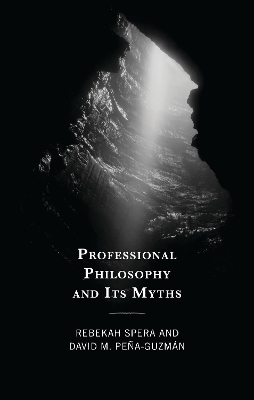
Professional Philosophy and Its Myths
Seiten
2024
Lexington Books (Verlag)
978-1-6669-3971-2 (ISBN)
Lexington Books (Verlag)
978-1-6669-3971-2 (ISBN)
Professional Philosophy and Its Myths exposes the myths that govern academic philosophy and keep philosophers from genuine self-knowledge. Only by reimagining what it means to be a philosopher and what it means to do philosophy will contemporary philosophers free their field from its present mythic order.
In Professional Philosophy and Its Myths, Rebekah Spera and David M. Peña-Guzmán argue that academic philosophy is steeped in a host of myths that keep professional philosophers in a state of self-ignorance. Understood as unconscious schemas that shape philosophers’ collective imaginary, these myths perform a dangerous ideological function within the discipline. Not only do they contribute to the overwhelming demographic homogeneity of the profession—ensuring that philosophy remains a holdout of white and male dominance—but they also prevent philosophers from seeing themselves as workers who, like all workers who sell their labor for a wage under capital, are subject to alienation, exploitation, and oppression. After outlining and critiquing these myths, Spera and Peña-Guzmán call upon philosophers to collectively invent new myths that will enrich rather than impoverish their psychic and professional lives. Through these new myths, they argue, a new philosophy—a “philosophy of the future”—will be born.
In Professional Philosophy and Its Myths, Rebekah Spera and David M. Peña-Guzmán argue that academic philosophy is steeped in a host of myths that keep professional philosophers in a state of self-ignorance. Understood as unconscious schemas that shape philosophers’ collective imaginary, these myths perform a dangerous ideological function within the discipline. Not only do they contribute to the overwhelming demographic homogeneity of the profession—ensuring that philosophy remains a holdout of white and male dominance—but they also prevent philosophers from seeing themselves as workers who, like all workers who sell their labor for a wage under capital, are subject to alienation, exploitation, and oppression. After outlining and critiquing these myths, Spera and Peña-Guzmán call upon philosophers to collectively invent new myths that will enrich rather than impoverish their psychic and professional lives. Through these new myths, they argue, a new philosophy—a “philosophy of the future”—will be born.
Rebekah Spera is postdoctoral fellow serving in the Writing Program at Emory University. David M. Peña-Guzmán is associate professor of humanities and comparative world literature at San Francisco State University.
Acknowledgments
Introduction: Philosophy’s Mythic Order
Chapter 1: The Philosophical Personality
Chapter 2: The Philosopher as One
Chapter 3: The Alienated Philosopher
Chapter 4: The Adjunct
Chapter 5: The Myths of Tomorrow
Appendix: Paths to Philosophy’s Future
Bibliography
About the Authors
| Erscheinungsdatum | 04.01.2025 |
|---|---|
| Sprache | englisch |
| Maße | 152 x 229 mm |
| Themenwelt | Geisteswissenschaften ► Philosophie |
| Sozialwissenschaften ► Pädagogik ► Allgemeines / Lexika | |
| Sozialwissenschaften ► Pädagogik ► Bildungstheorie | |
| Sozialwissenschaften ► Soziologie ► Allgemeines / Lexika | |
| ISBN-10 | 1-6669-3971-4 / 1666939714 |
| ISBN-13 | 978-1-6669-3971-2 / 9781666939712 |
| Zustand | Neuware |
| Informationen gemäß Produktsicherheitsverordnung (GPSR) | |
| Haben Sie eine Frage zum Produkt? |
Mehr entdecken
aus dem Bereich



aus dem Bereich
Einführung in die Theorie transformatorischer Bildungsprozesse
Buch | Softcover (2023)
Kohlhammer (Verlag)
CHF 47,60


