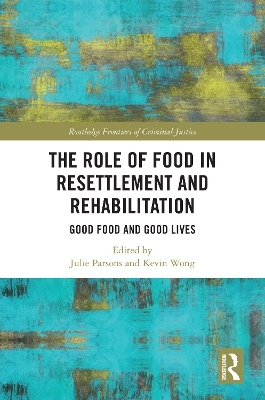
The Role of Food in Resettlement and Rehabilitation
Routledge (Verlag)
978-1-032-44848-0 (ISBN)
Exploring the role of food in enabling people with convictions to live a “good life”, this book examines the tangible ways in which growing food, cooking, and eating together has the potential to be both transformative and small steps incremental in facilitating desistance journeys for people with convictions.
At its most reductive, food sustains us physically; it’s the fuel which keeps us alive. Of course, emotionally, culturally, and socially it does more than that. This edited book addresses an under-researched area of resettlement and rehabilitation which has real-world application to policy and practice in criminal justice and related areas such as mental health, physical health, employment, and education. Importantly, given the relatability of food growing, cooking, and eating to the wider public, it offers opportunities to connect the desistance journeys and lives of people with convictions to the wider public.
The Role of Food in Resettlement and Rehabilitation will be of great interest to students and scholars of criminology, sociology, social work, and food studies. It is also important reading for government policymakers in criminal justice and health care, social policy, and criminal justice practitioners, including prison governors, social workers, and providers of services for people with convictions in custody and community.
Julie Parsons is Associate Professor in Sociology and Criminology. Since 2015, she has conducted a series of funded research projects at a resettlement scheme for criminal justice-affected people, establishing the PeN project (https://penprojectlandworks.org/) there in 2016. She is passionate about the power of everyday foodways in bringing people together. Kevin Wong is Reader in Community Justice and Associate Director, Policy Evaluation and Research Unit, Manchester Metropolitan University. He is the Editor of the British Journal of Community Justice, Director of the Manchester International Crime and Justice Film Festival, and an Associate Member of the UK Ministry of Justice Corrections Services Accreditation and Advisory Panel.
1. Everyday Foodways, an ingredient for good lives 2. The Back on Track café: foodways, co-production and affective community space 3. Prison Kitchens: institutionalising Kitchenism and Collective Cooking 4. 'It’s changed my behaviour and drug takin; things are changing without even realising': the transformational potential of land-based programmes. 5. Serving Time: An Exploration of the ‘Invisible Walls’ of Rehabilitation 6. ‘Doing Commensality’, Eating together in the visiting room: Families, food, and commensality 7. Healthy, humane and rehabilitative: the role of food in prisons across Scandinavia 8. Greener on the Outside for Prisons (GOOP): A Whole System Health and Justice Intervention of Growing Food for Good Lives 9. Community payback-supported mutual aid in food production and distribution: cooperating out of crime and food poverty? 10. Negotiation and reconciliation of ‘food cultures’ among catering managers and men in custody in Scottish prisons 11. The transformational potential of ‘doing’ everyday foodways for people with custodial and non-custodial sentences at LandWorks– a case study. 12. What’s good food got to do with It? Reflections on food as a mechanism of community building within and against the carceral state 13. Food justice – Concluding Comments
| Erscheinungsdatum | 19.07.2025 |
|---|---|
| Reihe/Serie | Routledge Frontiers of Criminal Justice |
| Zusatzinfo | 2 Tables, black and white; 3 Line drawings, black and white; 3 Halftones, black and white; 6 Illustrations, black and white |
| Verlagsort | London |
| Sprache | englisch |
| Maße | 156 x 234 mm |
| Gewicht | 630 g |
| Themenwelt | Medizin / Pharmazie ► Gesundheitsfachberufe ► Diätassistenz / Ernährungsberatung |
| Recht / Steuern ► EU / Internationales Recht | |
| Recht / Steuern ► Strafrecht ► Kriminologie | |
| Recht / Steuern ► Strafrecht ► Strafverfahrensrecht | |
| Sozialwissenschaften ► Pädagogik ► Sozialpädagogik | |
| Sozialwissenschaften ► Soziologie | |
| Technik ► Lebensmitteltechnologie | |
| ISBN-10 | 1-032-44848-2 / 1032448482 |
| ISBN-13 | 978-1-032-44848-0 / 9781032448480 |
| Zustand | Neuware |
| Informationen gemäß Produktsicherheitsverordnung (GPSR) | |
| Haben Sie eine Frage zum Produkt? |
aus dem Bereich