


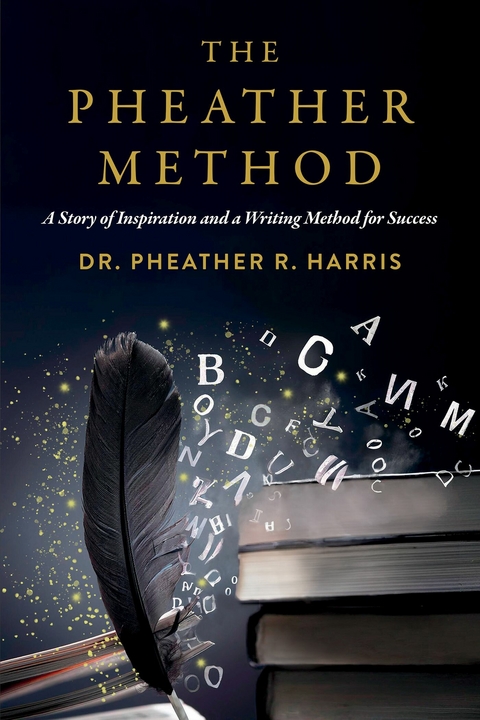
Pheather Method (eBook)
192 Seiten
Bookbaby (Verlag)
979-8-3509-8709-6 (ISBN)
Dr. Pheather R. Harris has worked in higher education for over two decades, providing service to stakeholders in the non-profit sector and at colleges and universities. She received her Bachelor of Arts degree in Communication from the University of Southern California, a Master of Arts degree in Education from Harvard University, and a Doctorate in Higher Education Administration from The George Washington University. She is passionate about giving people information that bolsters their academic and professional success. She has led multimillion dollar national grants, graduated at the top of her class from all the postsecondary institutions she attended, developed The Pheather Method (a writing system and mindset), and is a powerful motivational speaker. She enjoys spending time with her family, writing, and drawing connections between the beautiful, and not so beautiful, moments life has to offer.
"e;The Pheather Method: A Story of Inspiration and a Writing Method for Success"e; was developed to provide students with a writing system that guides them though how to produce a strong academic paper, while also offering academic professionals a mindset that honors the lived experience of the students they serve. For far too long, students have struggled with composing academic papers, establishing a writing structure, and honoring their voices in the process. Readers are left to piece together the finished product and often must fill in the blanks. This true story is centered on the life of the author, Pheather, and her relationship with education. Growing up in low-income neighborhoods, threatened by her environment, made it tough for her to embrace the light that shined within. As a young girl, she often pondered formal education's role in her life and knew early on that it did not reflect her reality. One night after receiving a less than desirable grade on a paper at Harvard in her first semester, Pheather sat in her dorm room, stared at a blank computer screen, and wondered whether she belonged at one of the most prestigious schools in the world. Despair and frustration arose from the bottom of her feet to the top of her head and a warm sensation of panic fell over her. She could not escape the feeling of inadequacy while tears rolled down her cheeks. She began to pray. That night, Pheather's prayers were answered, and she approached writing assignments differently. She graduated from the institution with high scores and The Pheather Method was born. What she learned in that time is that achieving sought after goals is nuanced, non-liner, difficult, yet worth it. Rooted in life lessons, academic prowess, and proven success, Pheather offers a writing system that produces winning results. It centers on the voice of the author, amplifies the unique gifts each of us carry to make the world a better place, and takes the reader on a journey of self-actualization and empowerment.
Preface
I have thought about writing this book for roughly five years, and still I’m weighing whether I should complete this project or not. I am a deeply private person, and I don’t necessarily want all of my childhood memories aired out within the pages of this work. My boundaries are something I developed over the years out of a need to survive. I was taught (by the streets) that demonstrating vulnerability, which is often misconstrued as weakness, leaves me open to being emotionally attacked. Consequently, I often retreat into myself to remain safe, and I am very sensitive about how people might perceive me. And yet, because I have learned so many lessons from my upbringing, as well as my academic experiences, I am determined to share my story with you. To be clear, whether or not I feel comfortable during this process of illumination is inconsequential, because it is still my duty to share. I have a responsibility to pass along the knowledge that was both given to me, and hard-won through adversity, to help whoever picks up this book develop a stronger sense of self, and to know that their contributions to the world will make it a better place. I believe that with all of my heart. My hope is that my transparency will help someone else traverse roads that are at times hidden—and for them to experience fewer barriers associated with achieving their maximum academic and professional potential.
This book is written from both the student and instructor perspective, specifically regarding my journey through the American school system. It alternates between the two lenses because both roles have given me insight into how to make the education system a more inclusive, and equitable, space. While it is often the case that people explore phenomena from one particular framework, or vantage point, I argue that just as research is messy and nuanced, so is the conversation related to achieving success in higher education.
Now I realize that people often consider the source of where the information comes from, and their authority on any material offered, before seriously considering whether to use the information given—which I absolutely encourage. At a time when information is everywhere, and deciphering what to believe and not believe is crucial, let me give you a look into who I am, where I come from, how I’ve earned my educational stripes, and what I hope to accomplish with this book.
To start, here are my credentials. I have worked in education for over two decades, serving students from diverse academic backgrounds in various academic settings. I attended a community college, where I earned my Associate of Arts degree in Liberal Arts, and then transferred to the University of Southern California where I earned a Bachelor of Arts Degree in Communication. Roughly a year later, I moved to Cambridge, Massachusetts, where I attended Harvard University, earning a Master’s Degree in Education, with a focus on Risk and Prevention. The Risk and Prevention program is focused on enhancing the expertise of educators to help them employ protective factors, for underserved students, that mitigate them leaving school. I moved back home to California in 2008, and quickly learned that most higher education institutions were on a hiring freeze due to the economy. In 2009, I moved to Virginia, a place I had never been before, and worked in the District of Columbia for the largest non-profit in the country. Soon thereafter, I earned a Doctoral Degree in Higher Education Administration, from George Washington University with a focus on the ways that colleges and universities can support students from underserved populations in science, technology, engineering, and mathematics (STEM). I have worked with thousands of students along the way, and have watched them succeed partly because of my advice to them. More specifically, the meaning we collectively helped emerge through dialog about their circumstances to help them to recognize challenges as opportunities in moments of hardship.
Okay, so these are also my lived experience credentials: I was a latch key kid. My parents split up when I was about five years old, and I grew up in poverty. My father did not graduate from high school and my mother raised five kids on her own—without a college degree. She was a secretary for a property management company, often taking the bus for hours every day to and from work to take care of her children. Three of my mother’s children have the same father, and my younger sister and I were born out of my parent’s relationship after my mother’s first marriage. When they broke up, he checked out. I lived in thirteen different places in Los Angeles as a child, and dropped out of the first high school I attended because of ongoing violence and threats. At the time, I did not think I was going to make it beyond the ninth grade. I am the second to the youngest of five, and had a beautiful son with my first boyfriend (who happened to be my next-door neighbor) who I met at age 13. We didn’t begin dating until I was 15 and he was 16. I graduated from the second high school I attended (after my mother moved us out of our rough neighborhood) without a plan, and had my son soon after graduation. My son was born prematurely with severe asthma. His father and I broke up when our child was two years old, and I raised him as a single parent ever since. His father lives out of the country and has been out of the country my son’s entire life. That’s another story for another time, perhaps. In the pages that follow, I will share some of the academic techniques and strategies that kept me at the top of my class in college despite having a storied relationship with education. So, grab your piece of technology, or pen and paper (my personal favorite), to jot down your ah ha! moments as you move through the pages of this book with me.
I decided to write this book because as a young girl, I wish I could have found real information on how to navigate college successfully. This work is intended to provide you with hope, motivation, and inspiration to process hardship. Not an excuse for the hardship; rather, a life-giving perspective. Trust me, I have been there, when things seemed bleak and immovable. For instance, when I became pregnant with my wonderful son, a little more than a year after high school, I wondered what would become of me, and searched for stories of single-parent mothers that were able to go to college and change the trajectory of their lives. I never found that book. Instead, I took the scary, unstable route to get to this point in my life, scrapping my knees along the way, tasting salty tears as they ran down my cheeks after my son went to sleep, praying and fighting to make a way. The path was foggy and dim, and at times I could not see the next step in front of me. Thankfully, as I pushed forward, I stumbled upon academic behaviors that served me very well, which allowed me to go to the best academic institutions in the world. Like so many other things in my life, I have come to learn how to create highways from roads with very little (to no) visibility. I value moments of silence, to reflect upon who I am, and what it means to occupy this body—a Black, single-parent, first-generation woman. What I mean by first generation is that my parents did not attend college prior to me. This is particularly significant, because if your parents attended college, then they, ostensibly, are able to teach you how to navigate the system. What you hold is the book I wish I could have read when I was in high school, just launching my academic journey.
In the chapters that follow, I share a little bit about my life growing up, my familial circumstances, and barriers that presented themselves. I am very open with you about who I am, and am careful about the words that I use, because I believe that the discussion about education can be sterile, and abstract, which is not useful when addressing systemic change, or issues of educational inequity. This book is meant to provide you with a framework that may help you achieve your goals in education (without dismissing the influence of your environment), and to perhaps enhance who you see yourself to be in the academic space. Additionally, and most importantly, you will learn about the Pheather Method of Academic Writing, which I created as a graduate student at Harvard. The Method helped me build a blueprint from which to build my writing assignments with confidence and clarity. It gave me a tangible resource that allowed me to move beyond a blank screen and get to the business of writing. Writer’s block became nonexistent when I began to use The Method.
I am currently a professional in higher education administration and wrote my dissertation on the relationship between faculty mentor engagement and African American science, technology, engineering, and mathematics persistence. The days when I was pursuing my doctorate were difficult because I did not have anyone in my family that could understand what I was going through. I recall leaving Gelman Library (at George Washington University) late at night and feeling overwhelmed with all of the layers associated with school. I would walk through campus at night, after work and class, with the crisp night air filling my lungs, thinking about my strategy of safety to get on the train, ride the shuttle, and walk through a dark parking structure to my car and make it to my son, daily. Every night when I would get home and see his face I would feel a wash of calmness and peace overtake me because I knew that he was okay. Something about seeing his little face, and us having a roof over our head, made me feel ever so grateful for being cared for by my heavenly Father. I hated being...
| Erscheint lt. Verlag | 14.2.2025 |
|---|---|
| Sprache | englisch |
| Themenwelt | Sozialwissenschaften ► Pädagogik |
| ISBN-13 | 979-8-3509-8709-6 / 9798350987096 |
| Informationen gemäß Produktsicherheitsverordnung (GPSR) | |
| Haben Sie eine Frage zum Produkt? |
 EPUB (Ohne DRM)
Größe: 2,1 MB
Digital Rights Management: ohne DRM
Dieses eBook enthält kein DRM oder Kopierschutz. Eine Weitergabe an Dritte ist jedoch rechtlich nicht zulässig, weil Sie beim Kauf nur die Rechte an der persönlichen Nutzung erwerben.
Dateiformat: EPUB (Electronic Publication)
EPUB ist ein offener Standard für eBooks und eignet sich besonders zur Darstellung von Belletristik und Sachbüchern. Der Fließtext wird dynamisch an die Display- und Schriftgröße angepasst. Auch für mobile Lesegeräte ist EPUB daher gut geeignet.
Systemvoraussetzungen:
PC/Mac: Mit einem PC oder Mac können Sie dieses eBook lesen. Sie benötigen dafür die kostenlose Software Adobe Digital Editions.
eReader: Dieses eBook kann mit (fast) allen eBook-Readern gelesen werden. Mit dem amazon-Kindle ist es aber nicht kompatibel.
Smartphone/Tablet: Egal ob Apple oder Android, dieses eBook können Sie lesen. Sie benötigen dafür eine kostenlose App.
Geräteliste und zusätzliche Hinweise
Buying eBooks from abroad
For tax law reasons we can sell eBooks just within Germany and Switzerland. Regrettably we cannot fulfill eBook-orders from other countries.
aus dem Bereich


