


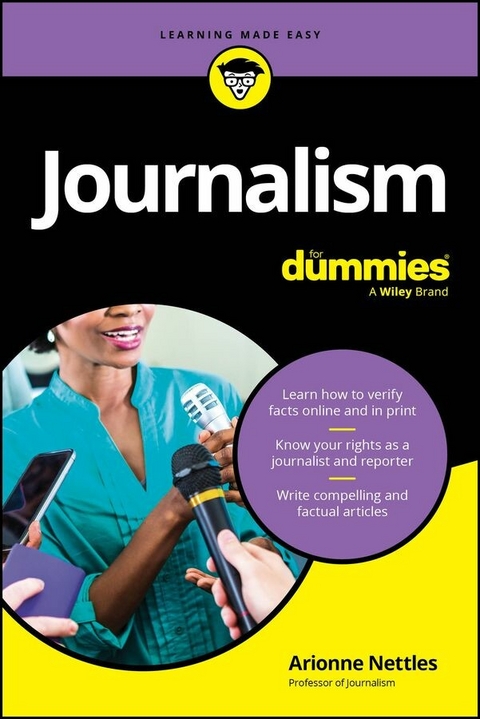
Journalism For Dummies (eBook)
352 Seiten
For Dummies (Verlag)
9781394279609 (ISBN)
Learn the skills you need to find sources, fact check, and write trusted articles
Since the advent of the internet and the birth of social media, it has become difficult to wade through the massive amount of information out there. Every day we see-and believe-news articles that are released then debunked the very next day. Journalism For Dummies will provide you with the tools you need to become a savvy interviewer, writer, and fact checker. If you're a journalist, a journalist-to-be, or just someone who wants to be smarter about what you read, this book can help. You'll learn how journalism has evolved into what it is today, how to utilize different media platforms, including social media, and how to produce work that people can trust. This book is a comprehensive and approachable entry point for anyone who wants to produce pieces with journalistic integrity.
- Consider how journalism functions in society, and why trustworthy journalism matters
- Become media literate and identify sensational or misleading stories and articles
- Learn about the reporting process, including newsworthiness, sourcing, fact-checking, and interview best practices
- Discover the ethics and laws associated with being a digital and print journalist
This is a great Dummies guide for students majoring in or taking journalism courses, freelance journalists looking to improve their sourcing abilities, and teachers hoping to increase their students' journalistic skills.
Arionne Nettles is a professor, culture reporter, and audio aficionado who serves as the Garth C. Reeves eminent scholar chair and instructor for digital journalism at Florida A&M University. She is also host of the HBCU history podcast Bragging Rights and Is That True? A Kids Podcast About Facts. Previously, Nettles worked as a digital producer at WBEZ and a multiplatform editor at the Associated Press.
Learn the skills you need to find sources, fact check, and write trusted articles Since the advent of the internet and the birth of social media, it has become difficult to wade through the massive amount of information out there. Every day we see and believe news articles that are released then debunked the very next day. Journalism For Dummies will provide you with the tools you need to become a savvy interviewer, writer, and fact checker. If you're a journalist, a journalist-to-be, or just someone who wants to be smarter about what you read, this book can help. You'll learn how journalism has evolved into what it is today, how to utilize different media platforms, including social media, and how to produce work that people can trust. This book is a comprehensive and approachable entry point for anyone who wants to produce pieces with journalistic integrity. Consider how journalism functions in society, and why trustworthy journalism matters Become media literate and identify sensational or misleading stories and articles Learn about the reporting process, including newsworthiness, sourcing, fact-checking, and interview best practices Discover the ethics and laws associated with being a digital and print journalist This is a great Dummies guide for students majoring in or taking journalism courses, freelance journalists looking to improve their sourcing abilities, and teachers hoping to increase their students' journalistic skills.
Chapter 1
Becoming a Journalist
IN THIS CHAPTER
Getting into the field
Understanding your responsibility as a journalist
Knowing what you need to be successful
Journalism is better when it’s filled with people of all backgrounds, living in all locations, and thinking in all kinds of ways. That’s why it’s so exciting that yours will be one of the industry’s next voices.
But it’s important to recognize that part of becoming a journalist does involve understanding all of the career pathways and tools to help you get your foot in the door.
In this chapter, I discuss how to start a career in journalism — including the common roadblocks many people encounter and the newer ways people are tackling them.
Exploring the Many Roads to Journalism
As a field, journalism was once seen as a trade anyone could enter. Not only could aspiring writers and broadcasters study at the university level, but they also had more opportunities to learn as apprentices on the job and in training programs created by media organizations.
In recent decades, this barrier to entry has become way higher, with many competitive roles at mainstream newsrooms going to graduates of elite journalism university programs and media entities no longer willing to train new journalists.
But now, today, we are seeing an emergence of opportunities for new journalists to join the industry — in nonprofit newsrooms, through independent work on social media, and from becoming media entrepreneurs themselves. For example, it’s extremely common today to see journalists solely post coverage of events and subject matter on social media instead of on a news website. The prevalence of online and digital tools means that, with the right training, the door is open for you.
The traditional road
Generally, getting a journalism job in a mainstream U.S. media organization (a TV news station, newspaper, major magazine, or radio station) means proving to its hiring managers that you already know enough about the field to be a good addition to its newsroom. For most new journalists, that can be tough. How do you prove you can do a job you haven’t yet been given the chance to do?
In the following sections, I cover ways new journalists often get noticed for these positions.
Attending journalism school
School is still one of the most traditional ways of learning journalism, building a portfolio, and making connections with those in the industry. It’s not the only way, but attaining an undergraduate or graduate degree is still popular. However, the cost of this route is high and it isn’t always financially viable.
Participating in campus media
Many journalists get their first real experience working on stories for their campus newspapers, magazines, radio stations, and TV stations. Here, they have the benefit of covering events and happenings at a place extremely familiar to them, guided by student editors who remember what it’s like to be brand-new at reporting stories. Journalists working at these media organizations must be students, but they don’t necessarily have to be part of the institution’s journalism program because the organization’s student editors generally train reporters themselves.
Doing internships and fellowships
These types of roles are often journalists’ first professional newsroom experiences. Internships are often three to six months in length and are for current students and those who have graduated within the past year. Fellowships are generally for journalists with little to no experience and can be about a year long. There are also special fellowships that seek to help journalists from underrepresented groups, as well as fellowships that train journalists in a certain area in order to increase the number of journalists working in that area. Examples include fellowships for students from historically Black colleges and other minority-serving institutions and fellowships for science reporting.
Many fellowships are for recent graduates, but that’s not always the case. Some fellowships are created for other people in need of experience, such as career-changers. So, even if you’re not sure you’re an ideal fit, apply anyway!
Joining journalism organizations
If you ask many people in journalism what has been their best medium for meeting and staying in touch with other journalists over the years, they’ll likely mention one of several professional affinity organizations. Many will also mention how an organization helped them land their first role and how they’re committed to helping new journalists do the same. The networking that these groups can provide is second to none, and it’s common for people to attend at least one annual conference per year.
Some journalism organizations were specifically created to support underrepresented groups, including the following:
- Asian American Journalists Association (AAJA):
www.aaja.org - Association of LGBTQ+ Journalists (NLGJA):
www.nlgja.org - National Association of Black Journalists (NABJ):
https://nabjonline.org - National Association of Hispanic Journalists (NAHJ):
https://nahj.org
Other organizations are focused on certain areas of journalism:
- Association of Health Care Journalists (AHCJ):
https://healthjournalism.org - Investigative Reporters & Editors (IRE):
www.ire.org - Online News Association (ONA):
https://journalists.org - Public Media Journalists Association (PMJA):
www.pmja.org
Be sure to check with each organization to see if there are local chapters near you. The national organizations provide the opportunity to connect with people across the United States and often beyond, but local chapters can give you a much more personal welcome, with resources tailored to journalists in your area.
Forging new paths
The traditional routes into journalism may still remain, but that doesn’t mean there aren’t new ways to get in. With every new digital trend, another journalism opening emerges.
In the following sections, I offer suggestions on how to work toward getting noticed, even if you’re creating your own path.
Attending a training or certificate program
There may not be as many training programs for journalists outside the traditional degree programs at universities, but there are different programs to train people for specific kinds of work. For example, broadcast institutes can teach people how to engineer and produce radio or TV shows. There are also writing certificate programs — and with the expansion and wide acceptance of online learning, this area is quickly growing.
Be sure to vet any journalism training program, especially any that requires payment or tuition. Ask for information about people who have completed the program before and see what information you can find about the organization offering the program in the news. Are its founders seen as industry leaders? Is it a new and innovative approach to teaching or something that’s tried-and-true? Make sure the investment is worth it.
Doing freelance work
The best practice you can get as a new journalist is real-world work as a freelancer. Freelance work especially helps when you don’t get the opportunity to have internships or work for a student newspaper. Freelance work builds your portfolio, and you can continue to replace your work with better work as you get bigger and better opportunities — opportunities that align closer with what you want to do. It’s most likely that this work will be digital or online compared to print, TV, or radio.
When I was first transitioning into journalism from working in another field, I quickly realized I needed a portfolio of work. I started taking very low-paying work just to get experience (because I had none at all) and then started to raise the caliber of assignments I would take as I got better and better, swapping out the older work in my portfolio for new and better work to share.
Connecting with other journalists
Staying connected with other journalists is the best way to find freelance work, stay up-to-date with the industry, and get career advice. Facebook, Slack, Google Groups — anywhere people gather online you’re likely to find journalism groups. Many of these groups exist specifically to help journalists with certain focuses, like those who are freelance magazine writers, or journalists with certain life experiences, like those who are parents.
Because people spend hours running them, some of these groups may have small subscription fees, but most are generally free. Even the paid groups often have scholarships or sliding-scale options to help them be even more affordable because the goal is often to help journalists get work.
I’ve found that spending a couple of dollars a month for a subscription is usually a financial benefit for me as a freelancer in the long run. It’s extremely difficult to scour...
| Erscheint lt. Verlag | 23.12.2024 |
|---|---|
| Sprache | englisch |
| Themenwelt | Sozialwissenschaften ► Kommunikation / Medien |
| Sozialwissenschaften ► Politik / Verwaltung | |
| Schlagworte | critical thinking • critical thinking book • digital journalism • Fact Checking • Fake News • Journalism • journalism book • journalism course • journalism interviewing • Journalism textbook • journalist career • Media Literacy • print journalism |
| ISBN-13 | 9781394279609 / 9781394279609 |
| Informationen gemäß Produktsicherheitsverordnung (GPSR) | |
| Haben Sie eine Frage zum Produkt? |
 EPUB (Adobe DRM)
Kopierschutz: Adobe-DRM
Adobe-DRM ist ein Kopierschutz, der das eBook vor Mißbrauch schützen soll. Dabei wird das eBook bereits beim Download auf Ihre persönliche Adobe-ID autorisiert. Lesen können Sie das eBook dann nur auf den Geräten, welche ebenfalls auf Ihre Adobe-ID registriert sind.
Details zum Adobe-DRM
Dateiformat: EPUB (Electronic Publication)
EPUB ist ein offener Standard für eBooks und eignet sich besonders zur Darstellung von Belletristik und Sachbüchern. Der Fließtext wird dynamisch an die Display- und Schriftgröße angepasst. Auch für mobile Lesegeräte ist EPUB daher gut geeignet.
Systemvoraussetzungen:
PC/Mac: Mit einem PC oder Mac können Sie dieses eBook lesen. Sie benötigen eine
eReader: Dieses eBook kann mit (fast) allen eBook-Readern gelesen werden. Mit dem amazon-Kindle ist es aber nicht kompatibel.
Smartphone/Tablet: Egal ob Apple oder Android, dieses eBook können Sie lesen. Sie benötigen eine
Geräteliste und zusätzliche Hinweise
Buying eBooks from abroad
For tax law reasons we can sell eBooks just within Germany and Switzerland. Regrettably we cannot fulfill eBook-orders from other countries.
aus dem Bereich


