


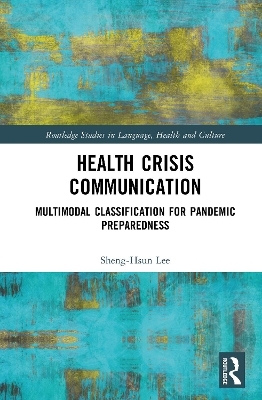
Health Crisis Communication
Multimodal Classification for Pandemic Preparedness
Seiten
2025
Routledge (Verlag)
978-1-032-89863-6 (ISBN)
Routledge (Verlag)
978-1-032-89863-6 (ISBN)
Sheng-Hsun Lee develops a new way of understanding public health crisis communication through the lens of multimodal classification.The book is an essential read for public health practitioners and researchers and advanced students in discourse analysis and public health communication.
Sheng- Hsun Lee develops a new way of understanding public health crisis communication through the lens of multimodal classification. He draws on examples from COVID- 19 press conferences in Taiwan and public online comments to outline multimodal classification as sorting pandemic phenomena into categorical types.
Lee argues that when public health officials classify health crisis phenomena into categories, they also set parameters for official responses and shape public perceptions of a crisis. He illustrates the argument by examining Taiwan’s initial successes in keeping most infections at bay and subsequent challenges of obtaining enough vaccines for international border reopening. The successes and challenges are closely linked to multimodal classification, which includes using speech, gestures, and objects to make some categories travel broadly and impede the circulation of other categories. The book discusses a wide range of crisis categories from the three dreadful first times— the first confirmed case, the first community-acquired case, and the first death— to the politicized debate over vaccine brands. Lee emphasizes the importance of understanding how crisis categories are produced, circulated, and received. The comprehensive coverage looks beyond initial responses to the COVID- 19 pandemic and outside English- dominant places to redefine effective public health messaging. Based on the findings, the book highlights implications for communicating official messages and offers a list of ready- to- use strategies for updating existing guidelines on public health communication.
The book is an essential read for public health practitioners, researchers, and advanced students in discourse analysis and public health communication.
Sheng- Hsun Lee develops a new way of understanding public health crisis communication through the lens of multimodal classification. He draws on examples from COVID- 19 press conferences in Taiwan and public online comments to outline multimodal classification as sorting pandemic phenomena into categorical types.
Lee argues that when public health officials classify health crisis phenomena into categories, they also set parameters for official responses and shape public perceptions of a crisis. He illustrates the argument by examining Taiwan’s initial successes in keeping most infections at bay and subsequent challenges of obtaining enough vaccines for international border reopening. The successes and challenges are closely linked to multimodal classification, which includes using speech, gestures, and objects to make some categories travel broadly and impede the circulation of other categories. The book discusses a wide range of crisis categories from the three dreadful first times— the first confirmed case, the first community-acquired case, and the first death— to the politicized debate over vaccine brands. Lee emphasizes the importance of understanding how crisis categories are produced, circulated, and received. The comprehensive coverage looks beyond initial responses to the COVID- 19 pandemic and outside English- dominant places to redefine effective public health messaging. Based on the findings, the book highlights implications for communicating official messages and offers a list of ready- to- use strategies for updating existing guidelines on public health communication.
The book is an essential read for public health practitioners, researchers, and advanced students in discourse analysis and public health communication.
Sheng- Hsun Lee is a Lecturer in School of Languages and Cultures at the University of Queensland. He researches health communication and language acquisition. His research has been published in international journals such as Applied Linguistics and Language in Society.
1. Introduction 2. The push and pull of COVID-19 classifications 3. Narrative classification 4. Numerical classification 5. Classification in mobility 6. Conclusion
| Erscheinungsdatum | 11.06.2025 |
|---|---|
| Reihe/Serie | Routledge Studies in Language, Health and Culture |
| Zusatzinfo | 7 Tables, black and white; 2 Line drawings, black and white; 45 Halftones, black and white; 47 Illustrations, black and white |
| Verlagsort | London |
| Sprache | englisch |
| Maße | 156 x 234 mm |
| Gewicht | 470 g |
| Themenwelt | Geisteswissenschaften ► Sprach- / Literaturwissenschaft ► Sprachwissenschaft |
| Studium ► Querschnittsbereiche ► Prävention / Gesundheitsförderung | |
| Sozialwissenschaften ► Kommunikation / Medien ► Kommunikationswissenschaft | |
| Sozialwissenschaften ► Politik / Verwaltung | |
| ISBN-10 | 1-032-89863-1 / 1032898631 |
| ISBN-13 | 978-1-032-89863-6 / 9781032898636 |
| Zustand | Neuware |
| Informationen gemäß Produktsicherheitsverordnung (GPSR) | |
| Haben Sie eine Frage zum Produkt? |
Mehr entdecken
aus dem Bereich
aus dem Bereich
das Manual zur psychologischen Gesundheitsförderung
Buch | Hardcover (2023)
Springer Berlin (Verlag)
CHF 55,95
Wissenschaftlich basierte Empfehlungen, Tipps und Ernährungspläne für …
Buch (2022)
Thieme (Verlag)
CHF 69,95


