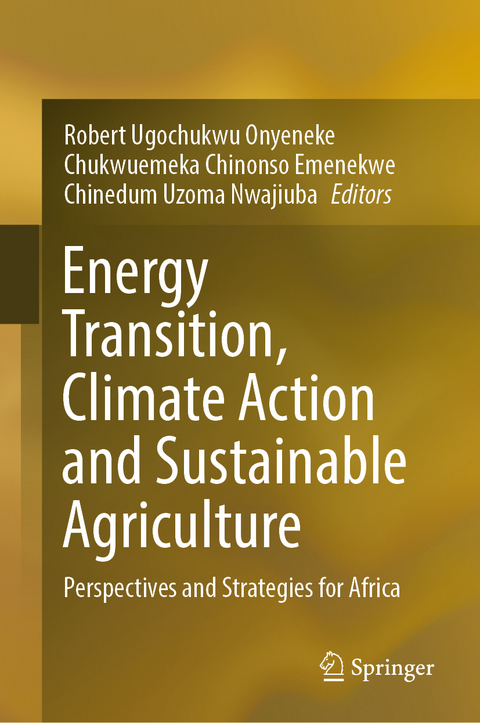
Energy Transition, Climate Action and Sustainable Agriculture
Springer International Publishing (Verlag)
978-3-031-83164-5 (ISBN)
This book offers a comprehensive exploration of climate justice intertwined with energy transitions, specifically focusing on the unique challenges and opportunities in developing countries. It presents a series of in-depth studies and discussions across various dimensions such as legal frameworks, economic incentives, gender issues, and the socio-economic impacts of energy policies. By dissecting complex relationships like those between renewable energy consumption and employment in Nigeria as well as the impacts of financial development, official development assistance, institutional quality and foreign direct investment on energy transition in Africa, this book illuminates the multifaceted nature of sustainable development. Starting with an overarching introduction to the imperatives of climate justice and the necessity for energy transition, the book delves into detailed analyses including the challenges and opportunities in renewable energy, the impacts of fossil fuel dependency and reforms, and the critical role of legal and institutional frameworks in supporting just transitions. Subsequent chapters discuss the gender-specific impacts of energy policies, the potential of international partnerships, and the entrepreneurial ventures emerging within just energy markets. Further, the book addresses public engagement, the educational imperatives for climate and energy literacy, and the intricate links between climate-induced migration, conflicts, and energy policies. It also explores the economic frameworks that can facilitate a just transition, evaluates the role of carbon markets in climate justice, and assesses how energy transitions impact water and food security. The book concludes by synthesizing key findings and offering strategic recommendations for integrating climate justice into energy transition policies. This final chapter provides actionable insights for policymakers, stakeholders, and communities aimed at fostering sustainable and equitable energy solutions. Targeted at policymakers, academics, and professionals involved in energy and climate policy, as well as students and researchers, this book serves as an essential resource for anyone committed to advancing sustainable and just energy transitions in developing countries.
Robert Onyeneke
Professor Robert Ugochukwu Onyeneke holds a Ph.D. in Agricultural Economics (with specialization in Resource and Environmental Economics). He is a Professor of Agricultural Resource and Environmental Economics in the Department of Agricultural Economics of Alex Ekwueme Federal University Ndufu-Alike, Ebonyi State, Nigeria. He has held several administrative positions in the University including the Director of the Centre for Climate Change and Development; Acting Director of the Centre for Internationalization, Linkages, Advancement and Global Ranking; Acting Director of Extension and Community Service; Deputy Director of Research and Development; as well as the Acting Head of Department of Agriculture of the University. Professor Onyeneke's scholarly work primarily focuses on the intersection of climate change impacts, agricultural value chain development, and sustainable energy solutions, with a particular emphasis on the African context. To his credit are many research papers published in peer reviewed journals, peer-reviewed book chapters and conference proceedings. He has also received grants to support his research. Professor Onyeneke has been involved in the development and review of some climate change and agricultural policies and plans in Nigeria. He has also served as an expert reviewer to the Intergovernmental Panel on Climate Change.
Chukwuemeka Emenekwe:
Chukwuemeka Emenekwe is a Lecturer and Researcher in the Department of Economics and Development Studies at Alex Ekwueme Federal University Ndufu-Alike, Nigeria. He holds a Ph.D. in Economics. His academic expertise spans energy-economy modelling and just energy transitions. Chukwuemeka has been instrumental in advancing research on the socioeconomic impacts of climate adaptation and mitigation strategies. He is a co-principal investigator in several key projects, including Nigeria's Deep Decarbonisation Pathways (DDP) project, Long-Term Low Emissions Development Strategy (LT-LEDS) and studies on fuel subsidy reforms. His work explores decarbonization pathways and renewable energy's role in fostering equitable transitions.
Chinedum Nwajiuba:
Professor Chinedum Uzoma Nwajiuba is a distinguished Nigerian academic, agricultural economist, and climate policy expert. He served as the Vice-Chancellor of Alex Ekwueme Federal University Ndufu-Alike (AE-FUNAI), Ebonyi State, from February 2016 to February 2021, where he led transformational initiatives in academic excellence and institutional development. Prof. Nwajiuba earned his Ph.D. in Agricultural Economics from the University of Hohenheim, Germany. His research focuses on agricultural economics, climate change adaptation, and sustainable development, with an emphasis on food systems and rural livelihoods. Prof. Nwajiuba is the Chairman of the Board of the West African Science Service Centre on Climate Change and Adapted Land Use (WASCAL), underscoring his regional leadership in climate action. He has contributed extensively to policy development and capacity building in climate resilience, earning respect as a thought leader in academia and beyond. He combines his academic expertise with a passion for advancing sustainable solutions to Africa's agricultural and environmental challenges.
Chapter 1. Introduction: The Imperative of Climate Justice and Energy Transition.- Chapter 2. Towards just energy transition: Assessing renewable energy consumption and aggregate employment in Nigeria using kernel regularized least squares (KRLS) approach.- Chapter 3. Renewable Energy: Challenges and Opportunities.- Chapter 4. Fossil Fuels: Economic Dependencies and Reform Impacts.- Chapter 5. Legal Frameworks for Sustainable Energy Policies.- Chapter 6. Gender Dimensions of Energy Transition.- Chapter 7. Building Partnerships for a Just Transition.- Chapter 8. Entrepreneurial Ventures in Just Energy Markets.- Chapter 9. Public Engagement and Behavioral Change.- Chapter 10. Adapting to Climate Impacts on Energy and Livelihoods.- Chapter 11. Educational Imperatives for Climate and Energy Literacy.- Chapter 12. Migration and Conflict: The Socio-Economic Ripple Effects.- Chapter 13. Economic Incentives and Fiscal Strategies for Energy Transition.- Chapter 14. Carbon Markets and Climate Justice.- Chapter 15. Water and Food Security in the Climate Context.- Chapter 16. Conclusion: Towards a Holistic Approach in Energy Transition.- Supplementary Sections.- Appendices.- Glossary.
| Erscheinungsdatum | 22.04.2025 |
|---|---|
| Zusatzinfo | XII, 565 p. 78 illus., 70 illus. in color. |
| Verlagsort | Cham |
| Sprache | englisch |
| Maße | 155 x 235 mm |
| Themenwelt | Naturwissenschaften ► Geowissenschaften ► Meteorologie / Klimatologie |
| Sozialwissenschaften ► Politik / Verwaltung ► Staat / Verwaltung | |
| Schlagworte | Adapting to climate change for energy and livelihood security • Behavioral change for just energy transition • Carbon market impacts on climate justice • Challenges and opportunities in renewable energy development • Climate justice and energy transition in developing countries • Economic incentives for sustainable energy transitions • Educational initiatives for climate and energy literacy • Fiscal strategies for energy transition • Gender dimensions in energy transition • Impact of renewable energy on developing economies • Impacts of fossil fuel subsidy reforms • Innovation and entrepreneurship in energy markets • International partnerships for just energy transition • Legal frameworks for sustainable energy policies • Public engagement strategies for energy transition • Renewable energy and employment impacts in Nigeria • Socio-economic effects of climate-induced migration • Water and food security in energy transition contexts |
| ISBN-10 | 3-031-83164-0 / 3031831640 |
| ISBN-13 | 978-3-031-83164-5 / 9783031831645 |
| Zustand | Neuware |
| Informationen gemäß Produktsicherheitsverordnung (GPSR) | |
| Haben Sie eine Frage zum Produkt? |
aus dem Bereich