


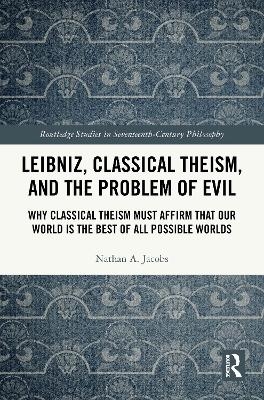
Leibniz, Classical Theism, and the Problem of Evil
Why Classical Theism Must Affirm That Our World is the Best of All Possible Worlds
Seiten
2025
Routledge (Verlag)
978-1-032-73921-2 (ISBN)
Routledge (Verlag)
978-1-032-73921-2 (ISBN)
This book offers a defense of Leibniz’s theodicy and his claim that our world is the best of all possible worlds. It considers Leibniz’s rationale for “optimism,” examines its roots in ancient and medieval thought, and highlights the very real challenges of evading optimism from within the framework of classical theism.
This volume offers a defense of Leibniz’s theodicy and his infamous claim that our world is the best of all possible worlds. It considers Leibniz’s rationale for “optimism,” examines its roots in ancient and medieval thought, and forwards a novel rereading of Leibniz’s theory of freedom in light of this background, all of which highlights the very real challenges of evading optimism from within the framework of classical theism.
Gottfried Leibniz is known for his “theodicy,” or defense of God's Goodness, Wisdom, and Justice despite the realities of evil in our world. This book argues that Leibniz’s optimism is inevitable for proponents of classical theism and even for many not-so-classical theists. The author’s argument is threefold. First, he demonstrates that Leibniz's theodicy is deeply rooted in the classical theist tradition, pagan and Christian, and shows that the philosopher of Leipzig is merely following these commitments to their logical conclusion, a conclusion that long precedes Leibniz. Second, he offers a novel rereading of Leibniz in the light of his philosophical and theological antecedents, a reading that, if correct, dispels ubiquitous but problematic assumptions about Leibniz's case, specifically those about divine and human freedom. Third, he demonstrates the analytic tether that connects classical theism to Leibniz’s conclusion, making his notorious optimism virtually inevitable for proponents of classical theism — and even for not-so-classical theists. This book demonstrates the ways in which Leibniz is relevant to not only classical theists and students of Modern philosophy but also to contemporary philosophers of religion more generally and philosophical theologians who are concerned with the problem of evil.
Leibniz, Classical Theism, and the Problem of Evil will appeal to scholars and graduate students interested in Leibniz, philosophy of religion, history of philosophy, philosophical theology, free will, and the problem of evil.
This volume offers a defense of Leibniz’s theodicy and his infamous claim that our world is the best of all possible worlds. It considers Leibniz’s rationale for “optimism,” examines its roots in ancient and medieval thought, and forwards a novel rereading of Leibniz’s theory of freedom in light of this background, all of which highlights the very real challenges of evading optimism from within the framework of classical theism.
Gottfried Leibniz is known for his “theodicy,” or defense of God's Goodness, Wisdom, and Justice despite the realities of evil in our world. This book argues that Leibniz’s optimism is inevitable for proponents of classical theism and even for many not-so-classical theists. The author’s argument is threefold. First, he demonstrates that Leibniz's theodicy is deeply rooted in the classical theist tradition, pagan and Christian, and shows that the philosopher of Leipzig is merely following these commitments to their logical conclusion, a conclusion that long precedes Leibniz. Second, he offers a novel rereading of Leibniz in the light of his philosophical and theological antecedents, a reading that, if correct, dispels ubiquitous but problematic assumptions about Leibniz's case, specifically those about divine and human freedom. Third, he demonstrates the analytic tether that connects classical theism to Leibniz’s conclusion, making his notorious optimism virtually inevitable for proponents of classical theism — and even for not-so-classical theists. This book demonstrates the ways in which Leibniz is relevant to not only classical theists and students of Modern philosophy but also to contemporary philosophers of religion more generally and philosophical theologians who are concerned with the problem of evil.
Leibniz, Classical Theism, and the Problem of Evil will appeal to scholars and graduate students interested in Leibniz, philosophy of religion, history of philosophy, philosophical theology, free will, and the problem of evil.
Nathan A. Jacobs, PhD, is Scholar in Residence of Philosophy and Religion at Vanderbilt Divinity School, Co-editor of Kant and the Question of Theology (CUP) and The Persistence of the Sacred in Modern Thought (UNDP) and co-author of In Defense of Kant’s “Religion” (IUP). Jacobs specializes in Modern philosophy and Eastern patristic thought.
Introduction Part 1: Optimism 1. Sufficient Reason for the Best Possible World 2. Optimal Goodness in the Best Possible World 3. Good, Evil, and the Will of God 4. Perhaps the Only Possible World Part 2: Optimism Renewed 5. Optimism Before Leibniz 6. Rethinking Leibniz on Freedom 7. Leibniz’s Theodicy Redux 8. The Inevitability of Leibniz
| Erscheinungsdatum | 22.07.2025 |
|---|---|
| Reihe/Serie | Routledge Studies in Seventeenth-Century Philosophy |
| Verlagsort | London |
| Sprache | englisch |
| Maße | 152 x 229 mm |
| Gewicht | 910 g |
| Themenwelt | Geisteswissenschaften ► Philosophie ► Geschichte der Philosophie |
| Geisteswissenschaften ► Philosophie ► Philosophie der Neuzeit | |
| Religion / Theologie ► Christentum ► Kirchengeschichte | |
| Sozialwissenschaften | |
| ISBN-10 | 1-032-73921-5 / 1032739215 |
| ISBN-13 | 978-1-032-73921-2 / 9781032739212 |
| Zustand | Neuware |
| Informationen gemäß Produktsicherheitsverordnung (GPSR) | |
| Haben Sie eine Frage zum Produkt? |
Mehr entdecken
aus dem Bereich


aus dem Bereich
eine andere Geschichte der Papststadt
Buch | Softcover (2024)
C.H.Beck (Verlag)
CHF 25,20
die Macht des Dunklen in unserer Zeit und wie wir ihr entgegentreten
Buch | Hardcover (2025)
Verlag Herder
CHF 27,90


