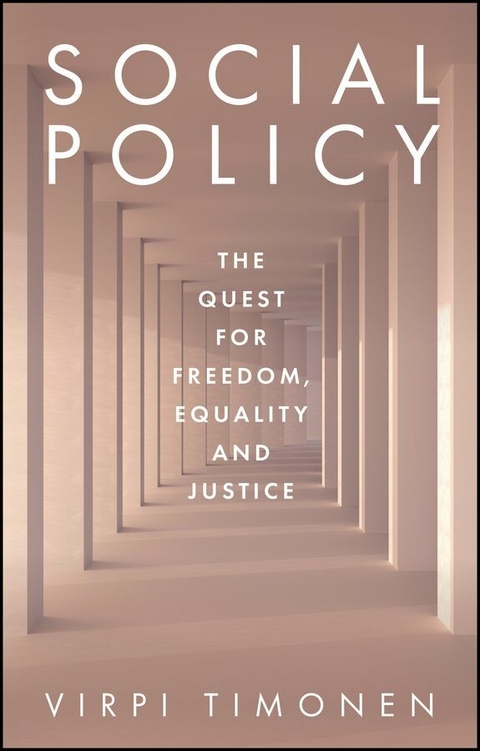
Social Policy (eBook)
261 Seiten
Polity (Verlag)
978-1-5095-6605-1 (ISBN)
This concise and readable book is a guide to those essential social policy concepts. In addition to freedom, equality and justice, the book covers concepts like social risks and rights that are critical for understanding welfare states, and examines social policies through the lenses of power, recognition and investment. It also reflects on the role of social policy in addressing the biggest challenges that humanity faces in the twenty-first century, including the megatrends of inequality and climate change.
Drawing on key works and examples from diverse contexts, this book will be of interest to undergraduate and postgraduate students of social policy, sociology, social work and other social sciences, as well as researchers, policymakers, practitioners and activists looking for an accessible introduction to the heart of social policy.
Virpi Timonen is Professor of Social and Public Policy at the University of Helsinki.
Concepts like freedom, equality and justice have many uses and even more misuses. In seeking to manage an increasingly complex world, it is more important than ever to think carefully about the meaning of such concepts which are central to policy debates and integral to implementing effective social policy around the world. This concise and readable book is a guide to those essential social policy concepts. In addition to freedom, equality and justice, the book covers concepts like social risks and rights that are critical for understanding welfare states, and examines social policies through the lenses of power, recognition and investment. It also reflects on the role of social policy in addressing the biggest challenges that humanity faces in the twenty-first century, including the megatrends of inequality and climate change. Drawing on key works and examples from diverse contexts, this book will be of interest to undergraduate and postgraduate students of social policy, sociology, social work and other social sciences, as well as researchers, policymakers, practitioners and activists looking for an accessible introduction to the heart of social policy.
2
Risks, Needs and Redistribution
Living in risk society
Before we delve into the ‘big three’ concepts of freedom, equality and justice, in this chapter I will outline some foundational concepts pertaining to social policies and welfare states. Being familiar with these concepts will help in understanding and applying the somewhat more abstract concepts of freedom (chapter 3), equality (chapter 4) and justice (chapter 5). Understanding the key concepts outlined in chapters 3, 4 and 5 will be easier if you first familiarize yourself with some of the terminology around social protection and welfare states, and some of the reasons for the existence of social policies and welfare states.
We will start with the concepts of risks and needs. Risks and needs constitute the basis for debates about the (re)distribution of resources in society. We are all aware of the basic human needs for air, water, food, clothing and shelter. We also have ideas about risks, ranging from global risks that might seem remote from some vantage points (such as the consequences of climate change) to risks that low-paid people in precarious work encounter every day, such as the risk of not being offered enough hours at work this week. Risks and needs are intertwined because risks are often linked to inability to (fully) meet needs. For example, someone on a so-called zero-hours contract (no guaranteed number of hours of paid work) faces the risk of precarious employment and insufficient income, meaning that they might be unable to meet their need for sufficient, nutritious food at times.
There are different kinds of risks. So-called natural risks have always affected humans and continue to do so; examples of these are volcanic eruptions, threat from pests and infestations, flooding, tsunamis and other events that are hard or impossible to predict and that are rooted in forces of nature. Such risks might jeopardize the ability of individuals and societies to meet their needs for shelter, food and security. Increasingly, however, contemporary societies are moulded and threatened by manufactured risks. These are risks that humans are directly or indirectly responsible for producing (‘manufacturing’) or exacerbating.
Manufactured risks are diverse, as some are associated with the economy and production, such as reliance on a small number of industries that are in intense global competition and hence liable to fluctuation in the employment they can offer to local people. Manufactured risks can also relate closely to the environment; for instance, reliance on fossil fuels generates risks of pollution and adverse health effects for humans and other species. Often risks are intertwined and multi-layered, such as fuel poverty arising from increases in fuel price, which in turn might arise from war or conflict (manufactured risks) and inability to move away from fossil fuels (manufactured risk) that damage the environment.
Furthermore, the boundary between natural and manufactured risks has become increasingly hard to define. Human activity is now – in the Anthropocene – so impactful that it shapes the global average temperatures and many of what were previously considered natural processes: frequency of adverse weather events, survival of species, feasibility of plants, location of habitation for humans and other species, and so on. Chapter 10 will explore the relevance of social policy for managing and reducing this new category of eco-social risks (Hirvilammi et al. 2023) arising from climate change and other manifestations of environmental degradation.
A much longer-established concern among social policy scholars and analysts has been various personal and social risks. Ulrich Beck (1992) argued that societies have become increasingly affluent but also in many ways riskier – to the extent that he labelled them risk societies. Beck’s chief example of manufactured risks with environmental repercussions was the Chernobyl nuclear disaster of 1986. Modernity – the dynamic social order and era that we are living in – has also given rise to technological, personal and social risks. Cybercrime, identity theft and challenges posed by (mis)use of artificial intelligence are examples of technological risks. Beck and Beck-Gernsheim (2002) highlighted intimate relationships as sources of personal risks, such as instability in partnerships, dissolution of unions (through separation and divorce) and lone parenthood. These risks have always existed, but they are much more prevalent in late modern societies with loose norms around relationships and personal lives.
In aggregate, the proliferation of personal, social, technological and manufactured risks increases the importance of individuals’ ability to anticipate and to manage risks. If we can handle, say, the social and economic consequences of marriage breakdown or being made redundant, we are probably going to do reasonably well despite the challenges of adapting to divorce or retraining for a job in a different industry. In contrast, a person who is unable to pay bills after a relationship breakdown because they lack personal and family resources and support suffers a major setback through the ensuing economic struggle and perhaps even associated health impacts. Some forms of social provision and a well-functioning welfare state can help to mitigate and compensate for the risks of relationship breakdown and insecure employment, but the magnitude of these and other social risks in the contemporary risk society can be so great that personal and other informal social resources come to play a decisive role in dealing with them. As personal resources – both material, such as income and housing, and immaterial, such as resilience – are unequally distributed, growth in social risks tends to lead to growing inequalities.
Among the social risks of direct relevance to social policy, a distinction can be drawn between old and new social risks. Old social risks relate to inability to earn a living and to meet needs in the event of sickness, accidents, unemployment or old age. The earliest social policies were devised and implemented in response to these risks in industrializing societies in Europe, hence the term ‘old’ social risks. The term ‘old’ does not imply that these risks have been overcome and no longer exist – they are still here today, albeit in somewhat different forms than in the earlier stages of welfare state development. When elements of collective social provision were first introduced in Europe, incipient welfare states were responses to the most disruptive aspects of early industrialization, such as gruesome work-related accidents in factories; poverty in large families with only one wage earner whose income was cut off during any unavoidable absences from work (e.g., when sick); child labour necessitated by poverty in families; and so on. These earlier responses to old social risks revolved around the notion of a male breadwinner as the head of family and as the sole (or chief) source of income (remunerated work) in a household, a gendered pattern that is further discussed in chapter 7. Examples of policies that were developed in response to old social risks include pensions, sickness and accident insurance, and unemployment benefits, all designed to provide some replacement income during periods that the (male) breadwinner had to spend outside the wage–labour nexus. These social policies that were developed to respond to old social risks offered workers varying levels of decommodification, that is, temporary security while not working (see chapter 6 for a fuller explanation).
New social risks have emerged because of extensive changes in economies, labour markets and societies. The most important changes that have given rise to new social risks include globalization in production and trade, the shift from manufacturing towards services (and corresponding change in labour markets and skills requirements), increase in women’s labour-market participation, and greater diversity in family forms. The relatively low incomes and precariousness associated with many (service-sector) jobs, lack of entitlement to traditional social insurance benefits (e.g., unemployment benefit) due to lack of work history (especially among young people), and the difficulties of combining paid employment and care (of children and older family members) are new social risks. People who are unable to afford childcare, and hence are unable to work, and those who are in casual, insecure and low-paid employment are experiencing new social risks. Such risks were relatively rare during the ‘Golden Age’ of welfare state development (the 1950s and 1960s in western democracies) because most care work was undertaken by women who were not employed outside the home and because stable employment in agriculture and manufacturing industries was by and large more accessible than today, even for semi-skilled or unskilled (male) workers. Given that both old and new social risks continue to exist and are in many ways interrelated, in the rest of the book I will mostly use the term ‘social risks’ (although new social risks are discussed in conjunction with the idea of social investment in chapter 9).
Having sketched out risks, let us turn to the related idea of needs. It stands to reason that the social risk of unemployment is related to the need for an income and the risk of not being able to afford...
| Erscheint lt. Verlag | 4.12.2024 |
|---|---|
| Sprache | englisch |
| Themenwelt | Sozialwissenschaften ► Politik / Verwaltung |
| Sozialwissenschaften ► Soziologie | |
| Schlagworte | assessing social policy • equitable social policy • how to assess social policies • how to make good social policy? • social policy and equality • social policy and equity • social policy and justice • Virpi Timonen • what guides social policy decisions? • what is public policy? • What is social policy? • what makes a good social policy? • what makes good policy? • what's the aim of social policy? • why does social policy matter? |
| ISBN-10 | 1-5095-6605-8 / 1509566058 |
| ISBN-13 | 978-1-5095-6605-1 / 9781509566051 |
| Informationen gemäß Produktsicherheitsverordnung (GPSR) | |
| Haben Sie eine Frage zum Produkt? |
 EPUB (Adobe DRM)
Kopierschutz: Adobe-DRM
Adobe-DRM ist ein Kopierschutz, der das eBook vor Mißbrauch schützen soll. Dabei wird das eBook bereits beim Download auf Ihre persönliche Adobe-ID autorisiert. Lesen können Sie das eBook dann nur auf den Geräten, welche ebenfalls auf Ihre Adobe-ID registriert sind.
Details zum Adobe-DRM
Dateiformat: EPUB (Electronic Publication)
EPUB ist ein offener Standard für eBooks und eignet sich besonders zur Darstellung von Belletristik und Sachbüchern. Der Fließtext wird dynamisch an die Display- und Schriftgröße angepasst. Auch für mobile Lesegeräte ist EPUB daher gut geeignet.
Systemvoraussetzungen:
PC/Mac: Mit einem PC oder Mac können Sie dieses eBook lesen. Sie benötigen eine
eReader: Dieses eBook kann mit (fast) allen eBook-Readern gelesen werden. Mit dem amazon-Kindle ist es aber nicht kompatibel.
Smartphone/Tablet: Egal ob Apple oder Android, dieses eBook können Sie lesen. Sie benötigen eine
Geräteliste und zusätzliche Hinweise
Buying eBooks from abroad
For tax law reasons we can sell eBooks just within Germany and Switzerland. Regrettably we cannot fulfill eBook-orders from other countries.
aus dem Bereich