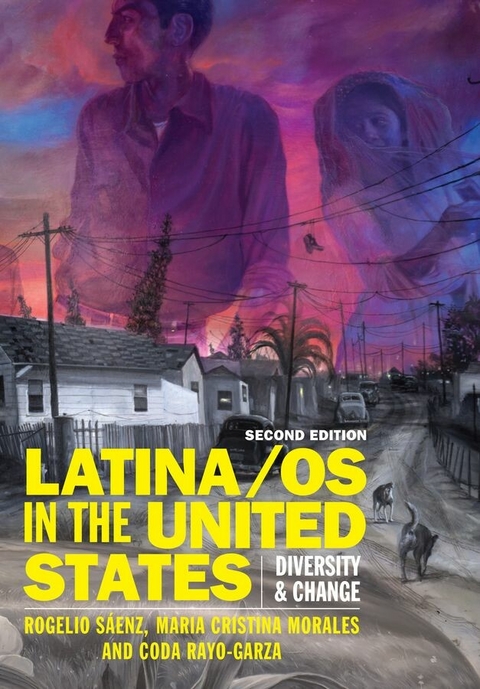
Latina/os in the United States (eBook)
746 Seiten
Polity (Verlag)
978-1-5095-3712-9 (ISBN)
In this second edition of Latina/os in the United States, Sáenz, Morales, and Rayo-Garza highlight the experiences of Latinos in a variety of domains, including gender and sexuality, education, political engagement, work and economic life, family, religion, health and health care, crime and victimization, mass media, and the arts. This updated edition includes the latest demographic trends, discusses recent mass shootings of Latinos, the impact of the Trump administration, and COVID-19. With greater focus on the Afro-Latino population and Latina/o social thought, it offers sociological perspectives on both native-born and immigrant populations, and engages readers in thinking about the major issues that Latinos are facing. The book clearly illustrates the diverse experiences of the array of Latino groups in the United States, with some of these groups succeeding socially and economically, while other groups continue to experience major social and economic challenges. The book concludes with a discussion of what the future holds for Latinos.
This book is essential reading for students, social scientists, and policymakers interested in Latinos and their place in contemporary society.
Rogelio Sáenz is Professor of Sociology and Demography at the University of Texas at San Antonio.
Maria Cristina Morales is Professor of Sociology at the University of Texas at El Paso.
Coda Rayo-Garza is a Ph.D. candidate in Applied Demography at the University of Texas at San Antonio.
1
Introduction
Hispanics set foot in this country long before the Pilgrims, one of many truths lost in the telling of American history. Now more Latinos are demanding answers from those who fail to acknowledge this continuing amnesia. Compared with white Americans, Latinos earn less, face more barriers to education and health care, and find themselves underrepresented in higher-paid areas of the workforce, as well as in popular culture. As long as our stories and voices continue to be written out of textbooks, omitted in film, TV, and print, and minimized in the halls of power, people will continue to see Latinos as something other than inherently American.
(Stephania Taladrid)
Journalist Stephania Taladrid (2021), who is a contributing writer to The New Yorker on issues related to the Latina/o population, aptly illustrates the overall US ignorance and exclusion of Latina/os. Despite common perceptions that Latina/os are newcomers to the US, they have a long presence in the US extending back nearly two centuries. Over this long period of time, countless numbers of Latina/os have been born in the US, while others continue to make their journey to this country. Over their long history in the US, Latina/os have made important contributions to this nation. In particular, Mexicans were initially incorporated into this country more than one and a half centuries ago, with Puerto Ricans becoming associated with the US more than a century ago. The US, especially in the Southwest (especially Arizona, California, Colorado, New Mexico, and Texas), bears profound Latina/o – particularly Mexican – roots. Indeed, much of the land in the Southwest (including California, Nevada, Utah, New Mexico, most of Arizona and Colorado, and parts of Oklahoma, Kansas, and Wyoming) belonged to Mexico until 1848 with the signing of the Treaty of Guadalupe Hidalgo at the end of the Mexican–American War (National Archives 2024). As a result of this treaty, Mexico lost about 55 percent of its land to the US. Indeed, Latina/os living in the Southwest exist in land that once was part of Mexico.
Over the last several decades, Latina/os have played an important role in the changing demography of the US. The increasing prominence of Latina/os makes them the engine of the US population. The growing presence of Latina/os in the US is having an impact on the nation’s culture and institutions. Population projections indicate that Latina/os will increasingly drive the nation’s demography throughout the twenty-first century. It is estimated that the Latina/o electorate will nearly double between 2012 and 2030, largely due to the rapidly growing number of young Latina/os turning eighteen years of age (Taylor et al. 2012a). Latina/os also accounted for more than three-fifths (62%) of the growth in people eligible to vote between the 2018 presidential and the 2022 mid-term election, increasing at a rate of 16 percent, higher than the change among other racial or ethnic groups (Natarajan and Im 2022). The potential political power of Latina/os is immense. At the national level, 65 percent of the US Latina/o citizens of voting age population (CVAP) are concentrated in five of the six most populous states (California, Texas, Florida, New York, and Illinois) compared to 32 percent of US non-Latina/os. At the state level, the Latina/o population is larger than the white population in California, New Mexico, and Texas.
This book provides a sociological overview of Latina/os to help readers better understand the past, present, and future of the diverse groups that comprise the Latina/o population in the US. In the following section we will identify the extensive roots and some of the major influences of Latina/os in this country in the realms of history, culture, language, and cuisine.
The Deep Roots and Influences of Latina/os on the US
The influence of Latina/os on the US reaches far back in history. A testament of this historical presence are the many cities across the Southwest that bear Spanish names, including Casa Grande, Guadalupe, Mesa, Nogales, Sierra Vista in Arizona; Chula Vista, Fresno, Los Angeles, Merced, San Diego, San Francisco in California; Aguilar, Alma, Blanca, Dolores, Las Animas, and Pueblo in Colorado; Belen, Española, Las Cruces, Las Vegas, Raton, and Santa Fe in New Mexico; and Amarillo, Del Rio, El Paso, La Feria, San Antonio, and Zapata in Texas.
In addition, the influence of Latina/os on the US can be seen in the English language. In the Southwest, Spanish words that have become part of the English language stem from the ranching past of Mexicans. The list of Spanish words that are part of the English language includes arroyo (stream), avocado, barbeque, buckaroo (derived from vaquero, the Spanish word for cowboy), burro (donkey), chaparral (thicket), conquistador, corral (pen), desperado (bandit), dolly welter (“a term for wrapping a lasso around a saddle horn … comes from ‘dale vuelta’ [Spanish for ‘give it a turn’], see Ponce 2022), junta (meeting), lariat (derived from la riata, Spanish word for rope), lasso (same as with lariat), mesa (plateau), mesquite, patio, pimento (pepper), rodeo, salsa, savanna, sierra (mountain range), tango, ten-gallon hat, tomato, and vanilla (see Wikipedia 2024).
Furthermore, Spanish language instruction in the US has increased dramatically over the last several decades and Spanish became the most popular language studied by American students at the university level in the mid-1990s (Gearing 2010). For example, according to a study of college enrollment in foreign languages in 2009 by the Modern Language Association (Furman et al. 2010), approximately 865,000 students in the US were enrolled in a Spanish language course, with French, the second most popular foreign-language course, having an enrollment only one-fourth that of Spanish. Nonetheless, the most recent Modern Language Association report indicates a decline in non-English language instruction with the number of persons enrolled in Spanish courses dropping by 17 percent between 2009 and 2016, compared with a decline of 13 percent for all other non-English languages combined (Looney and Lusin 2019). Still, Spanish continues to be the most popular foreign language taught in higher education today, with half of all the students enrolled in a foreign-language course taking Spanish (Maria 2023).
Similarly, according to the 2021 American Community Survey (ACS) (Ruggles et al. 2024), Spanish was the most common language among persons five years of age and older who spoke a language other than English in the US, with 41.3 million persons speaking Spanish at home (Ruggles et al. 2024). Furthermore, approximately 2.7 million non-Latina/o individuals – 69 percent of these being whites – spoke Spanish at home at that time (Ruggles et al. 2024). Who are these whites who speak Spanish at home? There are three possibilities. First, they could be persons who have a Latina/o-related ancestry but they do not identify as Latina/o today. Second, they could be whites born in Latin America, the Caribbean, or Spain, places where Spanish is spoken. Third, they could be married to a Latina/o spouse. We examined these possibilities using data from the 2021 ACS for whites who speak Spanish at home. There is no support for the first two possibilities: only approximately 9 percent of white Spanish speakers who reported one or two ancestries in the ACS listed a Latina/o-related ancestry, and only 4 percent of white Spanish speakers were born in a country where Spanish is spoken. However, white Spanish speakers are disproportionately married to Latina/o spouse, who are likely to have been born outside of the US. Approximately 37 percent of married white Spanish speakers have a spouse who is Latina/o, two-thirds of these Latina/o spouses being born outside of the US. This represents an interesting illustration of how Spanish-language use is maintained even in cases involving intermarriage.
The influence of Latina/os – especially of Mexicans – can also be seen in the food that Americans consume. Indeed, the three most popular ethnic cuisines in the US are Chinese, Mexican, and Italian (Williams 2020). In addition, Mexican food accounts for the largest share of the overall food market and Mexican restaurants account for 11 percent of all restaurants in the country, behind only those designated as “American” food restaurants, which supposedly serve traditional “American” food (Danziger 2023). The dethroning of ketchup by salsa for the title of the most popular condiment in 1991 is emblematic of the rising popularity of Mexican food in the US (O’Neill 1992). More recently, in June 2023 Modelo beer supplanted Budweiser beer as the US top seller of beer, after the latter’s nearly two-decade reign at the top (Moreno 2023; Tse 2023).
Furthermore, Mexican businesses have also made important inroads into the US and global markets. Cemex the second top cement supplier in the US (Leonard 2023) and Cinépolis (Kolmar 2023) and Grupo Bimbo (Bizvibe 2020) being the second largest movie theater chain and the fourth largest baker in the world, respectively. Moreover, Latina/o-owned small businesses have grown tremendously. For example, over the last decade, the number of Latina/o-owned small businesses rose by 34 percent compared to 1 percent for all other non-Latina/o-owned businesses (Cimini 2020; Mills et al. 2018).
In the world of music, Rolling Stone began a section on Latina/o music in late 2012 (Newman 2012). A significant number of Latina/o musicians have gained popularity as...
| Erscheint lt. Verlag | 3.12.2024 |
|---|---|
| Sprache | englisch |
| Themenwelt | Sozialwissenschaften ► Politik / Verwaltung |
| Schlagworte | best chicano textbook • best latino textbook • best Latinx textbook • chicano sociology • Chicano Studies • chicano textbook • Coda Rayo-Garza • fastest growing minority • fastest growing minority group • Hispanic or Latino? • Latino sociology • Latino studies • latino textbook • Latinx or Latina/o? • Latinx or Latino? • Latinx sociology • latinx studies • Latinx textbook • Maria Cristina Morales • Mexican Americans • Puerto Rican Americans • Rogelio Saenz • what are Hispanic americans? • where are there most Latinos? • who are Hispanic Americans? • why are latinos important |
| ISBN-10 | 1-5095-3712-0 / 1509537120 |
| ISBN-13 | 978-1-5095-3712-9 / 9781509537129 |
| Informationen gemäß Produktsicherheitsverordnung (GPSR) | |
| Haben Sie eine Frage zum Produkt? |
 EPUB (Adobe DRM)
Kopierschutz: Adobe-DRM
Adobe-DRM ist ein Kopierschutz, der das eBook vor Mißbrauch schützen soll. Dabei wird das eBook bereits beim Download auf Ihre persönliche Adobe-ID autorisiert. Lesen können Sie das eBook dann nur auf den Geräten, welche ebenfalls auf Ihre Adobe-ID registriert sind.
Details zum Adobe-DRM
Dateiformat: EPUB (Electronic Publication)
EPUB ist ein offener Standard für eBooks und eignet sich besonders zur Darstellung von Belletristik und Sachbüchern. Der Fließtext wird dynamisch an die Display- und Schriftgröße angepasst. Auch für mobile Lesegeräte ist EPUB daher gut geeignet.
Systemvoraussetzungen:
PC/Mac: Mit einem PC oder Mac können Sie dieses eBook lesen. Sie benötigen eine
eReader: Dieses eBook kann mit (fast) allen eBook-Readern gelesen werden. Mit dem amazon-Kindle ist es aber nicht kompatibel.
Smartphone/Tablet: Egal ob Apple oder Android, dieses eBook können Sie lesen. Sie benötigen eine
Geräteliste und zusätzliche Hinweise
Buying eBooks from abroad
For tax law reasons we can sell eBooks just within Germany and Switzerland. Regrettably we cannot fulfill eBook-orders from other countries.
aus dem Bereich