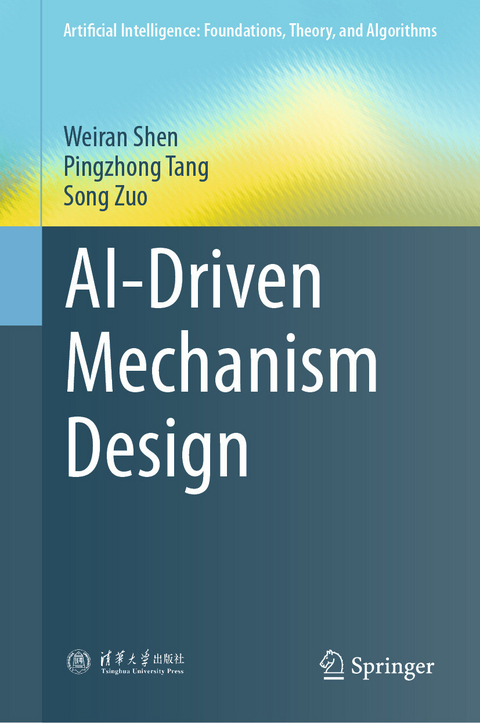
AI-Driven Mechanism Design (eBook)
130 Seiten
Springer Nature Singapore (Verlag)
978-981-97-9286-3 (ISBN)
Due to its huge success in industry, mechanism design has been one of the central research topics at the interface of economics and computer science. However, despite decades of effort, there are still numerous challenges, in terms of both theory and applications. These include the problem of how to design mechanisms for selling multiple items, dynamic auctions, and balancing multiple objectives, given the huge design space and buyer strategy space; and the fact that in practice, the most widely applied auction format (the generalized second price auction) is neither truthful nor optimal. Furthermore, many theoretical results are based upon unrealistic assumptions that do not hold in real applications.
This book presents the AI-driven mechanism design framework, which aims to provide an alternative way of dealing with these problems. The framework features two abstract models that interact with each other: the agent model and the mechanism model. By combining AI techniques with mechanism design theory, it solves problems that cannot be solved using tools from either domain alone. For example, it can reduce the mechanism space significantly, build more realistic buyer models, and better balance different objectives.
The book focuses on several aspects of mechanism design and demonstrates that the framework is useful in both theoretical analysis and practical applications.
Due to its huge success in industry, mechanism design has been one of the central research topics at the interface of economics and computer science. However, despite decades of effort, there are still numerous challenges, in terms of both theory and applications. These include the problem of how to design mechanisms for selling multiple items, dynamic auctions, and balancing multiple objectives, given the huge design space and buyer strategy space; and the fact that in practice, the most widely applied auction format (the generalized second price auction) is neither truthful nor optimal. Furthermore, many theoretical results are based upon unrealistic assumptions that do not hold in real applications.This book presents the AI-driven mechanism design framework, which aims to provide an alternative way of dealing with these problems. The framework features two abstract models that interact with each other: the agent model and the mechanism model. By combining AI techniques with mechanism design theory, it solves problems that cannot be solved using tools from either domain alone. For example, it can reduce the mechanism space significantly, build more realistic buyer models, and better balance different objectives.The book focuses on several aspects of mechanism design and demonstrates that the framework is useful in both theoretical analysis and practical applications.
| Erscheint lt. Verlag | 2.12.2024 |
|---|---|
| Reihe/Serie | Artificial Intelligence: Foundations, Theory, and Algorithms |
| Zusatzinfo | VIII, 130 p. 31 illus., 17 illus. in color. |
| Sprache | englisch |
| Themenwelt | Informatik ► Office Programme ► Outlook |
| Informatik ► Theorie / Studium ► Künstliche Intelligenz / Robotik | |
| Mathematik / Informatik ► Mathematik ► Angewandte Mathematik | |
| Mathematik / Informatik ► Mathematik ► Finanz- / Wirtschaftsmathematik | |
| Mathematik / Informatik ► Mathematik ► Statistik | |
| Sozialwissenschaften ► Soziologie ► Empirische Sozialforschung | |
| Technik ► Bauwesen | |
| Wirtschaft ► Betriebswirtschaft / Management ► Marketing / Vertrieb | |
| Schlagworte | AI-driven • Auction • Dynamic reserve prices • machine learning • Mechanism Design • Neural networks |
| ISBN-10 | 981-97-9286-X / 981979286X |
| ISBN-13 | 978-981-97-9286-3 / 9789819792863 |
| Informationen gemäß Produktsicherheitsverordnung (GPSR) | |
| Haben Sie eine Frage zum Produkt? |
 PDF (Wasserzeichen)
DRM: Digitales Wasserzeichen
Dieses eBook enthält ein digitales Wasserzeichen und ist damit für Sie personalisiert. Bei einer missbräuchlichen Weitergabe des eBooks an Dritte ist eine Rückverfolgung an die Quelle möglich.
Dateiformat: PDF (Portable Document Format)
Mit einem festen Seitenlayout eignet sich die PDF besonders für Fachbücher mit Spalten, Tabellen und Abbildungen. Eine PDF kann auf fast allen Geräten angezeigt werden, ist aber für kleine Displays (Smartphone, eReader) nur eingeschränkt geeignet.
Systemvoraussetzungen:
PC/Mac: Mit einem PC oder Mac können Sie dieses eBook lesen. Sie benötigen dafür einen PDF-Viewer - z.B. den Adobe Reader oder Adobe Digital Editions.
eReader: Dieses eBook kann mit (fast) allen eBook-Readern gelesen werden. Mit dem amazon-Kindle ist es aber nicht kompatibel.
Smartphone/Tablet: Egal ob Apple oder Android, dieses eBook können Sie lesen. Sie benötigen dafür einen PDF-Viewer - z.B. die kostenlose Adobe Digital Editions-App.
Buying eBooks from abroad
For tax law reasons we can sell eBooks just within Germany and Switzerland. Regrettably we cannot fulfill eBook-orders from other countries.
aus dem Bereich