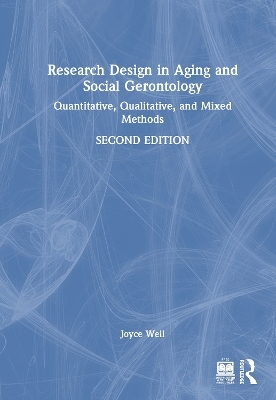
Research Design in Aging and Social Gerontology
Routledge (Verlag)
978-1-032-78530-1 (ISBN)
Fully updated, this second edition reflects recent changes in gerontology and includes more information about equity, diversity and inclusion; the impact of the COVID-19 pandemic; the use of virtual research methods; discussion about the researcher’s reflexivity; the role of theory in research; qualitative research developments; an expansion of secondary analysis of data;and the use of artificial intelligence in research.
Features include:
Descriptions, evaluations, and applications of a wide range of methodological approaches and methods used to collect data about older persons (quantitative, qualitative, mixed, and emergent methods: photovoice, virtual environments, etc.)
Ways to match research questions to selection of method without a preconceived methodological preference or dominance
Real-world and applied examples along with cases from the gerontological literature
"How to" sections about reading output/software reports and qualitative-analysis screenshots (from NVivo) and quantitative (SPSS) output and interpretation
Pedagogical tools in every chapter such as text boxes, case studies, definitions of key terms, discussion questions, and references for further reading on chapter topics
Glossary of key terms, complete sample research report, and an overview of past methodological research design work in gerontology
This text is intended for upper-level undergraduates and masters students in aging and gerontology as well as students in human development, applied anthropology, psychology, public health, sociology, and social work settings. Healthcare professionals, social workers, and care managers who work with older adults will also find this text a valuable resource.
At www.routledge.com/cw/weil instructors will find PowerPoint presentations, additional discussion questions, suggestions for in-class activities and assessments and a sample syllabus; and students will find flashcards based on glossary terms, a downloadable copy of the sample research report in the text, links to data sets, related websites, online videos and podcasts, further reading, select gerontological journals and multiple choice and true or false questions.
Joyce Weil, PhD, MPH, FGSA, is a social gerontologist and associate professor in the Gerontology Program of the Department of Health Sciences at Towson University. Her work centres around the meaning of place and place attachment for older adults and applying social research methodologies to the study of aging and older adults.
PART I. GETTING STARTED: AN OVERVIEW OF THE AGING RESEARCH PROCESS 1. Introduction 2. Designing Research about Older People and Aging 3. Gerontological Theoretical Approaches PART II. CHOOSING A RESEARCH METHOD AND SELECTING A DESIGN 4. Qualitative Methods 5. Quantitative Methods 6. Quantitative Data Analysis and Evaluation 7. Mixed Methods 8. Emerging and Future Methods PART III. ANALYZING RESULTS AND REPORTING FINDINGS 9. Quantitative, Qualitative Software and Computer-Assisted Research 10. Ethical Issues and Concerns in Aging Research 11. Reporting Aging Research
| Erscheinungsdatum | 16.05.2025 |
|---|---|
| Reihe/Serie | Textbooks in Aging |
| Zusatzinfo | 17 Tables, black and white; 44 Line drawings, black and white; 44 Illustrations, black and white |
| Verlagsort | London |
| Sprache | englisch |
| Maße | 178 x 254 mm |
| Gewicht | 810 g |
| Themenwelt | Geisteswissenschaften ► Psychologie ► Entwicklungspsychologie |
| Geisteswissenschaften ► Psychologie ► Familien- / Systemische Therapie | |
| Sozialwissenschaften ► Soziologie ► Empirische Sozialforschung | |
| ISBN-10 | 1-032-78530-6 / 1032785306 |
| ISBN-13 | 978-1-032-78530-1 / 9781032785301 |
| Zustand | Neuware |
| Informationen gemäß Produktsicherheitsverordnung (GPSR) | |
| Haben Sie eine Frage zum Produkt? |
aus dem Bereich