


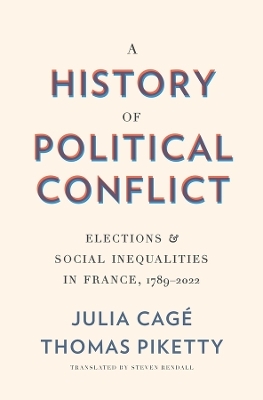
A History of Political Conflict
Elections and Social Inequalities in France, 1789–2022
Seiten
2025
Harvard University Press (Verlag)
9780674248434 (ISBN)
Harvard University Press (Verlag)
9780674248434 (ISBN)
Drawing on centuries of data, Julia Cagé and Thomas Piketty place today’s French politics in historical context. France is divided among bourgeois and distinct urban and rural working-class blocs—historically, an unstable structure. The authors show how inequality breeds tripartite competition and argue for the greater potential of two-way rivalry.
A pioneering history of voting and inequality, drawing on an unprecedented data set covering more than two centuries of sociological findings.
Who votes for whom and why? Julia Cagé and Thomas Piketty comb through more than two hundred years of data from some 36,000 French municipalities to show how inequality has shaped the formation of political coalitions, with stark consequences for economic and political development.
Cagé and Piketty argue that today’s tripartite division of French political life—a competition among a bourgeois central bloc and distinct factions of the urban and rural working classes—has a precise, and revealing, historical analogue. To understand contemporary tensions, we can look to the end of the nineteenth century and the beginning of the twentieth, another period when runaway economic inequality produced such a three-way rivalry. Cagé and Piketty show that tripartition has always been unstable, whereas the binary political conflict enabled by relative equality and typical of most of the twentieth century facilitated social and economic progress. Comparing these configurations over time helps us envisage possible trajectories for the French political system in the coming decades.
With its many changes in governmental structure since 1789, France is an ideal laboratory for studying the vicissitudes of modern political life in general, and electoral democracy in particular. Using France as a model, A History of Political Conflict offers a powerful framework for understanding the complex project of building and sustaining democratic majorities.
A pioneering history of voting and inequality, drawing on an unprecedented data set covering more than two centuries of sociological findings.
Who votes for whom and why? Julia Cagé and Thomas Piketty comb through more than two hundred years of data from some 36,000 French municipalities to show how inequality has shaped the formation of political coalitions, with stark consequences for economic and political development.
Cagé and Piketty argue that today’s tripartite division of French political life—a competition among a bourgeois central bloc and distinct factions of the urban and rural working classes—has a precise, and revealing, historical analogue. To understand contemporary tensions, we can look to the end of the nineteenth century and the beginning of the twentieth, another period when runaway economic inequality produced such a three-way rivalry. Cagé and Piketty show that tripartition has always been unstable, whereas the binary political conflict enabled by relative equality and typical of most of the twentieth century facilitated social and economic progress. Comparing these configurations over time helps us envisage possible trajectories for the French political system in the coming decades.
With its many changes in governmental structure since 1789, France is an ideal laboratory for studying the vicissitudes of modern political life in general, and electoral democracy in particular. Using France as a model, A History of Political Conflict offers a powerful framework for understanding the complex project of building and sustaining democratic majorities.
Julia Cagé is Professor of Economics at Sciences Po Paris and the author of Saving the Media and The Price of Democracy. Thomas Piketty is Professor of Economics and Economic History at the School for Advanced Studies in the Social Sciences and the Paris School of Economics. His books include A Brief History of Equality, Capital and Ideology, and the bestselling Capital in the Twenty-First Century.
| Erscheinungsdatum | 27.08.2025 |
|---|---|
| Übersetzer | Steven Rendall |
| Zusatzinfo | 36 Maps |
| Verlagsort | Cambridge, Mass |
| Sprache | englisch |
| Maße | 156 x 235 mm |
| Gewicht | 1587 g |
| Themenwelt | Sozialwissenschaften ► Politik / Verwaltung ► Politische Systeme |
| Sozialwissenschaften ► Politik / Verwaltung ► Politische Theorie | |
| Sozialwissenschaften ► Politik / Verwaltung ► Staat / Verwaltung | |
| ISBN-13 | 9780674248434 / 9780674248434 |
| Zustand | Neuware |
| Informationen gemäß Produktsicherheitsverordnung (GPSR) | |
| Haben Sie eine Frage zum Produkt? |
Mehr entdecken
aus dem Bereich



aus dem Bereich
Russland, Europa, Amerika
Buch | Softcover (2025)
C.H.Beck (Verlag)
CHF 25,20
Moskauer Erinnerungen
Buch | Hardcover (2025)
Droemer (Verlag)
CHF 34,95


