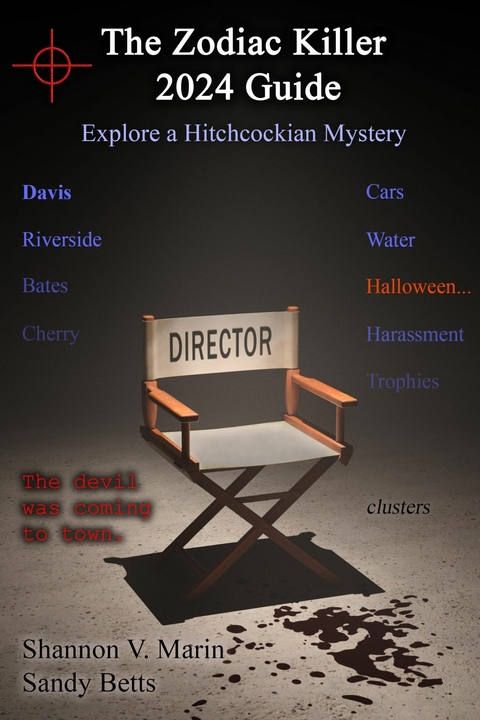
Zodiac Killer 2024 Guide (eBook)
360 Seiten
Bookbaby (Verlag)
979-8-3509-8376-0 (ISBN)
Sandy Betts has researched the Zodiac case for over three decades.
Zodiac gave proof in his communications for four attacks. These attacks spanned December 1968 to October 1969. The targets of the first three were male-female couples in rural areas. The last was a male taxi cab driver in San Francisco. In the taxi driver attack, police converged quickly and almost caught the killer. While other serial killers have also bragged in anonymous communications about their attacks, law enforcement decided that Zodiac's need for publicity was exceptional. There was hope that Zodiac had quit killing after his near arrest (or in the months that followed) and that an absence of proof for possible later killings confirmed this. Most candidate attacks after October 1969 were female abduction-murders. Law enforcement decided that sexual assault was part of many of these later attacks. These attacks differed too greatly from the confirmed attacks for the same killer to have committed both sets. The public had deluged law enforcement with "e;suspects"e; and many investigators were glad to see the case fade away. While five dead and two wounded was a tragedy, there were fresh murders to solve. Most serial killers are driven by uncontrollable emotional needs. That Zodiac needed publicity more than additional killings was a straightforward scenario. Unfortunately, it became the only scenario. Zodiac had used different weapons, targeted different types of victims, and carried out attacks in different locations. This was variation. Zodiac had also shown preferences for vehicles, water associations, and attacking close to significant calendar dates. This was repetition. In the third attack on a male-female couple, Zodiac wore a costume. All of this suggested a complex fantasy, not crimes driven to satisfy short-term cravings. Amateur researchers have reviewed many unsolved homicides. In 2020, researcher Kristi Hawthorne shared her discovery that a 1962 murder of a taxi cab driver in Oceanside was likely the prototype for the taxi driver killing in San Francisco in 1969. Both were accompanied by the taunting of law enforcement and threats to carry out attacks on a bus. For many years, a 1963 attack on the Santa Barbara County coast has been considered a likely prototype for the third confirmed male-female couple attack. These and other candidate attacks strongly support a scenario in which Zodiac committed recognizable attacks before 1968. Law enforcement was too quick to use a psychological profile to define the killer. While it is difficult to use individual murders after October 1969 as proof that Zodiac had continued to kill, the candidate list is a long one. The best scenario appears to be that Zodiac was carrying out a fantasy that included not just killing and spreading terror, but disgracing law enforcement. Zodiac was flexible. He was not an animal. Researchers have suggested many themes for Zodiac's communications and attacks. Alfred Hitchcock dramas now appear to have been quite influential. Other aspects of the case also suggest an unusual criminal. For people who enjoy exploring mysteries, this case is special.
Chapter II
Repeated Elements
Introduction
Law enforcement documented repeated elements in Zodiac actions in 1969. Robert Graysmith noted additional possibilities in his 1986 book. In online discussions, some researchers have been alert to additional elements that Zodiac may have repeated. The attack on Ray Davis (1962, Riverside) was the likely prototype for the shooting of Paul Stine (1969, San Francisco) and the attack on Linda Edwards and Robert Domingos (1963, Santa Barbara County) was the likely prototype for the Lake Berryessa attack (1969). These were examples of repeating sets of elements. Most candidate attacks after October 1969 repeat fewer elements than Zodiac used in the confirmed attacks. The primary later elements were water, vehicles, and elements that law enforcement had not recognized. With the current access to print and online cold case information, we can reconstruct much Zodiac’s framework for communications and attacks. All of this is part of a broad analysis of the Zodiac case.
The most important elements are names and harassment. These were not recognized in 1969 as having any value in understanding Zodiac and their importance continued after October 1969. (As usual, there were hints in Graysmith-1986 that they could be important.) Names and harassment show that Zodiac was carrying out a complex fantasy.
There are different possibilities for why Zodiac may have preferred a given element:
It had personal importance to Zodiac.
It supported a fantasy or theme.
Zodiac repeated an element that originally had little or no importance. We can imagine, at least as a thought experiment, an inverted pyramid in which each new attack created preferences for later communications and killings.
The element had practical value, such as helping to evade capture.
Zodiac’s experience led him to consider an element lucky, low risk, or gratifying.
Elements likely had various degrees of importance to Zodiac. Sometimes Zodiac may have settled for just a few elements because one or two were quite important. Some elements may have only had short-term appeal.
In some instances, Zodiac may have desired an element, but not had an interest in repeating it. For example, Zodiac may not have repeated a specific element inspired by a drama, but may have later acted out a different element from the same source story. Zodiac could have desired to repeat an element, but not found the opportunity. Also, unexpected witnesses may have made Zodiac reluctant to associate an attack with his Zodiac crimes. Mundane difficulties, such as car problems, could sometimes have interfered.
Sometimes an element may have existed, but is unknown:
It was not noticed or documented.
It was never made public.
An element was disclosed years ago, but is now forgotten.
The attributes that appear to be most relevant for victims are age, gender, race, name, hair color, and hair length. Most candidate and confirmed victims were likable. Attributes for attacks are mainly the date of the attack, the presence of cars, the weapon used, and the locations of different actions. Events before and after the attack can have meaning. Sexual aspects are important to note. Other attributes have relevance for some attacks.
The exactness with which Zodiac repeated elements seems to have varied. The attack on Paul Stine was a repeat of the shooting of Ray Davis (1962, Oceanside), but Davis’ body was left away from his cab while Stine’s was left inside. Also, the shooting of Paul Stine took place at Cherry and Washington Streets. Cherry likely was a reference to Cheri Jo Bates (1966, Riverside). It is difficult to know if Zodiac often substituted a similar element for an element that he could not match exactly. He could also have intentionally made a rough substitution to create ambiguity.
Investigators in law enforcement like to categorize repeated elements in crimes as:
Modus Operandi (MO): Actions necessary to commit the crime.
Signature: Unnecessary elements. These are the most unique to the perpetrator.
Most of the following elements would be part of Zodiac’s signature. Debating which category best describes an element is unproductive, however.
Initial Observations
“Original” is the view of law enforcement in October 1969, apparently before the shooting of Paul Stine. (Graysmith-1986, pages 80-81). The investigators were Ken Narlow, Les Lundblad, John Lynch, and Mel Nicolai. “Modified” primarily incorporates the killing of Ray Davis (1962, Oceanside), Linda Edwards and Robert Domingos (1963, Santa Barbara County), Cheri Jo Bates (1966, Riverside), and Paul Stine (1969, San Francisco). (The modified statements do not cover all strong candidate Zodiac attacks.) “Rigid conclusion” is an excessively narrow interpretation. Investigators may not have adopted all of the rigid conclusions described below, but they reflect the mindset of many people.
1. Original: The victims were young students, [male-female] couples.
Modified: All victims were under 30 and most were at least part-time students. Zodiac attacked at least four male-female couples, two lone males (taxi drivers), and one lone female.
Rigid conclusion: Zodiac was obsessed with killing young people, especially male-female couples.
A median age of about 20 for the victims in the 1960’s seems likely. Note that neither Darlene Ferrin nor Michael Mageau (1969, Blue Rock Springs) were college students, although they were in the typical age range for undergraduates.
While the confirmed attacks give the impression that Zodiac had an obsession with male-female couples, this is misleading. Ray Davis and Paul Stine were attacked while alone. Also, comparatively few candidate Zodiac actions occurred close to Valentine’s Day. If hatred for people in romantic relationships drove Zodiac, he likely would have made Valentine’s Day his focus. Interestingly, some candidate Zodiac victims were female-female couples. (None were romantic, as far as is known.) Law enforcement likely failed to consider that these could be Zodiac couple attacks. There are also candidate attacks in which Zodiac may have targeted three young females at once.
2. Original: The attacks all occurred on weekends, two near holidays.
Modified: The attacks mostly occurred on weekends and on or close to significant days, such as holidays and unofficial observances (e.g. Halloween).
The first use of a significant date may have been the attack on Cheri Jo Bates (1966, Riverside). She was killed the night before Halloween. Dates are generally less important for candidate attacks after October 1969 than for the attacks up until then. Law enforcement did notice that the SRHM (or SRHM+) attacks seemed to occur during the waning phases of the moon. (Flat Tire Murders, page 169.) Various uses of moon phases have been suggested.
3. Original: The murders were at dusk or night.
Modified: Zodiac primarily attacked at dusk or night.
Most candidate attacks occurred in the evening or at night. As per the previous observation, they were mostly on weekends. This included Friday evenings. When an unsolved homicide has strong Zodiac elements, but occurred on a weekday morning, we do feel hesitant about asserting Zodiac responsibility. The abduction and murder of Vicki Lynne Miner (1970, Buena Park) is an example. It is possible that Zodiac did abduct some hitchhikers between dawn and noon. Edwards and Domingos (1963) could have been killed during the middle of the day. (The time of the attack is apparently unknown.)
4. Original: Robbery or sexual molestation was not a motive.
Rigid conclusion: Zodiac would never introduce a sexual element.
If Zodiac knew that law enforcement dismissed him for attacks with sexual elements, he would have had a reason to introduce sexual elements to confuse investigators. Zodiac may have forced victims to undress to make them reluctant to attempt an escape from his vehicle or a hideout. Law enforcement seemed to assume that a female had been raped if she was found nude, though investigators sometimes were cautious. Leaving bodies nude also showed a degree of disrespect to the victims. It is possible that Zodiac sexually assaulted some victims, but this would have happened in a minority of the attacks on females.
An early candidate in which the victim was left nude was Leona Roberts (December 1969, Rodeo, Contra Costa County). Somewhat of a surprise is that the abductor of Kathleen Johns (1970, Modesto area), did not force her to undress before she escaped. Zodiac likely abducted her.
5. Original: A different weapon was used each time.
Modified: Zodiac used a variety of weapons, but had a preference for knives and .22 caliber firearms.
This is important because candidate attacks after October 1969 differ from the most likely previous attacks. The variation in the confirmed attacks (.22 caliber ammunition, 9mm ammunition, a knife, and apparently a different 9mm gun) suggests that Zodiac could be flexible. The more flexibility that we encounter, the more likely that Zodiac could adapt and was not obsessed with repeating a narrow set of actions. .22 caliber LR (long rifle) ammunition probably was Zodiac’s favorite.
6. Original: The killer had a compulsion to brag about the murders by phone or letter.
Modified: Zodiac bragged about his crimes to law...
| Erscheint lt. Verlag | 26.11.2024 |
|---|---|
| Sprache | englisch |
| Themenwelt | Sozialwissenschaften ► Politik / Verwaltung |
| ISBN-13 | 979-8-3509-8376-0 / 9798350983760 |
| Informationen gemäß Produktsicherheitsverordnung (GPSR) | |
| Haben Sie eine Frage zum Produkt? |
 EPUB (Ohne DRM)
Größe: 4,8 MB
Digital Rights Management: ohne DRM
Dieses eBook enthält kein DRM oder Kopierschutz. Eine Weitergabe an Dritte ist jedoch rechtlich nicht zulässig, weil Sie beim Kauf nur die Rechte an der persönlichen Nutzung erwerben.
Dateiformat: EPUB (Electronic Publication)
EPUB ist ein offener Standard für eBooks und eignet sich besonders zur Darstellung von Belletristik und Sachbüchern. Der Fließtext wird dynamisch an die Display- und Schriftgröße angepasst. Auch für mobile Lesegeräte ist EPUB daher gut geeignet.
Systemvoraussetzungen:
PC/Mac: Mit einem PC oder Mac können Sie dieses eBook lesen. Sie benötigen dafür die kostenlose Software Adobe Digital Editions.
eReader: Dieses eBook kann mit (fast) allen eBook-Readern gelesen werden. Mit dem amazon-Kindle ist es aber nicht kompatibel.
Smartphone/Tablet: Egal ob Apple oder Android, dieses eBook können Sie lesen. Sie benötigen dafür eine kostenlose App.
Geräteliste und zusätzliche Hinweise
Buying eBooks from abroad
For tax law reasons we can sell eBooks just within Germany and Switzerland. Regrettably we cannot fulfill eBook-orders from other countries.
aus dem Bereich