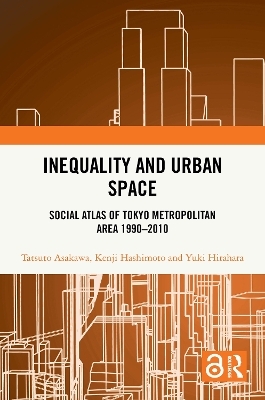
Inequality and Urban Space
Routledge (Verlag)
978-1-032-85126-6 (ISBN)
Asakawa, Hashimoto and Hirahara explores the widening inequality and its social consequences in Tokyo Metropolitan area by using two approaches, one from social class and social stratification theory and the other from urban sociology.
The book uses social atlases to visualize the socio-spatial structure of Tokyo, the most populous metropolitan area in the world using the analysis from the 1990, 2000 and 2010 National Census data. Until the 1970s, Japanese society had relatively small economic disparity between social classes. Today, Japan is a society of great inequality, with a huge number of people with low socio-economic status and many problems caused by poverty. The socio-spatial structure of thirty years of widening inequality in the metropolitan Tokyo area, which is fraught with many social problems, such as urban polarization, emergence of underclasses and health disparities are explored in this book. The structure and dynamics of class disparities among Tokyo Metropolitan area residents is also analyzed. Overall, this book visualizes three decades of widening inequality.
A vital resource for researchers, graduate students, undergraduates, urban policy makers and urban planners who are interested about Tokyo as a metropolis in East Asia and those keen on understanding the widening inequality and its social consequences in Tokyo Metropolitan area.
The Introduction and Chapter 3 of this book is freely available as a downloadable Open Access PDF at http://www.taylorfrancis.com under a Creative Commons Attribution-Non Commercial-No Derivatives (CC BY-NC-ND) 4.0 license.
Tatsuto Asakawa is a Professor of Faculty of Human Sciences at Waseda University. Kenji Hashimoto is a Professor of Faculty of Human Sciences at Waseda University. Yuki Hirahara is an Assistant Teacher of Faculty of Human Sciences at Waseda University.
Table of Contents
Introduction. Inequality and Urban Space: Tasks and Methods
1. Scope and Origin of Tokyo
2. Changes to the Spatial Structure of Tokyo’s 23 Wards Over Time
3. Time Difference Gentrification and the Changing Spatial Structure in the 23 Wards of Tokyo
4. Changes in the Spatial Structure of the Tokyo Metropolitan Area
5. Class composition and spatial structure in the Tokyo Metropolitan Area
6. Spatial structure of economic inequality in the Tokyo Metropolitan Area and how it has changed over time
7. Living Areas and Social Capital
Bibliography
Index
| Erscheinungsdatum | 26.03.2025 |
|---|---|
| Zusatzinfo | 14 Tables, black and white; 11 Line drawings, black and white; 93 Halftones, black and white; 104 Illustrations, black and white |
| Verlagsort | London |
| Sprache | englisch |
| Maße | 156 x 234 mm |
| Gewicht | 440 g |
| Themenwelt | Naturwissenschaften ► Geowissenschaften ► Geografie / Kartografie |
| Sozialwissenschaften ► Soziologie ► Mikrosoziologie | |
| ISBN-10 | 1-032-85126-0 / 1032851260 |
| ISBN-13 | 978-1-032-85126-6 / 9781032851266 |
| Zustand | Neuware |
| Informationen gemäß Produktsicherheitsverordnung (GPSR) | |
| Haben Sie eine Frage zum Produkt? |
aus dem Bereich