


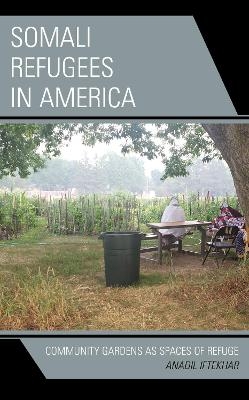
Somali Refugees in America
Community Gardens as Spaces of Refuge
Seiten
2025
Lexington Books (Verlag)
978-1-6669-6355-7 (ISBN)
Lexington Books (Verlag)
978-1-6669-6355-7 (ISBN)
This study, based at a community garden in a small town in Minnesota, explores different factors that affect the acculturation process of twenty Somali refugee women. Using Berry’s framework of acculturation patterns, the study also looks at how social capital complements the process of acculturation.
This study looks at the acculturation and social capital of twenty Somali refugee women participating in a community garden in a small town in Minnesota. The women had all been refugees at some point, even if they did not enter the US as a refugee. Using phenomenological interviews to gather the data, the author draws on Berry’s framework and juxtaposes it against two other models of acculturation. Doing so allows the exploration of the pros and cons of each model and then offer suggestions for more holistic approaches to understanding and measuring acculturation. There are many aspects of life in the U.S. that were new to the Somali women such as driving, adult education, employment opportunities, and maintaining culture. Through many support systems, and efforts at keeping Somali culture intact through food and religion, along with the language barrier, the women adjusted to life in America. Participation at the community garden was an important part of their daily routine (even if only during the short growing season), giving the women agency, independence and the ability to create something and be on their own. In essence, the garden functioned as a mini-Somalia for them, providing not only a means of acculturation and accumulation of social capital, but a place of bonding.
This study looks at the acculturation and social capital of twenty Somali refugee women participating in a community garden in a small town in Minnesota. The women had all been refugees at some point, even if they did not enter the US as a refugee. Using phenomenological interviews to gather the data, the author draws on Berry’s framework and juxtaposes it against two other models of acculturation. Doing so allows the exploration of the pros and cons of each model and then offer suggestions for more holistic approaches to understanding and measuring acculturation. There are many aspects of life in the U.S. that were new to the Somali women such as driving, adult education, employment opportunities, and maintaining culture. Through many support systems, and efforts at keeping Somali culture intact through food and religion, along with the language barrier, the women adjusted to life in America. Participation at the community garden was an important part of their daily routine (even if only during the short growing season), giving the women agency, independence and the ability to create something and be on their own. In essence, the garden functioned as a mini-Somalia for them, providing not only a means of acculturation and accumulation of social capital, but a place of bonding.
Anadil Iftekhar received her PhD from the University of Missouri, Columbia, in December.
Acknowledgments Introduction Chapter 1: Somali Life in America Chapter 2: Putting the Community in the Garden Chapter 3: To Become American or Not? Conclusion: How to Talk about the Displaced Appendix: Questionnaire for the Interviews Bibliography Index About the Author
| Erscheinungsdatum | 22.02.2025 |
|---|---|
| Zusatzinfo | 2 tables |
| Sprache | englisch |
| Maße | 152 x 229 mm |
| Themenwelt | Sozialwissenschaften ► Ethnologie |
| Sozialwissenschaften ► Politik / Verwaltung | |
| Sozialwissenschaften ► Soziologie | |
| ISBN-10 | 1-6669-6355-0 / 1666963550 |
| ISBN-13 | 978-1-6669-6355-7 / 9781666963557 |
| Zustand | Neuware |
| Informationen gemäß Produktsicherheitsverordnung (GPSR) | |
| Haben Sie eine Frage zum Produkt? |
Mehr entdecken
aus dem Bereich

aus dem Bereich
Prolegomena zu einer Geschichte der Magie
Buch | Hardcover (2025)
Matthes & Seitz Berlin (Verlag)
CHF 53,20
ethnographische Texte
Buch | Hardcover (2025)
Konstanz University Press (Verlag)
CHF 36,40
Buch | Softcover (2024)
Königshausen u. Neumann (Verlag)
CHF 39,20


