


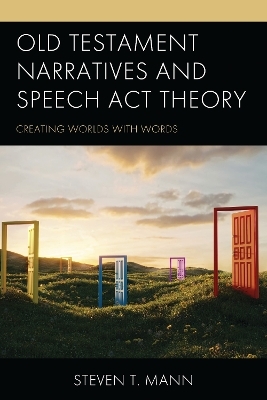
Old Testament Narratives and Speech Act Theory
Creating Worlds with Words
Seiten
2025
Lexington Books/Fortress Academic (Verlag)
978-1-9787-1686-5 (ISBN)
Lexington Books/Fortress Academic (Verlag)
978-1-9787-1686-5 (ISBN)
Old Testament Narratives and Speech Act Theory explores the ways in which words can create worlds within Old Testament narratives. Whereas characters can use their words in particular ways to impact the imaginations of their listeners, the storyteller attempts to transform the audience with the world(s) of the narrative.
Old Testament Narratives and Speech Act Theory explores the creative power of words in Old Testament narratives. While the most famous example of this phenomenon might involve divine utterances such as, “Let there be light” (Gen. 1:1), Steven T. Mann argues that human characters can also create worlds with their words in an attempt to influence the imaginations, and therefore actions, of their listeners. This study focuses on the performative nature of speeches that are found in several key Old Testament narratives, including Genesis 4:1-26; 18:16-33, Exodus 1:8-22; 32:1-14, Numbers 13–14, 2 Samuel 7:1-17, Amos 7:1-6, and Jonah 2:1-10; 4:2-3. Within these narratives, characters use their words to create competing worlds that clash as they attempt to advance their own agendas. The storyteller’s portrayal of these narrative worlds invites the audience to incorporate viewpoints of certain characters into their own world.
Old Testament Narratives and Speech Act Theory explores the creative power of words in Old Testament narratives. While the most famous example of this phenomenon might involve divine utterances such as, “Let there be light” (Gen. 1:1), Steven T. Mann argues that human characters can also create worlds with their words in an attempt to influence the imaginations, and therefore actions, of their listeners. This study focuses on the performative nature of speeches that are found in several key Old Testament narratives, including Genesis 4:1-26; 18:16-33, Exodus 1:8-22; 32:1-14, Numbers 13–14, 2 Samuel 7:1-17, Amos 7:1-6, and Jonah 2:1-10; 4:2-3. Within these narratives, characters use their words to create competing worlds that clash as they attempt to advance their own agendas. The storyteller’s portrayal of these narrative worlds invites the audience to incorporate viewpoints of certain characters into their own world.
Steven T. Mann is associate professor of biblical and theological studies at Azusa Pacific Seminary, Azusa Pacific University.
Chapter One: Speech Act Theory and Biblical Narrative
Chapter Two: A Clash of Imaginations in Genesis 4
Chapter Three: Prayerful Imaginations: The Power of “Perhaps” (Genesis 18:16-33; Exodus 32:1-14; Amos 7:1-6)
Chapter Four: Predatory and Protective Worlds in Exodus 1:8-22
Chapter Five: Imagining the Land: A Duel of Descriptions in Numbers 13–14
Chapter Six: Imagining the Temple (2 Samuel 7:1-17)
Chapter Seven: Performative Prayers of a Prophet (Jonah 2:1-10 [2-11]; 4:2-3)
Chapter Eight: How to Do Things with Worlds
| Erscheinungsdatum | 31.12.2024 |
|---|---|
| Zusatzinfo | 27 Tables |
| Sprache | englisch |
| Maße | 152 x 229 mm |
| Themenwelt | Religion / Theologie ► Christentum ► Bibelausgaben / Bibelkommentare |
| Religion / Theologie ► Christentum ► Kirchengeschichte | |
| Geisteswissenschaften ► Religion / Theologie ► Judentum | |
| Geisteswissenschaften ► Sprach- / Literaturwissenschaft ► Anglistik / Amerikanistik | |
| Geisteswissenschaften ► Sprach- / Literaturwissenschaft ► Literaturwissenschaft | |
| Sozialwissenschaften ► Pädagogik | |
| ISBN-10 | 1-9787-1686-9 / 1978716869 |
| ISBN-13 | 978-1-9787-1686-5 / 9781978716865 |
| Zustand | Neuware |
| Informationen gemäß Produktsicherheitsverordnung (GPSR) | |
| Haben Sie eine Frage zum Produkt? |
Mehr entdecken
aus dem Bereich


aus dem Bereich
Buch | Softcover (2021)
De Gruyter (Verlag)
CHF 44,90


