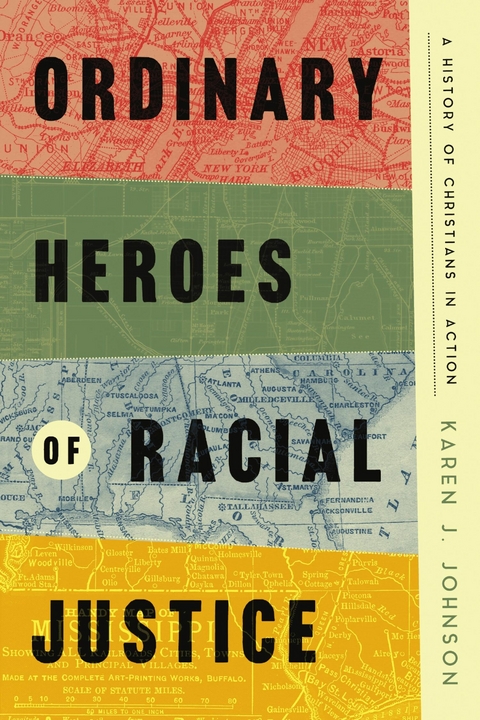
Ordinary Heroes of Racial Justice (eBook)
352 Seiten
IVP Academic (Verlag)
978-1-5140-1000-6 (ISBN)
Karen J. Johnson (PhD, University of Illinois at Chicago) is professor of history and chair of the history department at Wheaton College. Her expertise is in the history of religion and race in America. She is the author of One in Christ: Chicago Catholics and the Quest for Interracial Justice and coeditor of Understanding and Teaching Religion in US History.
Karen J. Johnson (PhD, University of Illinois at Chicago) is professor of history and chair of the history department at Wheaton College. Her expertise is in the history of religion and race in America. She is the author of One in Christ: Chicago Catholics and the Quest for Interracial Justice and coeditor of Understanding and Teaching Religion in US History.
Introduction
A SHORT STORY
Race has mattered throughout American and American church history, and it continues to shape our lives in ways we may not even see. Some Christians in America have carried racial burdens more heavily than others. But today no Christian in America, no matter their racial background, can ignore race. This is a gift from God, a moment when we, the church in all its diversity, can seek justice and righteousness in all their fullness. We must not let this moment pass.
At least for some White Christians, including me, it has not always been this way. Based on factors such as where and when we have lived, we have been able to be blind to race in America. When I grew up in the suburbs of Chicago, the place where I lived and the circles in which I traveled limited my ability to see that race mattered. Had you asked me, a White person living in a mostly White, middle- and upper-class suburb, whether I thought race still affected people’s experiences in America, I would have been puzzled by the question. Perhaps race affected people somewhere else, but not in my town. Things were peaceful there, and the racial minorities for the most part seemed very successful. And yet, my context was profoundly shaped by race. By context, I mean the place where I lived, the economic systems that enabled it to be as it was, the social norms, and even the evangelical Christian church where we worshiped. But because it was so homogenous and because the day-to-day patterns of my life were focused on other things, I assumed race did not matter.
Often we need to be with people we can trust to feel free enough to reconsider our core beliefs. For me, the secular liberal arts college I attended was not that safe space. My church, like most White evangelical churches in the 1980s and 1990s, implicitly taught me to mistrust those Christians who worked for what they called social justice because I understood that they held to a false gospel, the social gospel. While I could not have defined what the social gospel was precisely, I thought it was concerned more with people’s bodies than with their souls, and I thought true Christians cared about people’s spiritual relationships with God, which was somehow separated from questions of physical suffering. What I did not know was that my vague fear had a history, that my tendency toward concern only for a person’s soul at the expense of their body was the result of complicated historical dynamics from nearly one hundred years prior. Nor did I know that generations of Christians—for thousands of years—had cared for people’s eternal and temporal needs. As a Christian without knowledge of the history of those faithful followers who had lived before me, I was stranded in the present, unable to see that God’s people should care about salvation and shalom, by which I mean the restoration of all things to the way God meant them to be. Therefore, I doubled down into my own personal righteousness.
My time at this secular college gave me many gifts, however, and one of the most important was a hard-won conviction that Christians need not fear ideas. When I read biblical higher criticism for a class on the New Testament, which did not assume Scripture’s inerrancy and explained away Jesus’ divinity, I was plagued with fear. Perhaps my faith was founded on lies and I could not trust that Scripture was God’s Word. But God used a fellow Christian who lived about sixteen hundred years ago to help restore my faith when I took a philosophy class the next term. We read Augustine, that great father of the faith, who proclaimed that all truth is God’s truth. As I prayed that term, my fear dissipated. If all truth is God’s truth, then I do not need to fear what I might learn. God can handle it, and he will lead me into truth.
This freedom to explore and confidence in God’s superiority and sovereignty was a gift I carried to the evangelical seminary where I worked on my master’s degree. There, finally in a place where I could trust my teachers more fully, God taught me something new, something that now seems so obvious but then was fresh and amazing: because race matters in American life, the church, Jesus’ body on earth, needs to address it. Even more, Satan has used race to cripple the church’s witness to the world, fostering injustice and disunity. In seminary, God gave me eyes to see what had been there in plain sight. He gave me ears that heard and a mind that began to understand. And he gave me a call to speak to the body of Christ about what I was learning, to call my brothers and sisters of all hues into a messy, uncomfortable journey to help each other live out the unity Jesus already won for us on the cross.
THREE BITS OF WISDOM
I want to highlight three bits of wisdom derived from the journey I just described that can help us repent, which in the biblical Greek derives from a term meaning “to turn.” They are (1) to ask how our context shapes us, (2) to recognize that we are historical beings, and (3) to practice courage in the process.
First, we all live in contexts that affect our ability to see the world. My context growing up blinded me to race’s power in America. Like many people, I was so immersed in my context that I could not see how it was blinding me to what was actually happening. A joke about fish can illustrate this dynamic. It goes like this: “There are these two young fish swimming along, and they happen to meet an older fish swimming the other way, who nods at them and says, ‘Morning, boys. How’s the water?’ And the two young fish swim on for a bit, and then eventually one of them looks over at the other and goes, ‘What the hell is water?’”1
Part of growing in wisdom is realizing that we live in water and then understanding the character of that water. Christian life and worship are meant to be lived in our contexts, lived in the water where we swim. But our lives and worship as Christians, which extend well beyond church walls, also contain the power to transform our contexts because they should be transcultural and intercultural, reflecting the nature of the body of Christ. This book is meant to help us see our contexts better.
How can we begin to see more clearly? The answer to this question is the second nugget of truth from my story: history can help us see our contexts more clearly so we can better serve God faithfully in our generation. Studying history can give us what historians call a historical consciousness, the gift of seeing how things came to be as they are. Essentially, we can see that our present assumptions and ways of living have a history, and although they seem normal and perhaps inevitable, they are not. Rather, as cocreators with Christ, people God has put on this earth to be his hands and feet, we can make changes in the present so that our generation and our children’s children can live differently. In this book, I will use history to help us see the water in which we swim. As we read about those from different eras and see our contexts more clearly, we also avoid what the British author and apologist C. S. Lewis calls “chronological snobbery,” the belief that those of us living are better than and know more than those who are dead.2 I believe we have much to learn from Christians who have lived before us, and this book offers a handful of men and women whose faith transformed their contexts.
This process of beginning to see requires courage. But, and here is the third key point, we have a faith that calls us to courage, not to fear. God is bigger than all we know, and he can handle our questions and our fumbling. Therefore, Christians need not fear the insights secular disciplines can offer. Nor should we fear the insights of those who are not believers. God’s common grace falls on all people. We want to have our eyes open wide and to probe how our faith addresses the joys and sorrows of our time. As we do this, we should expect that God will teach us new things, that some of the assumptions—shaped by our historical contexts and our sin—that have undergirded our lives will be uprooted as he conforms us to the image of Christ. Trying to understand race in America as we seek to love God and love others takes courage. But, as Paul reminded Timothy, God has not given us a spirit of fear, but of power, love, and self-discipline (2 Timothy 1:7).
I write as an evangelical Christian who is a professional historian. I am a born-again Christian who believes in Jesus’ divinity and that his death on the cross atoned for my sins. I believe that people must be converted and that Scripture is God’s inerrant word. I believe that our faith must be lived out, not just held as a set of beliefs. My journey of following Jesus into the tangle of race in America brought me into a mostly Black neighborhood on Chicago’s west side, where fellow members of an interracial church patiently taught me about racial reconciliation and God’s love. That journey also brought me to graduate school to study race and urban history, and then back to the suburbs to teach at an evangelical Christian college, where I learned from the best about how to weave together my faith with the discipline of history. I have come to believe that understanding the past with love can help us love our neighbors better in the present and bless our children’s children, to a thousand generations. As a Christian and a historian, I wonder a lot. I do not know everything, but I can ask good questions. This book is the fruit of those questions, of wondering about race, God, and the church in US history.
WHY READ THIS...
| Erscheint lt. Verlag | 29.7.2025 |
|---|---|
| Verlagsort | Lisle |
| Sprache | englisch |
| Themenwelt | Religion / Theologie ► Christentum ► Kirchengeschichte |
| Sozialwissenschaften ► Politik / Verwaltung | |
| Schlagworte | African American • BIPOC • calvary • Catherine • Chicago • Circle Urban Ministries • Civil Rights • Clarence Jordan • Faith • Friendship House • Georgia • Huekck • Interracial • Jimmy Carter • John Perkins • Koinonia Farm • Mississippi • New York • Rock of Our Salvation Church • Voice |
| ISBN-10 | 1-5140-1000-3 / 1514010003 |
| ISBN-13 | 978-1-5140-1000-6 / 9781514010006 |
| Informationen gemäß Produktsicherheitsverordnung (GPSR) | |
| Haben Sie eine Frage zum Produkt? |
 EPUB (Wasserzeichen)
DRM: Digitales Wasserzeichen
Dieses eBook enthält ein digitales Wasserzeichen und ist damit für Sie personalisiert. Bei einer missbräuchlichen Weitergabe des eBooks an Dritte ist eine Rückverfolgung an die Quelle möglich.
Dateiformat: EPUB (Electronic Publication)
EPUB ist ein offener Standard für eBooks und eignet sich besonders zur Darstellung von Belletristik und Sachbüchern. Der Fließtext wird dynamisch an die Display- und Schriftgröße angepasst. Auch für mobile Lesegeräte ist EPUB daher gut geeignet.
Systemvoraussetzungen:
PC/Mac: Mit einem PC oder Mac können Sie dieses eBook lesen. Sie benötigen dafür die kostenlose Software Adobe Digital Editions.
eReader: Dieses eBook kann mit (fast) allen eBook-Readern gelesen werden. Mit dem amazon-Kindle ist es aber nicht kompatibel.
Smartphone/Tablet: Egal ob Apple oder Android, dieses eBook können Sie lesen. Sie benötigen dafür eine kostenlose App.
Geräteliste und zusätzliche Hinweise
Buying eBooks from abroad
For tax law reasons we can sell eBooks just within Germany and Switzerland. Regrettably we cannot fulfill eBook-orders from other countries.
aus dem Bereich