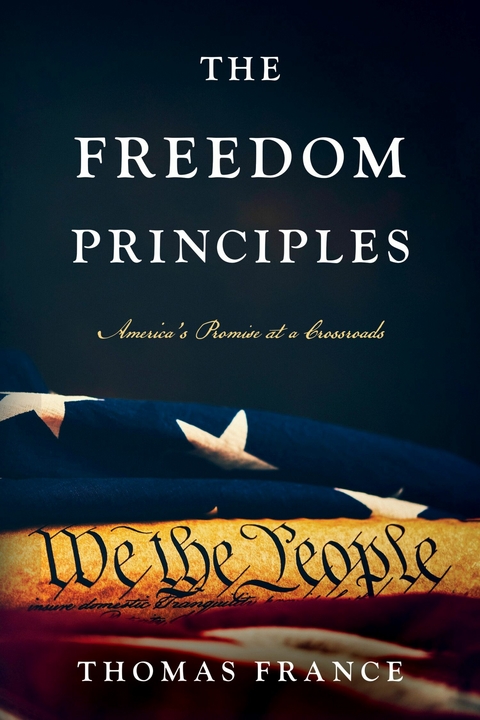
Freedom Principles (eBook)
164 Seiten
Bookbaby (Verlag)
979-8-3509-7606-9 (ISBN)
Thomas France is a lawyer, author, husband, and father of three who was born and raised in Corvallis, Oregon. He graduated from Oregon State University and Washington and Lee University Law School. Tom is a corporate attorney and has represented Fortune 500 corporations, small businesses, and individual entrepreneurs in a variety of business transactions for 28 years. He lives in the Virginia suburbs of Washington, D.C., with his family. Tom wrote 'The Freedom Principles: America's Promise at a Crossroads' because America has kept its promise to him. Although he is an unremarkable man in most respects, his journey has been remarkable. He is a corporate lawyer, living an upper middle-class life in the suburbs of Washington, DC, yet he is just one generation removed from the poverty and isolation of the Ozark Mountains and the hardscrabble life of rural, small-town Iowa. His American dream has been made possible by the unconditional love and support of family, certain fundamental values and principles that have shaped and guided his life, and the power and inspiration of America's promise of freedom and democracy.
"e;A rousing aspirational assessment of American values."e; - Kirkus ReviewsCan America rediscover hope and optimism and revitalize its promise of freedom and democracy? This promise is powerful and inspirational freedom unleashes our human potential by incentivizing us to maximize our spiritual, emotional, intellectual, and physical potential, and democracy is the only viable means for free people to collectively give their consent to be governed. But nearly 250 years into America's audacious experiment, its promise of freedom and democracy is at a crossroads, stalemated by the fear, anger, and division that has swamped our public life. In this memoir, Thomas France suggests a path for reinvigorating America's promise through a renewed appreciation of and commitment to certain fundamental principles that empower our freedom: Fairness, Responsibility, Engagement, Enterprise, Discipline, Opportunity, and Morality. France explores the impact that each of these principles has had on his life and illustrates how they can inform and guide our individual lives and support our collective relationships by providing a platform of common understanding and values that can help us better navigate our differences and disagreements. Embracing these principles gives us the strength to resist fear, anger, and hate; it allows us to solve problems and find success; it enables freedom to be a way of life, not just a slogan. With a renewed personal commitment to these freedom principles, we can overcome our fears, begin to heal some of our divisions, become more comfortable trusting ourselves and our fellow citizens, and work more purposefully and effectively in pursuit of our individual happiness. We can rediscover our hope and optimism and write a new chapter of the American story that recognizes freedom and democracy as our shared American value.
1
A Journey in Search of America’s Promise
The young couple stared apprehensively at the ship that would carry them on their long, possibly perilous, journey. They contemplated the challenges and difficulties of the more than three-thousand-mile trip that was ahead of them, but their thoughts focused more on what they were leaving behind. Their love and marriage had upended their lives in so many ways that they never imagined when they first met.
Thomas William France was a fortunate son of the nineteenth-century English class system. He was born on New Year’s Day 1832 in Lancashire County, England, into a family that owned a large amount of land. Unlike most English children of that era, he was raised in the cocoon of wealth, comfort, education, and social status that land ownership provided. So long as he adhered to the rules and expectations of his privileged class, he would have access to social and economic opportunities available to only a few people.
Alice Carter was not so fortunate. She was born into a poor family tethered to the English lower class, destined for a life of poverty and few options. Education was unavailable, work was menial, and social relationships were prescribed and constrained. Her course in life was determined for her by her birth. Who she wanted to be and what she wanted to do with her life were not relevant; her destiny was not for her to decide.
Thomas William France and Alice Carter were not supposed to fall in love. They were from different worlds that were not permitted to commingle. Loving each other and pursuing a life together was a breach of their social obligations; it was a rejection of the rules and norms that determined who they could love and marry. Their love was an affront to the society in which they existed.
The France family would never recognize the love that had drawn Thomas and Alice to each other and would never accept their desire to be together. Thomas William’s father made clear to his son that marrying a poor, illiterate woman from a lower social class was not an option, regardless of how honestly Thomas believed he had found the love of his life. Love, no matter how authentic, could not supersede the rigors of the social order. The rules and norms of the order determined who you could love and be with, and there was no one in his family who Thomas could turn to for support and understanding. His mother had passed away and his father had remarried a woman with her own children who was incentivized to ensure her children would have a share of the France family estate. The stepmother had seized on the opportunity to exploit the wedge between Thomas and his father over the relationship with Alice. She had fanned the flames of fear about the damage the scandalous relationship would inflict on the family’s reputation and had eagerly encouraged the ultimatum her husband delivered to his son: end the relationship at once and forever or lose his inheritance.
The social order that prohibited Thomas and Alice from loving each other was a human creation, but it violated human nature. It sought to smother the innate human desire to determine one’s happiness and destiny. For generations, that social order had exercised control over all aspects of human life—family and social relationships, economic opportunity, worship, civic obligations—but it was operating on borrowed time because it was at war with perhaps the most essential element of the human condition: the yearning to breathe free.
Thomas William France was born into a social class that provided the comfort and security of wealth and opportunity, but the price for that comfort and security was too steep for him to pay. He was not willing to relinquish the core of his human freedom, even if retaining that freedom would cost him his inheritance, social standing, and even his family. He would reject everything he was supposed to value in order to retain the freedom to be with the woman he loved.
Alice Carter also would reject the edicts of the social order into which she was born. She would not let it determine the value and possibility of her life and would not allow it to discourage her from one day teaching herself to read and write and from becoming a strong, independent woman. And she would not accept its judgment that she was not worthy of the love of Thomas William France. She may have been born into a poor family that was the product of the English lower class, but that would not define who she was or who she could be.
Thomas and Alice took each other by the hand as they continued to stare at the ship. They were on the precipice of leaving much behind them: a society that was constraining but familiar and secure; a future that was limited but mostly predictable; friends and family they never would see again. The journey ahead would be unfamiliar, unsecure, and unpredictable, and everyone they would engage with on this new journey would be a stranger. But the journey before them promised hope and opportunity; it promised a life not determined for them by their birth but a destiny they could mold with their ability, their industry and their character; it promised to satisfy their yearning to breathe free; it promised the pursuit of happiness together.
They were apprehensive, but they were resolute as they began walking together, hand-in-hand, to board the ship that would carry them on their journey across the waters of the Atlantic Ocean to the shores of America. There would be no turning back from their shared journey in search of America’s promise of freedom and democracy.
America’s Promise at a Crossroads
The United States of America was founded on an audacious promise, boldly proclaimed in its Declaration of Independence:
“We hold these truths to be self-evident, that all men are created equal, that they are endowed by their Creator with certain unalienable Rights, that among those are Life, Liberty, and the pursuit of Happiness. That to secure these rights, Governments are instituted among Men, deriving their just powers from the consent of the governed.”
This bold Declaration, radical for the time in which it was made, promised that the United States of America would ensure the right of Americans to be free human beings and to collectively have the ultimate voice in preserving that right. America’s founding promise forever linked freedom and democracy.
As the Declaration of Independence recognized, this promise is powerful and inspirational because it reflects fundamental truths. Freedom unleashes our human potential by incentivizing us to maximize our spiritual, emotional, intellectual, and physical potential, and democracy is the only viable means for free people to collectively give their consent to be governed. Together, freedom and democracy are our guiding light.
America has never lived up to its audacious promise. Throughout our history, ordinary men and women have done the work and made the sacrifices that have fueled America’s growth, security, and prosperity, even as many of them have been denied its promise of freedom and democracy because of their race, gender, religion, ethnicity, economic class, education, or social status. But these Americans did not give up on the struggle for freedom and democracy. The struggle to expand America’s promise to all of its people has been the essential and enduring arch of the American story, and this struggle’s successes have produced the broadest and greatest harvest of human happiness in history. It has been long, difficult, and chaotic—and often unjust, bloody, and brutal—and it has encountered many crossroads that have threatened to derail the promise. But America’s promise has endured.
I have been blessed by America’s promise of freedom and democracy, but I did not truly begin to understand and appreciate this blessing until 2016. In March of that year, my mom died after a lengthy battle with Alzheimer’s, and my dad would pass away a little more than a year later. Evelyn France was the strongest, most independent person I have ever known. She was born in a cabin in the Ozark Mountains and although she shared few details of her childhood, it was one of abject poverty and constant struggle. Her mom died of tuberculosis when Mom was a little girl, and her older brothers basically raised her while her father worked manual labor jobs and struggled with his own demons. The family eventually settled in Independence, Missouri, and continued to scrape by as best they could. Mom moved out on her own her senior year in high school and rented an apartment in a rough neighborhood of Kansas City. She went to school during the day and worked as a waitress at a diner in the evenings, yet she still managed to do well enough in school to make the National Honor Society and get admitted to Graceland College in Lamoni, Iowa.
It was at Graceland that Mom met Thomas Traxler France. Dad was born and raised in Lamoni, a small farming town in southern Iowa, near the Missouri border. He was the son of a U.S. postman, and although his upbringing certainly was more stable and comfortable than Mom’s, his family was by no means wealthy and faced the typical struggles and challenges of making ends meet in rural America. Like Mom, Dad also was tremendously strong-willed and determined, although I never really grasped this until the last years of his life.
I did not fully appreciate how much my parents meant to me and how much they did for me until they were gone. They were solid, quiet, down-to-earth, unpretentious people who lived solid, quiet, down-to-earth, unpretentious lives. Their story is the story...
| Erscheint lt. Verlag | 20.1.2025 |
|---|---|
| Sprache | englisch |
| Themenwelt | Sozialwissenschaften ► Politik / Verwaltung |
| ISBN-13 | 979-8-3509-7606-9 / 9798350976069 |
| Informationen gemäß Produktsicherheitsverordnung (GPSR) | |
| Haben Sie eine Frage zum Produkt? |
 EPUB (Ohne DRM)
Größe: 3,7 MB
Digital Rights Management: ohne DRM
Dieses eBook enthält kein DRM oder Kopierschutz. Eine Weitergabe an Dritte ist jedoch rechtlich nicht zulässig, weil Sie beim Kauf nur die Rechte an der persönlichen Nutzung erwerben.
Dateiformat: EPUB (Electronic Publication)
EPUB ist ein offener Standard für eBooks und eignet sich besonders zur Darstellung von Belletristik und Sachbüchern. Der Fließtext wird dynamisch an die Display- und Schriftgröße angepasst. Auch für mobile Lesegeräte ist EPUB daher gut geeignet.
Systemvoraussetzungen:
PC/Mac: Mit einem PC oder Mac können Sie dieses eBook lesen. Sie benötigen dafür die kostenlose Software Adobe Digital Editions.
eReader: Dieses eBook kann mit (fast) allen eBook-Readern gelesen werden. Mit dem amazon-Kindle ist es aber nicht kompatibel.
Smartphone/Tablet: Egal ob Apple oder Android, dieses eBook können Sie lesen. Sie benötigen dafür eine kostenlose App.
Geräteliste und zusätzliche Hinweise
Buying eBooks from abroad
For tax law reasons we can sell eBooks just within Germany and Switzerland. Regrettably we cannot fulfill eBook-orders from other countries.
aus dem Bereich