


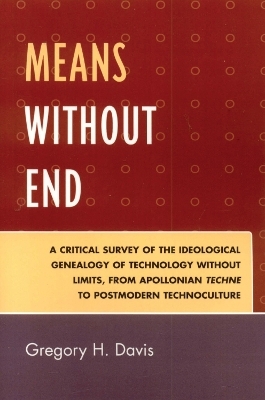
Means Without End
A Critical Survey of the Ideological Genealogy of Technology without Limits, from Apollonian Techne to Postmodern Technoculture
Seiten
2006
University Press of America (Verlag)
978-0-7618-3485-4 (ISBN)
University Press of America (Verlag)
978-0-7618-3485-4 (ISBN)
Starting with the Apollonian Greek theory of techne, this book presents a history of transformations of ideas about technology, viewed within their philosophical, theological, and scientific contexts. It focuses on the ideological genealogy of technology without limits and finds its cultural roots in Christian theology.
Means without End is based on a recognition that contemporary technology is without limits in both a practical and an ideological sense. In following the historical evolution of ideas about technology in Western culture and situating them in the philosophical, theological, and scientific ideological contexts in which they emerged, this work examines a development that has radically altered the conditions of contemporary existence.
The analysis, critical at all points, begins with the Apollonian Greek techne of limits and situates the ideological roots of technology without limits in Christian theology of the Patristic and Medieval periods. Other highlights include ideological underpinnings of the Scientific Revolution and its implications for philosophy and technology; the formulation by Enlightenment philosophes of a secular, technology-promoting theory of progress, their critique of received ideas, and Rousseau's radical stance vis-à-vis progress and technology; Marx's technology-based theory of dialectical materialism, the development of the philosophy of will and the idea of autonomous art, and Nietzsche's eventual proclamation of nihilism in the 19th Century; and the emergence of technology without limits in the 20th Century, reflected in the German reactionary modernists' theory of autonomous technology, Ellul's and Marcuse's critique of the "technological society" after World War II, and Virilio's pessimistic assessment of postmodern technoculture.
Means without End is based on a recognition that contemporary technology is without limits in both a practical and an ideological sense. In following the historical evolution of ideas about technology in Western culture and situating them in the philosophical, theological, and scientific ideological contexts in which they emerged, this work examines a development that has radically altered the conditions of contemporary existence.
The analysis, critical at all points, begins with the Apollonian Greek techne of limits and situates the ideological roots of technology without limits in Christian theology of the Patristic and Medieval periods. Other highlights include ideological underpinnings of the Scientific Revolution and its implications for philosophy and technology; the formulation by Enlightenment philosophes of a secular, technology-promoting theory of progress, their critique of received ideas, and Rousseau's radical stance vis-à-vis progress and technology; Marx's technology-based theory of dialectical materialism, the development of the philosophy of will and the idea of autonomous art, and Nietzsche's eventual proclamation of nihilism in the 19th Century; and the emergence of technology without limits in the 20th Century, reflected in the German reactionary modernists' theory of autonomous technology, Ellul's and Marcuse's critique of the "technological society" after World War II, and Virilio's pessimistic assessment of postmodern technoculture.
Gregory H. Davis is Professor of Humanities and Political Science at the College of San Mateo, California, where he has taught Technology, Contemporary Society, and Human Values for more than 25 years. He received his M.A. and B.A. from Stanford University. He is the author of Technology: Humanism or Nihilism, also from the University Press of America.
Part 1 Preface
Part 2 Introduction
Chapter 3 One: The Classical Greek Period
Chapter 4 Two: The Patristic and Medieval Period of Christian Culture
Chapter 5 Three: The Renaissance and The Scientific Revolution
Chapter 6 Four: The Enlightenment
Chapter 7 Five: The Nineteenth Century
Chapter 8 Six: The Twentieth Century
Part 9 Bibliography
Part 10 Index
Part 11 About The Author
| Erscheint lt. Verlag | 19.8.2006 |
|---|---|
| Verlagsort | Lanham, MD |
| Sprache | englisch |
| Maße | 165 x 228 mm |
| Gewicht | 349 g |
| Themenwelt | Sonstiges ► Geschenkbücher |
| Geisteswissenschaften ► Geschichte ► Allgemeine Geschichte | |
| Geisteswissenschaften ► Philosophie ► Ethik | |
| Sozialwissenschaften ► Soziologie | |
| ISBN-10 | 0-7618-3485-0 / 0761834850 |
| ISBN-13 | 978-0-7618-3485-4 / 9780761834854 |
| Zustand | Neuware |
| Informationen gemäß Produktsicherheitsverordnung (GPSR) | |
| Haben Sie eine Frage zum Produkt? |
Mehr entdecken
aus dem Bereich



aus dem Bereich
eine Reise um die Welt zu außergewöhnlichen Persönlichkeiten, …
Buch | Softcover (2023)
Piper (Verlag)
CHF 25,20
Eine wahre Geschichte von Schiffbruch, Mord und Meuterei
Buch | Hardcover (2024)
C.Bertelsmann (Verlag)
CHF 34,95


