Queens, Queenship, and Natural Resource Management in Premodern Europe, 1400-1800
Routledge (Verlag)
978-1-032-72305-1 (ISBN)
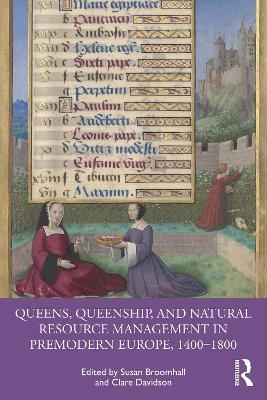
Early modern queens interacted with human and nonhuman worlds through natural resource management activities that have rarely been the focus of sustained historical analysis. This volume engages with the wide range of nonhuman materials, living and inanimate, that premodern queens had the power to direct and dispose of, to utilise, enjoy, and commercialise, to visualise and commemorate, and even to destroy, on and in their lands, forests, waterways, and oceans. Both queenship and natural resource management were configured by contemporary gender ideologies, which structured a dynamic relationship between queenship and the more-than-human world. The case studies in this collection explore how queens’ natural resource management was impacted by their cultural and personal contexts, particularly their changing status as queens regnant, consort, dowager, or regent. The contributors draw on diverse materials and employ a variety of historical approaches—including political, economic, cultural, literary, legal, and animal studies—to demonstrate how queens interacted with the nonhuman world and how their engagements were embedded in premodern gender rules.
This collection will be of great value for undergraduate and postgraduate students, and scholars, in gender and women’s history, environmental history, queenship studies, and early modern studies.
Susan Broomhall is the Director of the Gender and Women’s History Research Centre and Professor of Early Modern Studies at the Australian Catholic University. She researches women and gender in the early modern world, including the role of gender ideologies in premodern natural resource management. Clare Davidson is a research fellow at Australian Catholic University. She works on the medieval and early modern history of emotions, law, gender, and belief, and the reception of medieval and early modern history in contemporary law and politics.
1. Queens, Queenship, and Natural Resource Management in a More-than-Human Premodern World
Susan Broomhall and Clare Davidson
1. Preserving the queen’s resources, pressing ancient privileges: Joan of Navarre and the management of forest and park lands
Elena Woodacre
2. Bohemian Queens and the Management of the Royal Domain Estates in Medieval Times
Robert T. Tomczak
3. Sovereign Hybridities: Anne of Brittany, Claude of France and more-than-human resource management at the château of Blois
Susan Broomhall
4. Catherine of Aragon, the Forest and Hunting: Representations, Knowledge and Practices of a Foreign-Born Consort
Sally Fisher
5. Redefining Resource Stewardship in the Interest of the Dynasty: Bona Sforza’s Innovations in Poland and Lithuania
Darius von Güttner-Sporzyński
6. Catherine of Austria (1507–1578), Portuguese Colonialisation and the Brazilian Arara
Jessica O’Leary
7. Queen Elizabeth’s mineral grants: how corporate monarchy and corporate mining structured natural resource policy in late sixteenth-century England
Clare Davidson
8. Anna Jagiellon’s forest management: legal bases, methods of governance and exploitation
Agnieszka Pawłowska-Kubik
9. The Soapmakers and the Queen: The Rhetoric of Maternalism in the ‘Oil Affairs’ of late Sixteenth-Century England
Sarah Bendall
10. A Danish Queen as Industrial Entrepreneur: Charlotte Amalie of Hessen-Kassel and her Lands
Cathleen Sarti
11. Queen Charlotte and the colonies: Queenly agency in collecting Australia’s flora and fauna
Lorinda Cramer
| Erscheinungsdatum | 15.04.2025 |
|---|---|
| Zusatzinfo | 1 Line drawings, black and white; 13 Halftones, black and white; 14 Illustrations, black and white |
| Verlagsort | London |
| Sprache | englisch |
| Maße | 156 x 234 mm |
| Gewicht | 660 g |
| Themenwelt | Geschichte ► Allgemeine Geschichte ► Neuzeit (bis 1918) |
| Geisteswissenschaften ► Geschichte ► Regional- / Ländergeschichte | |
| Geschichte ► Teilgebiete der Geschichte ► Kulturgeschichte | |
| Sozialwissenschaften ► Politik / Verwaltung ► Staat / Verwaltung | |
| ISBN-10 | 1-032-72305-X / 103272305X |
| ISBN-13 | 978-1-032-72305-1 / 9781032723051 |
| Zustand | Neuware |
| Informationen gemäß Produktsicherheitsverordnung (GPSR) | |
| Haben Sie eine Frage zum Produkt? |
aus dem Bereich