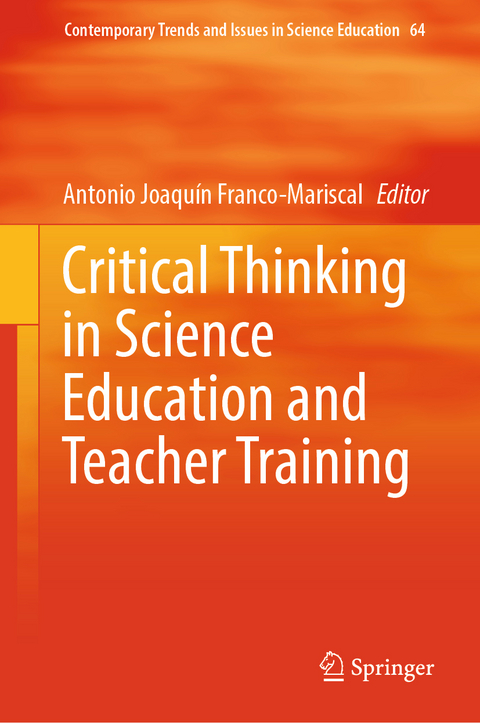
Critical Thinking in Science Education and Teacher Training
Springer International Publishing (Verlag)
978-3-031-78577-1 (ISBN)
This edited volume explores the challenge of fostering critical thinking (CT) skills in science education, presenting the ENCIC-CT model as a framework for development. Named after the Science Education and Competences (Enseñanza de las Ciencias y Competencias, ENCIC) research group at the University of Malaga, Spain, this model emphasizes cultivating CT through socio-scientific issues and daily-life problems. It includes three key domains: knowledge, skills, and dispositions, each encompassing various dimensions addressed through scientific practices like argumentation, inquiry, and modeling. Teaching strategies such as gamification, role-playing, micro-debates, augmented reality, controversy mapping, and digital storytelling are highlighted. Spanning theoretical perspectives and practical experiences from early childhood to higher education, this book consolidates findings from the Spanish R&D project, "Citizens with Critical Thinking: A Challenge for Teachers in Science Education." It is an essential resource for educators, researchers, and practitioners, offering valuable insights and practical applications for all educational levels.
Antonio Joaquín Franco-Mariscal is a science education professor at the University of Malaga, Spain. He leads 3 R&D projects, focusing on critical thinking, digital-ecological transition in science education, and mobile applications for scientific argumentation. He has received 2 innovation awards and 12 research awards in Spanish education. He is associate editor on the Revista Eureka board.
Chapter 1. Theoretical perspectives and approaches for the development of critical thinking.- Chapter 2. Fostering critical thinking in a socio-scientific issue on energy use.- Chapter 3. Development of Critical Thinking in a Historical Context: The Theory of Spontaneous Generation. Ana María Abril-Gallego, Marta Romero-Ariza, Antonio Quesada-Armenteros, and Cristina Cobo-Huesa.- Chapter 4. Personal Autonomy and Decision-Making in Early Childhood Education through the Naturalization of Spaces with the Think-Pair-Share Technique.- Chapter 5. The Comprehensive Treatment of the Urban Space Care Problem through Controversy Mapping in Architecture Students.- Chapter 6. Critical Analysis of Information on Pasteurization by High School Biology Students.- Chapter 7. Secondary School Students' Argumentation on Energy Production and Consumption.- Chapter 8. Argumentation by secondary school students in an inquiry about yogurt consumption.- Chapter 9. Enhancing Argumentation in Teacher Training through Debates within the Context of Formative Research in Uruguay.
| Erscheinungsdatum | 31.12.2024 |
|---|---|
| Reihe/Serie | Contemporary Trends and Issues in Science Education |
| Zusatzinfo | XXI, 320 p. 53 illus., 27 illus. in color. |
| Verlagsort | Cham |
| Sprache | englisch |
| Maße | 155 x 235 mm |
| Themenwelt | Sozialwissenschaften ► Pädagogik ► Erwachsenenbildung |
| Schlagworte | Argumentation in Science Education • Augmented Reality in Science Education • critical thinking • Critical Thinking and Early Childhood Science Education • Critical Thinking and Science Education in Primary School • Critical Thinking and Science Education in Secondary School • Critical Thinking and Science Teacher Training • Decision-Making in Science Education • Digital Storytelling in Science Education • Evidence Evaluation in Critical Thinking • Inquiry in Science Education • Role-playing in Science Education • socio-scientific issues • Toulmin’s argumentation model • Toulmin's Argumentation Model |
| ISBN-10 | 3-031-78577-0 / 3031785770 |
| ISBN-13 | 978-3-031-78577-1 / 9783031785771 |
| Zustand | Neuware |
| Informationen gemäß Produktsicherheitsverordnung (GPSR) | |
| Haben Sie eine Frage zum Produkt? |
aus dem Bereich