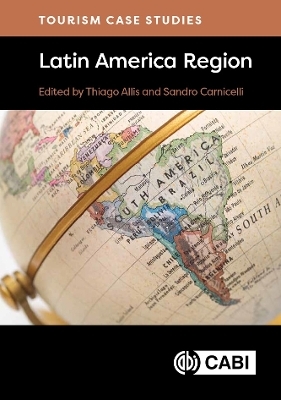
Tourism Case Studies Latin America Region
CABI Publishing (Verlag)
978-1-80062-853-3 (ISBN)
Latin America is a complex mosaic of nations, people and landscapes, with unique cultural, scenic and economic resources but with no more than 6% of global international tourist arrivals (World Bank, 2019). The region hosts several top international destinations - such as the Caribbean islands and the sacred city of the Incas, Machu Picchu (Peru). Cities like São Paulo and Mexico City are internationally known for their Meetings Incentives Conferences and Exhibitions (MICE) sector. Galapagos (Ecuador) and Fernando de Noronha (Brazil) are areas of significant ecological importance. However, even if some of the destinations are well known internationally, the region is still seen as an untouched source for tourism at global and regional scales. Moreover, the region is still underrepresented in international tourism literature and content for pedagogical and educational purposes still limited. This gap needs to be filled, to help inform tourism developments and to better educate the next generation. This can help shift students and practitioners away from an over-dependence on models and ideas developed and tested in different social and cultural settings that may not be appropriate for a Latin American context. Therefore, this book aims to bring together researchers, students, practitioners and other agents involved with research, teaching and the operation of tourism to share their research and work experiences in Latin America, in the form of case studies focusing on real-world examples.
Thiago Allis (Edited By) Thiago Allis is Associate Professor of Leisure and Tourism, at the School of Arts, Sciences and Humanities, at the University of São Paulo (EACH-USP). He has a degree in Tourism, a master's degree in Latin American Integration and a PhD in Architecture and Urban Planning. He leads the Mobility and Tourism Research Group (MobTur) and his teaching and research expertise cover tourism, urban tourism and tourism mobilities. He has academic backgrounds in Brazil and abroad (East Timor, Austria, Spain, UK). Sandro Carnicelli (Edited By) Sandro Carnicelli is a Professor of Tourism and Leisure Studies at the University of the West of Scotland and the Deputy Director of the Centre for Culture, Sport, and Events (CCSE). Sandro is an alumnus of the Royal Society of Edinburgh/Young Academy of Scotland, and a member of the ABRATUR (International Academy for the Development of Tourism Research in Brazil). As a researcher, Sandro has been working in the fields of Tourism, Events, and Leisure for almost 20 years. He has delivered funded projects for organisations such as the Carnegie Trust, UK Department of Transport, the Moffat Trust, The Higher Education Academy, and the UKRI-GCRF. He currently serves on the Editorial Board of Leisure Studies Journal, and Journal of Adventure Education and Outdoor Learning. He also acts as Associate Editor for Event Management Journal and is currently the Editor in Chief of the World Leisure Journal.
Section 1: Community Empowerment and Social Engagement in Tourism Chapter 1: Community-based tourism initiatives as a tool for empowering indigenous communities: Evidence from the Yucatan Peninsula, Mexico Chapter 2: 'We are a territory, a territory of struggles': Community and Resistance Tourism in a Territorial Museum on the outskirts of São Paulo Chapter 3: Tourism as a 'tecnologia social': the case of Ururay Group Chapter 4: Tourism Done by indigenous peoples and traditional communities in Brazil's first World Heritage Mixed Site Chapter 5: Public territorial governance and community-based tourism for sustainable local development: a case-study of Paraty/Brazil Chapter 6: Pretos que voam - An Afrocentric collective project to promote the access of peripheral black people to airline crew jobs in Brazil Section 2: Sustainability Challenges and Nature-Based Responses in Tourism Chapter 7: Birdwatching tourism in sustainable and accessible destinations: the case of the entrepreneurial venture Explora Caloccita in the Mexican Pacific coast Chapter 8: New Challenges for Nature-based Tourism in Patagonia Chapter 9: Sustainable Tourism in Galapagos: the perception of the stakeholders Chapter 10: Tourism Clusters, Nature Research and Visitor Experiences: the case of Fundación in Barranquilla, Colombian Caribbean Section 3: Culture and Heritage in Tourism Chapter 11: Cultural identity and tourism awareness of Rímac residents Chapter 12: Co-creation and developing the creative economy: The ‘Galo da Madrugada’ case Chapter 13: Real Argentinian food: Tensions and conflicts in value-added processes of products to commercialization and tourism Chapter 14: Looking Behind the Stage in a Beach Paradise: Taganga, Colombia Chapter 15: Qhapaq Ñan as World Heritage Site. New tourist destinations and inherited tensions in Argentina Chapter 16: Tourists Perceptions of Cultural Experiences In Heritage Hotels In Queretaro City Section 4: Destination management and tourism marketing Chapter 17: Nation Branding in Latin America: repositioning Brazil to reset its brand image Chapter 18: Traversing the Andes on the Most Beautiful Train in the World Chapter 19: Developing a rural tourism route through the integration of local stakeholders: challenges and opportunities for family farmers in Porto Seguro-Bahia (Brazil) Chapter 20: A city developed for (and by) tourism: Campos do Jordão (São Paulo, Brazil) Chapter 21: Placemaking Perspective And Determinants Of Tourism: A Case Study of A Creative Design City In Brazil Section 5: Economic Development and Policy in Tourism Chapter 22: Fiscal incentives for hotels in Buenos Aires City, Argentina Chapter 23: Impacts of capital investment in tourism infrastructure: The Case of the Kuélap’s Cable Car System Chapter 24: Conditional subsidies for domestic tourists: The case of PreViaje in Argentina Chapter 25: Buenos Aires youth tourism access policy Chapter 26: Pedal power to the people? Cycle Tourism and Local Economic Development in Cuba?
| Erscheinungsdatum | 26.03.2025 |
|---|---|
| Verlagsort | Wallingford |
| Sprache | englisch |
| Maße | 172 x 244 mm |
| Themenwelt | Sozialwissenschaften ► Ethnologie |
| Sozialwissenschaften ► Soziologie | |
| Wirtschaft | |
| ISBN-10 | 1-80062-853-6 / 1800628536 |
| ISBN-13 | 978-1-80062-853-3 / 9781800628533 |
| Zustand | Neuware |
| Informationen gemäß Produktsicherheitsverordnung (GPSR) | |
| Haben Sie eine Frage zum Produkt? |
aus dem Bereich