


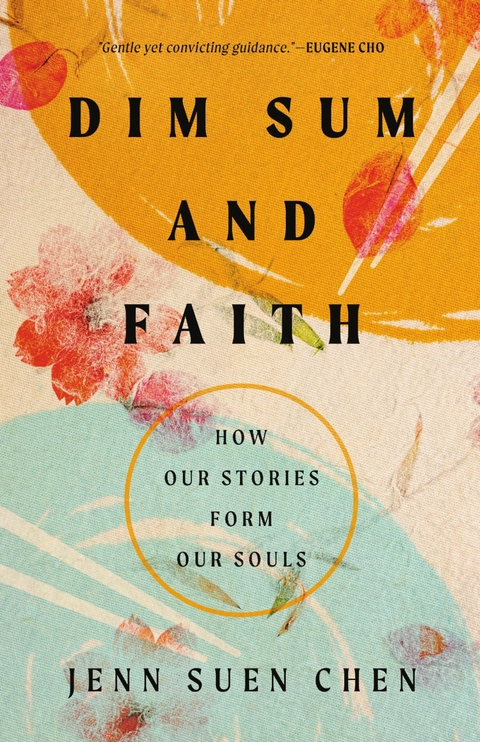
Dim Sum and Faith (eBook)
208 Seiten
IVP Formatio (Verlag)
978-1-5140-1247-5 (ISBN)
Jenn Suen Chen is a spiritual director, speaker, and leader in the area of spiritual formation and crosscultural ministry. She is codirector of Summit Clear (with her husband, John), an organization focused on providing spiritual direction, mentoring, and leadership coaching for those in crosscultural work. She serves with Pioneers and spent twenty-five years living in Asia raising her family. Jenn and John have four adult children and live in the Pacific Northwest.
Jenn Suen Chen is a spiritual director, speaker, and leader in the area of spiritual formation and crosscultural ministry. She is codirector of Summit Clear (with her husband, John), an organization focused on providing spiritual direction, mentoring, and leadership coaching for those in crosscultural work. She serves with Pioneers and spent twenty-five years living in Asia raising her family. Jenn and John have four adult children and live in the Pacific Northwest.
Introduction
You know my thoughts even when I’m far away. You see me when I travel and when I rest at home. You know everything I do.
There was nowhere to escape the cold.
It was our first long winter in China, and the frigid, short days moved in on my soul, threatening to dim any glimmer of warmth or light. We had recently moved seven thousand miles across the ocean from a familiar, safe place to a country I was sure would never feel that way. Our apartment on the seventh floor lacked an elevator, which left us with no choice but to climb up and down 225 stairs multiple times a day. The back of the building overlooked a small cement courtyard, where grandmothers gathered daily with their groceries for neighborhood gossip and grandfathers brought their colorful birds in bamboo cages and played Chinese chess sitting on round plastic stools. The open-air vegetable market was adjacent to our apartment, and the confusing aroma of barbecue pork, fresh fish, and trash wafted up through our windows.
That winter, the unfamiliarity of this place was unbearable for my newly pregnant self. I was often curled up in bed, nausea and sadness consuming my willpower to move. My firstborn, who was two years old at the time, ran his toy trains over me as he snacked on the last bits of cereal we had brought from America and sipped milk from his purple cup. Sensitive to my feelings, he tried to cheer me up with his giggles. It usually worked, at least for a few moments.
We had landed in China just a month earlier, having said goodbye to friends and family, packed our lives into suitcases, and joined new friends who were living in the northeast of the country. Getting up each morning was challenging, and the shame over how I felt was my heaviest burden. Though these were not my best moments, they were certainly some of my most honest ones. I had always been able to put on a smile, find my thankful heart, and push through. Until now.
For a person who rarely struggles with not having enough energy, this felt like coming to the end of myself. The grief felt so foreign, like an enemy had moved in and taken residence in my soul. I hated these feelings of anxiety and fear, both of which I had tried to run from most of my life. If I could have fixed myself, I would have done it. But the toll of goodbyes and moving halfway around the world had caused a tear in my heart, and I feared I would never heal. I couldn’t remember ever feeling more unsure of myself. I loved my husband and toddler and was so excited for a new baby on the way. Our new community was warm and welcoming, and our neighbors served us with loving hospitality. So what was wrong with me?
This place of wilderness I was encountering not only felt unfamiliar but exceptionally uncomfortable. On other occasions I probably could have rallied, having managed to avoid sadness and grief from crushing me. Until now, I had always clung to the truths that had been deposited in me so early on—truths around who God is and my identity as his child. A strong calling had propelled me into this life overseas. Now I could not even recognize myself. While everyone around me seemed to be living with great purpose and ability, even simple tasks like cooking and cleaning had become challenging for me.
When Life Feels Uncomfortable
How did I get here? This question began as a whisper deep in my soul but grew to a heart’s cry demanding an answer. You too may have wondered the same thing at some point in your journey. At times, we may have whispered this in desperation. Other times, we may have spoken it in deep gratitude. But it is a question that boomerangs back to us and begs our attention. We might think we know what is really going on inside our hearts. I thought I did, until the stirring of countless wonderings and insufficient responses left me confused and wanting.
It’s important to pay attention to our hearts, especially when life feels uncomfortable.
This is a book about showing up honestly in our stories, which is not easy to do on our own. I will share parts of my life with you, my reader, and I invite you to pay attention to the things that stir in your heart as you read. This is not a book about my struggle with depression and how I got through it. However, it is an invitation to join me in exploring both the light and dark places of our stories.
I want to invite you on a journey of tracing our stories and discovering how they have formed us spiritually. As an Asian American woman, I’ve always followed along, doing what I was told and what others thought I should do. I became skilled at fitting into whatever mold I was given, which often included multiple spaces. I’ve always bridged cultures.
Maybe you have too.
Honesty calls for something deep within us and tells us that we can no longer continue as we are. It has required a deep dive into my story and called for something more than I thought I had.
When we are young, the answers we are given are concrete and surprisingly clear. Adults respond to our questions even if they don’t have answers. As we get older and begin to think on our own, we find ourselves dissecting those answers that have become part of our worldview—and discover that some of what we thought was true no longer holds water. That can feel so jarring. Accepting the things that are happening right now to be just “what is” can be so difficult and making sense of it impossible. If your life has been anything like mine, your story has been filled with deep grief alongside deep joy. It seems the two must live together in every story. However, while we may share similar elements of joy and pain, no story is the same.
Importance of Storytelling
I’m extending an invitation to join me in telling our stories with God. Author and speaker Curt Thompson writes, “We are storytellers. We yearn to tell and hear stories of goodness and beauty, and this is the echo of God’s intention. We long for our stories to be about joy, not just reflections of what we believe but of who we are, who we long to be.”1 The memories that make up the stories of our lives are woven together, and they must be told for us to heal. Thompson says the real details of our stories aren’t as important as how and what we remember.
However, learning to tell our stories can feel like an impossible task. To begin, we each have a story. We tell our stories every day, but we don’t often tell stories that have made us who we are. Many people I come alongside these days struggle at the beginning of our sessions to recall memories from their early years. They tell me, “There doesn’t seem to be anything important to remember.” Some have told me they can’t remember anything before the age of ten. However, as we create space together and wait patiently with God in silence, the memories begin to surface as we learn to just be in this place and let God direct the process. We don’t have to worry that we don’t remember everything because that’s not the point. But we must begin to understand that we each have a story, and our story matters.
We can bring our memories to God: “O Lord, you know my thoughts even when I’m far away” (Psalm 139:2). He is gentle and so kind, and whether we knew him at a certain point in our story, he was there with us. As we curiously explore, we can begin to articulate what we have come to believe about ourselves, God, others, and the world. Parents, teachers, and other adults who were part of our shaping sometimes had a positive influence on us, and at other times they left painful marks on our lives. Siblings play a role in our placement within our family structure. It has been said that no two siblings experience their family and environment in the same way. Additionally, we must consider all the uncontrollable circumstances we were born into and experienced throughout childhood.
What values were part of our shaping process? What principles were important to those influential adult figures in our lives, and how did that translate in the environment we were raised in? What beliefs did we come to hold? The questions are endless. We are not meant to do this journey of storytelling in an individual vacuum but in community. There is so much research being done around the healing that happens both in our brains and in our bodies when we intentionally come together. We were made to be a collective people, connected to one another, with remembrance as our way of life. To do this work, we need a curious heart. I invite you to be curious about your story as I share my story with you.
To see the beauty in life, we must look at everything and learn to look everywhere. We must turn over the rocks and look in all the crevices. What we discover underneath might not be beautiful, feel important, or be worth noticing at first. Most of us have spent much of our lives asleep to the deep stirrings of our soul. This book is a call to awaken our hearts. There is so much to see and so much to learn. And beyond that, there is so much more we could ever want in this life with God. It’s hard to remember that we can find God in our ordinary moments when nothing special seems to be happening. Yet, we can discover God’s holy presence in the mundane, where the plain becomes sacred. We must be present to meet God in the living moments.
I invite us to journey backward in time into our stories, because it is there that the beliefs—and sometimes...
| Erscheint lt. Verlag | 12.8.2025 |
|---|---|
| Verlagsort | Lisle |
| Sprache | englisch |
| Themenwelt | Religion / Theologie ► Christentum ► Moraltheologie / Sozialethik |
| Sozialwissenschaften | |
| Schlagworte | AAPI • American • Asian • Broken • Character • Christian • Cultural • Diversity • Ethnic • Family • Food • Formation • God • Grief • Home • Hospitality • Identity • Immigrant • Impact • Jesus • Korean • meal • Meditation • Nationality • Principles • privilege • Shame • Spiritual • Transformative • whole |
| ISBN-10 | 1-5140-1247-2 / 1514012472 |
| ISBN-13 | 978-1-5140-1247-5 / 9781514012475 |
| Informationen gemäß Produktsicherheitsverordnung (GPSR) | |
| Haben Sie eine Frage zum Produkt? |
 EPUB (Wasserzeichen)
DRM: Digitales Wasserzeichen
Dieses eBook enthält ein digitales Wasserzeichen und ist damit für Sie personalisiert. Bei einer missbräuchlichen Weitergabe des eBooks an Dritte ist eine Rückverfolgung an die Quelle möglich.
Dateiformat: EPUB (Electronic Publication)
EPUB ist ein offener Standard für eBooks und eignet sich besonders zur Darstellung von Belletristik und Sachbüchern. Der Fließtext wird dynamisch an die Display- und Schriftgröße angepasst. Auch für mobile Lesegeräte ist EPUB daher gut geeignet.
Systemvoraussetzungen:
PC/Mac: Mit einem PC oder Mac können Sie dieses eBook lesen. Sie benötigen dafür die kostenlose Software Adobe Digital Editions.
eReader: Dieses eBook kann mit (fast) allen eBook-Readern gelesen werden. Mit dem amazon-Kindle ist es aber nicht kompatibel.
Smartphone/Tablet: Egal ob Apple oder Android, dieses eBook können Sie lesen. Sie benötigen dafür eine kostenlose App.
Geräteliste und zusätzliche Hinweise
Buying eBooks from abroad
For tax law reasons we can sell eBooks just within Germany and Switzerland. Regrettably we cannot fulfill eBook-orders from other countries.
aus dem Bereich


