


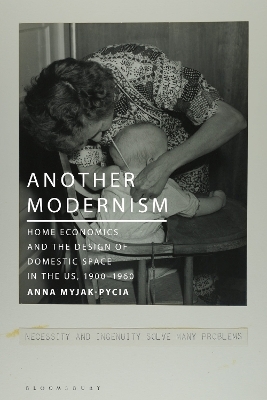
Another Modernism
Home Economics and the Design of Domestic Space in the US, 1900-1960
Seiten
2025
Bloomsbury Visual Arts (Verlag)
978-1-350-41638-3 (ISBN)
Bloomsbury Visual Arts (Verlag)
978-1-350-41638-3 (ISBN)
Exploring how the home economics movement offered an alternative to mainstream modernist architecture – one which foregrounded women, participatory design, sustainability, and accommodated the disabled body.
Filling an important gap in design history, Another Modernism examines how domestic space was conceived by the US home economics movement in the first half of the 20th century.
In doing so, it tells the story of how home economists—mainly women—developed design that challenged the traditional architecture of American farm communities and countered the approach of modernist architects. Uncovering unacknowledged contributions of women to domestic architecture and design history, it reveals early instances of participation, sustainability, and accommodating the disabled body in domestic design.
In contrast to the canonical modernist model of space, which is primarily visual, home economists centered on a user who interacts with the interior in a tactile, bodily way. Although both strove for efficiency, they understood it differently: whereas for many of the mainstream modernists the term ‘efficiency’ meant functionalist aesthetics, for home economists it signified design solutions intended to ease the labor of an average American homemaker. The book argues that the home economists’ focus on tactility, the user’s corporeality, movement, access, preferences, and her engagement in the design process, constituted an alternative model of modern architecture – a popular and largely rural modernism centered on the specificity of the female user and her personal experience of the domestic interior.
Based on little-known archival material, and with an emphasis on mostly female researchers, designers, and users/occupants, Another Modernism will appeal to architects, design historians, and anyone interested in gender, women's and disability studies, as well as non-visual approaches to design.
Filling an important gap in design history, Another Modernism examines how domestic space was conceived by the US home economics movement in the first half of the 20th century.
In doing so, it tells the story of how home economists—mainly women—developed design that challenged the traditional architecture of American farm communities and countered the approach of modernist architects. Uncovering unacknowledged contributions of women to domestic architecture and design history, it reveals early instances of participation, sustainability, and accommodating the disabled body in domestic design.
In contrast to the canonical modernist model of space, which is primarily visual, home economists centered on a user who interacts with the interior in a tactile, bodily way. Although both strove for efficiency, they understood it differently: whereas for many of the mainstream modernists the term ‘efficiency’ meant functionalist aesthetics, for home economists it signified design solutions intended to ease the labor of an average American homemaker. The book argues that the home economists’ focus on tactility, the user’s corporeality, movement, access, preferences, and her engagement in the design process, constituted an alternative model of modern architecture – a popular and largely rural modernism centered on the specificity of the female user and her personal experience of the domestic interior.
Based on little-known archival material, and with an emphasis on mostly female researchers, designers, and users/occupants, Another Modernism will appeal to architects, design historians, and anyone interested in gender, women's and disability studies, as well as non-visual approaches to design.
Anna Myjak-Pycia is a senior researcher at the Institute for the History and Theory of Architecture (GTA), ETH Zürich, Switzerland.
List of Figures
Acknowledgments
Introduction
1. Institutions
2. Theory of Domestic Space
3. Design Practice
4. Disabled Homemaker
5. Visual Idiom
Conclusion
Index
| Erscheinungsdatum | 12.07.2025 |
|---|---|
| Zusatzinfo | 70 bw illus |
| Verlagsort | London |
| Sprache | englisch |
| Maße | 162 x 236 mm |
| Gewicht | 740 g |
| Themenwelt | Sozialwissenschaften ► Soziologie ► Gender Studies |
| Technik ► Architektur | |
| ISBN-10 | 1-350-41638-X / 135041638X |
| ISBN-13 | 978-1-350-41638-3 / 9781350416383 |
| Zustand | Neuware |
| Informationen gemäß Produktsicherheitsverordnung (GPSR) | |
| Haben Sie eine Frage zum Produkt? |
Mehr entdecken
aus dem Bereich


aus dem Bereich
Mein Leben zwischen Öffentlichkeit und Selbstschutz | Limitierte …
Buch | Softcover (2025)
riva (Verlag)
CHF 33,90
eine kritische Theorie in 99 Fragmenten
Buch | Softcover (2023)
Campus (Verlag)
CHF 55,95


