


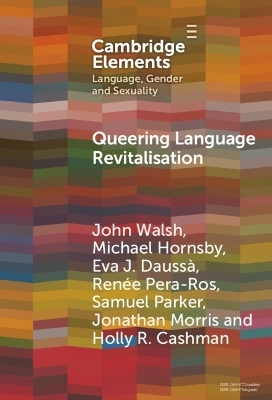
Queering Language Revitalisation
Navigating Identity and Inclusion among Queer Speakers of Minority Languages
Seiten
2025
Cambridge University Press (Verlag)
978-1-009-59102-7 (ISBN)
Cambridge University Press (Verlag)
978-1-009-59102-7 (ISBN)
This Element aims to understand how multilingualism, second language acquisition and minority language revitalisation have overlooked queer sexual identities. The marginalisation of queer subjects in these strands of linguistics can be traced to the Fishmanian model of 'Reversing Language Shift' (RLS).
This Element aims to deepen our understanding of how the fields of multilingualism, second language acquisition and minority language revitalisation have largely overlooked the question of queer sexual identities among speakers of the languages under study. Based on case studies of four languages experiencing differing degrees of minoritisation – Irish, Breton, Catalan and Welsh – it investigates how queer people navigate belonging within the binary of speakers/non-speakers of minoritised languages while also maintaining their queer identities. Furthermore, it analyses how minoritised languages are dealing linguistically with the growing need for 'gender-fair' or 'gender-neutral' language. The marginalisation of queer subjects in these strands of linguistics can be traced to the historical dominance of the Fishmanian model of 'Reversing Language Shift' (RLS), which assumed the importance of the deeply heteronormative model of 'intergenerational transmission' of language as fundamental to language revitalisation contexts.
This Element aims to deepen our understanding of how the fields of multilingualism, second language acquisition and minority language revitalisation have largely overlooked the question of queer sexual identities among speakers of the languages under study. Based on case studies of four languages experiencing differing degrees of minoritisation – Irish, Breton, Catalan and Welsh – it investigates how queer people navigate belonging within the binary of speakers/non-speakers of minoritised languages while also maintaining their queer identities. Furthermore, it analyses how minoritised languages are dealing linguistically with the growing need for 'gender-fair' or 'gender-neutral' language. The marginalisation of queer subjects in these strands of linguistics can be traced to the historical dominance of the Fishmanian model of 'Reversing Language Shift' (RLS), which assumed the importance of the deeply heteronormative model of 'intergenerational transmission' of language as fundamental to language revitalisation contexts.
Introduction: Queering minority language revitalisation Michael Hornsby and John Walsh; 1. Intersecting identities in minority language contexts: LGBTQ+ Speakers of Welsh Jonathan Morris and Samuel Parker; 2. Queering language revitalisation: How a queer arts collective navigates identity, migration, and the Irish language John Walsh; 3. Making Breton gender – and LGBTQIA+ – Fair: Typographical and lexical expansion to reflect diversity within the Breton-speaking community Michael Hornsby; 4. The battle for authority, legitimacy, and agency in the twitter fields of the Catalan gender-neutral linguistic revolution Eva J. Daussà and Renée Pera-Ros; 5. Discussion: Queering language revitalisation Holly Cashman; References.
| Erscheinungsdatum | 22.01.2025 |
|---|---|
| Reihe/Serie | Elements in Language, Gender and Sexuality |
| Zusatzinfo | Worked examples or Exercises |
| Verlagsort | Cambridge |
| Sprache | englisch |
| Maße | 152 x 229 mm |
| Gewicht | 262 g |
| Themenwelt | Geisteswissenschaften ► Sprach- / Literaturwissenschaft ► Sprachwissenschaft |
| Sozialwissenschaften ► Soziologie ► Gender Studies | |
| ISBN-10 | 1-009-59102-9 / 1009591029 |
| ISBN-13 | 978-1-009-59102-7 / 9781009591027 |
| Zustand | Neuware |
| Informationen gemäß Produktsicherheitsverordnung (GPSR) | |
| Haben Sie eine Frage zum Produkt? |
Mehr entdecken
aus dem Bereich


aus dem Bereich
Eine Wiederentdeckung
Buch | Softcover (2025)
Piper (Verlag)
CHF 19,55
Das umfassende Standardwerk auf der Grundlage der aktuellen amtlichen …
Buch | Hardcover (2024)
Duden (Cornelsen Verlag)
CHF 48,95


