


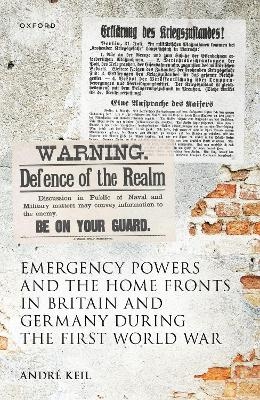
Emergency Powers and the Home Fronts in Britain and Germany during the First World War
Seiten
2025
Oxford University Press (Verlag)
978-0-19-891854-7 (ISBN)
Oxford University Press (Verlag)
978-0-19-891854-7 (ISBN)
The First World War transformed modern politics. No example demonstrates this more powerfully than the enactment and use of emergency powers by all belligerents. Wartime governments passed extensive emergency legislation that allowed them to pursue their war efforts with little democratic scrutiny and legal restrictions. In Britain, the Defence of the Realm Act transferred law-making powers from Parliament to the government and suspended vital elements of the unwritten constitution. In Germany, the declaration of the state of siege meant that the military assumed executive powers on the home front. These powers were initially used to suppress dissent, establish censorship of the press, and combat espionage. Yet, by 1918, they had been extended to regulate almost any aspect of everyday life on the home front. Understanding the political and social dynamics on the home front is only possible when the crucial importance of these emergency powers is considered. The experience of life under a permanent state of exception during the war transformed the relationship between the state and its citizens. Yet it also marked the rise of the state of exception as a paradigm of rule.
Using Britain and Germany as examples of the wartime state of exception, André Keil offers a detailed analysis of the use of emergency powers during the war. By drawing on a wide range of archival sources, he explains the rise of this new paradigm of government and how it shaped politics in Britain and Germany well beyond the First World War. The book offers a wealth of local examples that explain how ideologies and perceptions of the 'enemy within' shaped the use of repressive emergency powers by politicians, police, and military. It also traces how the critique and resistance against these measures helped to establish civil liberties as a new field of political activism. In essence, Keil offers a unique perspective on German and British politics during the First World War and tests the notion of the war being a 'laboratory for the state of exception'.
Using Britain and Germany as examples of the wartime state of exception, André Keil offers a detailed analysis of the use of emergency powers during the war. By drawing on a wide range of archival sources, he explains the rise of this new paradigm of government and how it shaped politics in Britain and Germany well beyond the First World War. The book offers a wealth of local examples that explain how ideologies and perceptions of the 'enemy within' shaped the use of repressive emergency powers by politicians, police, and military. It also traces how the critique and resistance against these measures helped to establish civil liberties as a new field of political activism. In essence, Keil offers a unique perspective on German and British politics during the First World War and tests the notion of the war being a 'laboratory for the state of exception'.
André Keil is a Senior Lecturer in Modern European History at Liverpool John Moores University. He previously held lectureships at Durham University and the University of Sunderland. His research and teaching covers German and British history between 1850 and 1950. He has published widely on the history of the state of exception, the history of dictatorships and authoritarian politics, the First World War, and the politics of memory culture in modern Germany.
| Erscheinungsdatum | 14.05.2025 |
|---|---|
| Reihe/Serie | Studies in German History |
| Verlagsort | Oxford |
| Sprache | englisch |
| Maße | 160 x 242 mm |
| Gewicht | 496 g |
| Themenwelt | Geschichte ► Allgemeine Geschichte ► Neuzeit (bis 1918) |
| Geisteswissenschaften ► Geschichte ► Regional- / Ländergeschichte | |
| Sozialwissenschaften ► Politik / Verwaltung ► Politische Theorie | |
| ISBN-10 | 0-19-891854-2 / 0198918542 |
| ISBN-13 | 978-0-19-891854-7 / 9780198918547 |
| Zustand | Neuware |
| Informationen gemäß Produktsicherheitsverordnung (GPSR) | |
| Haben Sie eine Frage zum Produkt? |
Mehr entdecken
aus dem Bereich


aus dem Bereich
Geschichte einer wilden Handlung
Buch | Hardcover (2024)
C.H.Beck (Verlag)
CHF 47,60


