


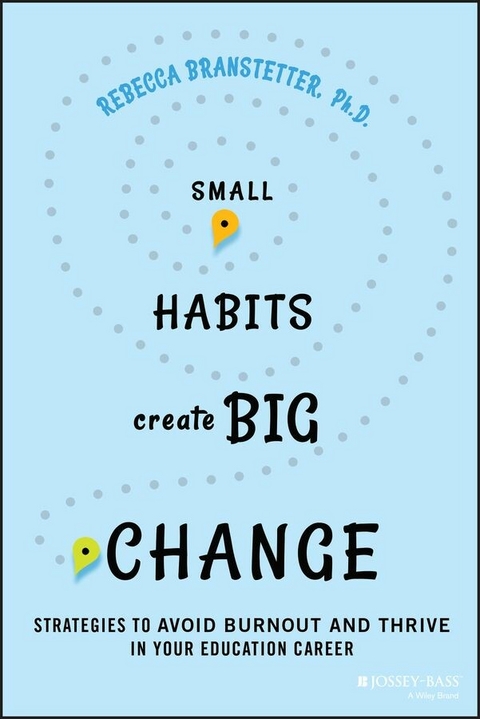
Small Habits Create Big Change (eBook)
224 Seiten
Wiley (Verlag)
978-1-394-23894-1 (ISBN)
Small on-the-job changes you can make to identify your strengths, prevent burnout, and maintain your passion for being an educator
Small Habits Create Big Change is a valuable collection of micro-habits-small, science-backed adjustments-that educators can use to reclaim their mental health and their love for their jobs. This book helps you identify your unique personality type, so you can find the hacks and tweaks that will actually work as you strive to manage stress and reignite your passion for working with students. Many educators feel overwhelmed, frustrated, and on the verge of burnout, but it's never too late to turn things around. Best of all, psychologist Rebecca Branstetter gives you solutions that you can use while you work, so you don't have to sacrifice your already-scarce downtime.
Large-scale approaches to preventing educator burnout often fail to consider an important fact-educators are individuals, and no one-size-fits-all solution will really fit everyone. People's innate strengths and weaknesses play a big part in determining whether the changes we make are likely to work for us. This unique book accounts for what makes you who you are, giving you options, ideas, and proven strategies that set you up for success. This way, you can manage stress, battle burnout, and get excited about your career once again.
- Identify your strengths and weaknesses using the exclusive Thrive-o-gram personality indicator
- Learn micro-habits that turn research about burnout prevention into transformation in your daily life
- Understand how to tap into your core strengths and protect your positive energy
- Personalize your action steps with a Thriving Roadmap
This book isn't just about understanding who you are. It's about preventing burnout by aligning your work with your core strengths, values, and habits. All K-12 educators, including school psychologists and school-based mental health providers, will benefit from this balanced approach to work, fostering self-compassion, mindfulness, and resilience.
REBECCA BRANSTETTER, PhD, is the founder of The Thriving Students Collective and Thrive Hive TV Network, online platforms for boosting the mental health and learning needs of children and the educators who support them. A national media expert, Rebecca's expertise has appeared in The Washington Post, NPR, CNN, and Parents magazine.
Small on-the-job changes you can make to identify your strengths, prevent burnout, and maintain your passion for being an educator Small Habits Create Big Change is a valuable collection of micro-habits small, science-backed adjustments that educators can use to reclaim their mental health and their love for their jobs. This book helps you identify your unique personality type, so you can find the hacks and tweaks that will actually work as you strive to manage stress and reignite your passion for working with students. Many educators feel overwhelmed, frustrated, and on the verge of burnout, but it's never too late to turn things around. Best of all, psychologist Rebecca Branstetter gives you solutions that you can use while you work, so you don't have to sacrifice your already-scarce downtime. Large-scale approaches to preventing educator burnout often fail to consider an important fact educators are individuals, and no one-size-fits-all solution will really fit everyone. People's innate strengths and weaknesses play a big part in determining whether the changes we make are likely to work for us. This unique book accounts for what makes you who you are, giving you options, ideas, and proven strategies that set you up for success. This way, you can manage stress, battle burnout, and get excited about your career once again. Identify your strengths and weaknesses using the exclusive Thrive-o-gram personality indicator Learn micro-habits that turn research about burnout prevention into transformation in your daily life Understand how to tap into your core strengths and protect your positive energy Personalize your action steps with a Thriving Roadmap This book isn't just about understanding who you are. It's about preventing burnout by aligning your work with your core strengths, values, and habits. All K-12 educators, including school psychologists and school-based mental health providers, will benefit from this balanced approach to work, fostering self-compassion, mindfulness, and resilience.
CHAPTER 1
Boosting Positive Energy
“I have so many mixed emotions about teaching. I enjoy aspects of my job but also find it hard to maintain my joy and energy throughout the day.”
—Anonymous
When I started out my career in education, I was pretty darn excited about everything I’d learned in graduate school. I was armed with best practices! I was young! I was determined! I had positive energy! TGIM, people! I could have pushed over a small SUV with the superhuman strength I felt inside to Change. The. MF. World.
I vividly remember sitting in staff meetings, pencil poised above my notepad, ready to learn!
And I also remember noticing grouchy people, pencils down, ready to complain. What the heck was wrong with them?
Fast forward 10 years, and oh snap … I was the grouch. Maybe not on the outside to a casual observer, but on the inside. I had grown cynical. Slowly, I had begun drowning in the quicksand of negativity, anxious about the high expectations I could never meet, and demoralized at the grossly understaffed and under-resourced system I worked in. And each day, more and more tasks and roles were being added to my already full plate. Sound familiar?
(Oh! And if that doesn’t sound familiar because you’re brand new to the profession – don’t freak out! You are in the lucky position to stop burnout before it even takes hold!)
Let’s do a quick reflection to see how full your tank is.
On a scale of 1-10 with one being “I want to quit” and 10 being “TGIM! (Thank Goodness it’s Monday!),” I am at a ________ with my positive energy level.
Why Filling Your Tank Is Essential
When you think of someone who is burned out, you might conjure up an image of someone just “phoning it in” and not caring about their job. That’s not what burnout for educators and care professionals usually looks like. It often looks like running on empty in overdrive.
Passion can often lead to burnout.1 Educators are the perfect example of passion-driven helping professionals, and thus they are more susceptible to burnout because they are surrounded by pressure to love the job. I experienced this firsthand, as a school psychologist bringing home my work every night and weekend because I cared so much. I was running on the fumes of my bigger why – my love for the students I served.2 Chances are, you have done the same.
I could go into all the dangers of running on fumes in overdrive, and all the dangers of chronic stress. But chances are, you already know that high levels of stress or chronic stress is related to almost any negative outcome you can think of. If you want to freak yourself out, check out APA’s 2023 Stress in America report, which paints a vivid picture of how stress is more than just an emotional burden: it’s a physical one, too. Stress, often seen as a mental and emotional challenge, manifests physically, leading to conditions like heart disease and weakened immune systems. Particularly striking is the hidden toll of stress on those who appear resilient; they can show accelerated aging at the cellular level, a somber reminder that appearances can be deceiving, and that resilience can have a cost. This revelation underscores the need for more supportive environments in our schools, where educators’ successes aren’t at the expense of their own health.
The thing is, you can’t typically control the stressors – high class sizes, high demands, increasing student needs – but you can control your mindset and reaction to the stressors.
I’m not saying that burnout is some sort of personal self-care fail. I’m not going to spout “cruel optimism” where we put the burden of change on the individual in a system where the stress cards are stacked against them. This book is about practical optimism. We absolutely need to work on upstream workplace issues like reducing class size, increasing mental health and learning supports, and giving educators more autonomy over bureaucracy. We also need to acknowledge that there are larger forces at work in our society that add stress upon stress, such as racism, sexism, ablism, and policy choices that adversely impact marginalized groups in our schools. But until we sort all those complex upstream challenges, what can we do on Monday? What is the fuel for a happy educator in challenging circumstances? Let’s geek out on that.
Before we launch into the happiness fuel we need to thrive as educators, let’s pause for a moment about the goal itself, of boosting positive emotions. Barbara Frederickson’s research on happiness reveals that positive emotions are not just pleasant but necessary to be a functioning human! Engaging in activities that make us happy doesn’t only improve our mood; it also enhances our creativity, problem-solving skills, and even our physical health. Happiness is not a “nice to have,” it is a “need to have” for educators to thrive. Positive emotions both broaden and build our cognitive and emotional resources.3
Just look at Figure 1.1, showing all the correlates of happiness!
While we can all agree happiness is a worthy goal in and of itself, there are also many reasons to prioritize happiness as educators, as it also improves our craft and student outcomes. The double-edged sword of helping professionals is that we tend to be high achievers (great!) but we can also be a self-critical bunch (not so great). When a lesson bombs, an angry parent shows up with harsh words, or when a hard-to-reach student is giving us a hard time again, we often take it to heart.
With the barrage of daily stressors and “best-laid-plans shortfalls,” we often give our weaknesses and limitations more attention than our strengths. But research suggests that thinking about personal strengths can increase our happiness and reduce depression.4
FIGURE 1.1 Broaden and Build Theory
While we shouldn’t ignore our shortcomings, reflecting on our strengths can help remind us of our positive attributes, and this can build our confidence, self-efficacy, and self-esteem – and, in turn, increase happiness.
Research shows that using your strengths intentionally at work leads to greater overall satisfaction and makes mundane or frustrating tasks feel less burdensome.5
A recent study shows that people who have the opportunity to use their strengths are:6
- 7.8% more productive
- 6x as likely to strongly agree that they have the chance to do what they do best every day
- 6x more likely to be engaged at work
So how can we focus on our strengths? In one study, participants tried using a personal strength each day for one week. Compared with those who didn’t try to use a strength – instead they wrote about their memories every day for a week – those who identified and used their strengths reported an increase in happiness and a decrease in symptoms of depression immediately after the one-week experiment, and those changes persisted six months later.7
Bridging the Research to Your Reality
Now the fun part! Let’s translate that research into reality. What practical things can you do, during your day, to shift your lens from focusing on what’s wrong to what’s strong?
Know Your Strengths
Step one is knowing your strengths. When I present across the country and ask a room of educators what their strengths are, I am frequently met with blank stares. What typically follows is one reluctant participant raises their hand and offers, almost as if a question “I’m a good listener?” Another tentatively adds, “I am good at helping?” Even when I give teachers permission to brag a little, very few people feel comfortable sharing their strengths. Some have “strength blindness” altogether, where they’ve never really even thought to stop and think about what they’re good at. Sometimes educators are so focused on their students’ strengths, they forget to look at their own! If you took the Thrive-o-gram, now you’re one of the small percentage of adults who know and can articulate their strengths! Now is a great time to pull it out as a reference so you can have your strengths at the forefront of your mind as you read this book. And if you haven’t taken it yet, this is an optimal time to do that!
Recognizing Flow in the Classroom
Have you ever felt so immersed in an activity that time seemed to vanish? This state, known as “flow,” is not just a fleeting joy but a critical psychological state where you’re at your most engaged and productive. Reflect on when you experience flow during your school day – those moments when joy in teaching makes time fly.
I am in flow when _______________
Chances are, in these moments, you are using your strengths. This is your positive energy fuel!
Micromovements Toward Recharging
The key to sustainable energy isn’t found in grand gestures and big chunks of time to rest, but in the small, consistent efforts to recharge. Like a car, it’s easier to refuel a little at a time rather than stressing out when you’re running on fumes and trying to find a bunch of time to refuel. Small, micromovements...
| Erscheint lt. Verlag | 23.9.2024 |
|---|---|
| Sprache | englisch |
| Themenwelt | Sozialwissenschaften ► Pädagogik |
| ISBN-10 | 1-394-23894-0 / 1394238940 |
| ISBN-13 | 978-1-394-23894-1 / 9781394238941 |
| Informationen gemäß Produktsicherheitsverordnung (GPSR) | |
| Haben Sie eine Frage zum Produkt? |
 EPUB (Adobe DRM)
Größe: 9,9 MB
Kopierschutz: Adobe-DRM
Adobe-DRM ist ein Kopierschutz, der das eBook vor Mißbrauch schützen soll. Dabei wird das eBook bereits beim Download auf Ihre persönliche Adobe-ID autorisiert. Lesen können Sie das eBook dann nur auf den Geräten, welche ebenfalls auf Ihre Adobe-ID registriert sind.
Details zum Adobe-DRM
Dateiformat: EPUB (Electronic Publication)
EPUB ist ein offener Standard für eBooks und eignet sich besonders zur Darstellung von Belletristik und Sachbüchern. Der Fließtext wird dynamisch an die Display- und Schriftgröße angepasst. Auch für mobile Lesegeräte ist EPUB daher gut geeignet.
Systemvoraussetzungen:
PC/Mac: Mit einem PC oder Mac können Sie dieses eBook lesen. Sie benötigen eine
eReader: Dieses eBook kann mit (fast) allen eBook-Readern gelesen werden. Mit dem amazon-Kindle ist es aber nicht kompatibel.
Smartphone/Tablet: Egal ob Apple oder Android, dieses eBook können Sie lesen. Sie benötigen eine
Geräteliste und zusätzliche Hinweise
Buying eBooks from abroad
For tax law reasons we can sell eBooks just within Germany and Switzerland. Regrettably we cannot fulfill eBook-orders from other countries.
aus dem Bereich


