


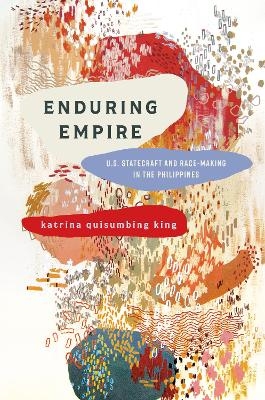
Enduring Empire
U.S. Statecraft and Race-Making in the Philippines
Seiten
2025
|
New edition
Stanford University Press (Verlag)
978-1-5036-4325-3 (ISBN)
Stanford University Press (Verlag)
978-1-5036-4325-3 (ISBN)
In 1898 the United States became a formal overseas empire and claimed sovereignty over the Philippine islands, justifying its rule in explicitly racial terms. Less than fifty years later, in 1946, Philippine independence was recognized by the United States, even as it continued to exert influence over the domestic and foreign affairs of the newly decolonized Republic. Despite some differences, U.S. control remained racial and imperial.
Enduring Empire shows how U.S. federal state actors translated their ideas of race into state structures. Through innovating constitutional law, bureaucratic administration, and legislation, state actors built a durable and flexible system of racial-imperial rule that not only lasted beyond the period of formal empire but continues to this day. katrina quisumbing king traces debates among U.S. presidents, federal legislators, administrators, and justices about what kind of state the United States should be, the place of nonwhite people in the polity, and the best way to maintain U.S. white hegemony. In charting how state actors' positions—some nativist, isolationist, and protectionist and others expansionist, interventionist, and imperialist—evolved, quisumbing king identifies key moments when they cemented racial ideas into law and reshaped the terms of U.S. racial-imperial formation.
Enduring Empire shows how U.S. federal state actors translated their ideas of race into state structures. Through innovating constitutional law, bureaucratic administration, and legislation, state actors built a durable and flexible system of racial-imperial rule that not only lasted beyond the period of formal empire but continues to this day. katrina quisumbing king traces debates among U.S. presidents, federal legislators, administrators, and justices about what kind of state the United States should be, the place of nonwhite people in the polity, and the best way to maintain U.S. white hegemony. In charting how state actors' positions—some nativist, isolationist, and protectionist and others expansionist, interventionist, and imperialist—evolved, quisumbing king identifies key moments when they cemented racial ideas into law and reshaped the terms of U.S. racial-imperial formation.
katrina quisumbing king is Assistant Professor of Sociology at Northwestern University.
| Erscheinungsdatum | 11.06.2025 |
|---|---|
| Reihe/Serie | Articulations: Studies in Race, Immigration, and Capitalism |
| Zusatzinfo | 13 tables, 5 figures, 2 halftones |
| Verlagsort | Palo Alto |
| Sprache | englisch |
| Maße | 152 x 229 mm |
| Themenwelt | Geschichte ► Teilgebiete der Geschichte ► Kulturgeschichte |
| Sozialwissenschaften ► Ethnologie | |
| Sozialwissenschaften ► Soziologie | |
| ISBN-10 | 1-5036-4325-5 / 1503643255 |
| ISBN-13 | 978-1-5036-4325-3 / 9781503643253 |
| Zustand | Neuware |
| Informationen gemäß Produktsicherheitsverordnung (GPSR) | |
| Haben Sie eine Frage zum Produkt? |
Mehr entdecken
aus dem Bereich



aus dem Bereich
Die Revolution des Gemeinen Mannes
Buch | Softcover (2024)
C.H.Beck (Verlag)
CHF 16,80
Eine Geschichte des Geschmacks
Buch | Hardcover (2025)
C.H.Beck (Verlag)
CHF 49,95
vom Mittelalter bis zur Gegenwart
Buch | Softcover (2024)
C.H.Beck (Verlag)
CHF 16,80


