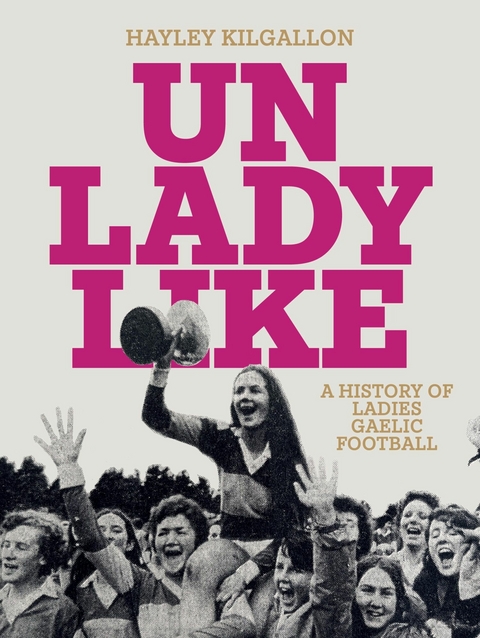
Unladylike (eBook)
317 Seiten
New Island (Verlag)
978-1-83594-004-4 (ISBN)
HAYLEY KILGALLON is a PhD student at the School of History in University College Dublin. Her research area is the history of women's sport in Ireland with a particular focus on ladies' Gaelic football and she has contributed on this subject to RTÉ, BBC Gaeilge and numerous journals. She has been a judge for the Young Social Innovators Ireland Awards and has played Gaelic football at club level in Sligo, Boston and Dublin.
After first emerging in the 1920s, ladies Gaelic football was soon sidelined; breathless women chasing after a football was just too unladylike for the powers that be. Despite this resistance, the sport became a popular novelty act at local carnivals. And when the Ladies GaelicFootball Association (LGFA) was founded in Tipperary in July 1974, fifty years of extraordinary growth were set in motion. From writing the rule book to a membership of nearly 200,000, the earliest All-Stars to game-changing partnerships, this definitive history captures that unstoppable journey to becoming a national sport and so much more. Lavishly illustrated and drawing from national, club and personal archives, UNLADYLIKE is for the players, the fans, the kit-washers, the sandwich-makers and the supporters alike, and confirms the best is yet to come.
HAYLEY KILGALLON is a PhD student at the School of History in University College Dublin. Her research area is the history of women's sport in Ireland with a particular focus on ladies' Gaelic football and she has contributed on this subject to RTÉ, BBC Gaeilge and numerous journals. She has been a judge for the Young Social Innovators Ireland Awards and has played Gaelic football at club level in Sligo, Boston and Dublin.
Ladies Gaelic football needed a space to grow – and it found it at carnivals and festivals across the island of Ireland in the 1960s. A key feature of the social scene in Ireland at the time, carnivals and festivals often functioned as fundraising events for local causes. Speaking to the GAA Oral History project in 2012, Marie McAleer, a founding member of the LGFA, recalled how women’s Gaelic football was organised as a ‘side event’ at carnivals and that ‘it was always a bit of fun’ taking part.1 However, newspaper archives reveal that these carnival games were not just a fundraising stunt or light entertainment; rather, they could be meaningful, competitive – and popular – matches that gave women an outlet to play Gaelic football.
Furthermore, newspaper archives revealed that festival matches had been organised as early as the 1940s. For example, in October 1945, the Lucan Pipe Band organised a GAA tournament and announced that a women’s football match between Clondalkin and Leixlip would take place before a men’s Gaelic football match featuring Saggart and Donaghmore.2 In August 1949, The Nationalist newspaper in Tipperary advertised that a women’s football match would be one of the attractions at the Kilsheelan Super Fete in aid of Power Charity Home and Kilsheelan Sportsfield Fund.3 It is unclear from the notice alone what code of football the women would have played, but the paper reveals that ‘there was very keen interest […] in the novel Ladies’ Football match which ended in a draw’, 2–5 to 1–8.4 A notice in the Nationalist and Leinster Times from June 1945 advertised an upcoming carnival in Athy, in which a women’s football match would feature alongside other attractions such as a pram race, a children’s fancy dress parade and golf putting.5
Once again, it is not clear what code of football the women played at the Athy festival, and this lack of clarity resurfaces in other newspaper notices, such as one that appeared in The Nationalist in June 1947, which only informed readers that the ladies’ football match occurring at a carnival in aid of Cloneen National School would be seven-a-side.6
From the late 1950s into the 1960s, it appears that ladies Gaelic football was becoming a popular attraction at carnivals in Cork. Notices in the Southern Star, The Cork Examiner and Evening Echo map the spread of the game through the county at events in Ringaskiddy, Crosshaven, Carrigaline, and later in Fermoy, Bandon, Douglas, Roscarbery and Ballyvourney. At the same time, Gaelic football matches for women were being organised in other counties, such as Louth, Meath, Tipperary, Fermanagh and Offaly.
The popularity of the game was evidently increasing, and this was leading some to wonder – likely for the first time – whether things could be taken further. Reporting on a women’s Gaelic football tournament being held in Offaly in September 1967, the Offaly Independent concluded that ‘this tournament is no carnival catch penny […] and if the idea catches on it may open up a whole new vista for the future.’7 Four teams took part in this competition, organised by the Arden Pitch and Putt Club, and it was won by Tullamore Camogie Club, their ‘positioning and combination’ leading them to be ‘deserving winners’ over the other competitors: Sacred Heart School, Vocational School and Arden Pitch and Putt.8
The ‘new venture’ was labelled a successful ‘experiment’ and, ultimately, the success of this competition meant that the idea did catch on locally. Another women’s Gaelic football competition was held in late 1967, this time expanding to eight teams.9 The newly organised league featured seven teams from Offaly (Kinitty, Arden Pitch and Putt, Hairdressers, Cloonagh, Mountbolus, Marian Hostel and Vocational School), as well as Lorrha from Co. Tipperary.10 The final was held in January 1968 and was described by the Leinster Express as ‘a fitting climax to a highly successful league campaign for two evenly matched sides [serving] up splendid fare’, with the Marian Hostel emerging victorious over Lorrha on a score-line of 2–3 to 1–2.11
Building on the success of the league, another seven-a-side competition was organised in the spring/summer of 1968 with ten teams from four counties (Offaly, Westmeath, Tipperary and Meath) slated to participate.12 The final of the ‘Midlands County League’, the Leinster Express stated, was to be ‘the feature event of the closing stages of the Carnival’ taking place on Whit Monday.13
In Waterford, a tournament involving twenty teams was organised in the summer of 1970. Ahead of the final of the competition, the Irish Press noted that the tournament was played with ten players on each team and players were allowed to pick the ball up directly off the ground and throw it, but were not allowed to shoulder charge.14 The paper also commented that many of the players togging out for the final were married and the captains of the two sides facing off for the championship were sisters.
Both single and married women played Gaelic football at the time, though it seemed that, for some reason, being a married woman was of added interest. Like when a note on the newly formed ladies’ football team in the Pike-Killrossanty area in 1967 also commented on the relationship status of some of the players, stating (maybe with a tone of surprise) that some of woman ‘are of the veteran married status’.15
These carnival games and festival tournaments were undoubtedly central to the progression of women’s Gaelic football from a novelty act to a serious sport.
Whether married or single, what is clear is that during this period teams and tournaments grew out of workplaces, existing sports clubs and organisations such as the Irish Countrywomen’s Association (ICA) and Macra na Feirme. In Tipperary in 1969, a ladies’ football competition was held that included teams from the local county council, Clonmel post office, and Showering’s, a local cider manufacturer.16 The inclusion of schools like the Vocational School in Offaly also points to a wide age profile of female Gaelic football players.
While the carnival games were generally organised as a fun activity, the recurrence and regularity with which games were organised suggested that women took Gaelic football seriously and were committed to playing games. Perhaps they were encouraged by local people involved in organising the games and tournaments. The desire to support a local fundraising initiative or community event may also have encouraged young girls and women to get involved. Still, it was clear that participation levels were rising.
It is clear, too, that camogie players were drawn to Gaelic football. However, the Camogie Association appear to have been somewhat concerned, or to have even disapproved of, the growing popularity of ladies Gaelic football. It was noted by the Southern Star that members of the Coiste Camogie Vigilance Committee attended the football match between Clonakilty and Bandon that was organised as part of the West Cork Festival in July 1965.17 Though the newspaper did not elaborate on the reasons for the Coiste Camogie Vigilance Committee’s presence at the game, the Southern Star did remark that the game ‘provided plenty of excitement’ for the large crowd that gathered for it.18 This suggests that there was considerable interest in women’s Gaelic football in West Cork and it can perhaps be deduced that the Camogie Association – locally, at least – were concerned about the rising following of Gaelic football among women.
From the 1960s onwards ladies Gaelic football began to become a popular feature at local carnivals. Here, Ballycumber, Co. Offaly line out for a team photo ahead of a match against Clara in 1969 (Phyllis Price née Hackett).
This apparent concern was to be found elsewhere in the country. For example, in February 1967 in Co. Mayo, it was reported by the Connaught Telegraph that the Mayo Camogie County Board were unhappy with a Carmel Murray from Castlebar who had written to the Mayo Football County Board to propose that a women’s Gaelic football team be set up in the county: ‘they intend to inform her that her place is on a camogie team’, the Connaught Telegraph revealed.19 Murray’s letter had also been reported on in both the Mayo News, which noted that it had been read to a ‘surprised meeting’, and the Western People, which called it an ‘unusual request’.20
While the Mayo Football County Board’s surprised reaction to...
| Erscheint lt. Verlag | 12.9.2024 |
|---|---|
| Verlagsort | London |
| Sprache | englisch |
| Themenwelt | Sachbuch/Ratgeber ► Sport ► Ballsport |
| Geschichte ► Allgemeine Geschichte ► Zeitgeschichte | |
| Geschichte ► Teilgebiete der Geschichte ► Kulturgeschichte | |
| Sozialwissenschaften ► Soziologie ► Gender Studies | |
| Weitere Fachgebiete ► Sportwissenschaft | |
| Schlagworte | All-Ireland final • All-Stars • Breaking Barriers • Camogie • corporate sponsor • GAA • Gaelic Football • Gender stereotypes • hayley kilgallon • Helen O’Rourke • Helen Oxe2x80x99Rourke • History of sport • Ireland • Irish Diaspora • Irish History • Irish Sport • island of ireland • ladies gaelic football • ladies' gaelic football • Ladies' Gaelic Football Association • ladyball • lgfa • Lidl • National Association • Northern Ireland • novelty act • social change • sporting history • TG4 • Tipperary • Women in Sport |
| ISBN-10 | 1-83594-004-8 / 1835940048 |
| ISBN-13 | 978-1-83594-004-4 / 9781835940044 |
| Informationen gemäß Produktsicherheitsverordnung (GPSR) | |
| Haben Sie eine Frage zum Produkt? |
 EPUB (Adobe DRM)
Kopierschutz: Adobe-DRM
Adobe-DRM ist ein Kopierschutz, der das eBook vor Mißbrauch schützen soll. Dabei wird das eBook bereits beim Download auf Ihre persönliche Adobe-ID autorisiert. Lesen können Sie das eBook dann nur auf den Geräten, welche ebenfalls auf Ihre Adobe-ID registriert sind.
Details zum Adobe-DRM
Dateiformat: EPUB (Electronic Publication)
EPUB ist ein offener Standard für eBooks und eignet sich besonders zur Darstellung von Belletristik und Sachbüchern. Der Fließtext wird dynamisch an die Display- und Schriftgröße angepasst. Auch für mobile Lesegeräte ist EPUB daher gut geeignet.
Systemvoraussetzungen:
PC/Mac: Mit einem PC oder Mac können Sie dieses eBook lesen. Sie benötigen eine
eReader: Dieses eBook kann mit (fast) allen eBook-Readern gelesen werden. Mit dem amazon-Kindle ist es aber nicht kompatibel.
Smartphone/Tablet: Egal ob Apple oder Android, dieses eBook können Sie lesen. Sie benötigen eine
Geräteliste und zusätzliche Hinweise
Buying eBooks from abroad
For tax law reasons we can sell eBooks just within Germany and Switzerland. Regrettably we cannot fulfill eBook-orders from other countries.
aus dem Bereich