


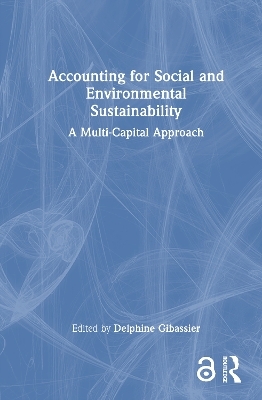
Accounting for Social and Environmental Sustainability
A Multi-Capital Approach
Seiten
2025
Routledge (Verlag)
978-1-032-88392-2 (ISBN)
Routledge (Verlag)
978-1-032-88392-2 (ISBN)
This book offers an in-depth examination of multi-capital accounting, the accounting of the future, which has already been integrated within the Corporate Sustainability Reporting Directive and will follow on from sustainability reporting.
For a company, managing its social and environmental performance is no longer just a matter of reducing its impact; it must also be able to assess its contribution to resolving or aggravating social and environmental problems. This book argues that the current work on accounting for sustainability has not yet given organisations a tool to integrate their performance within the planetary and social framework that conveys actual "planetary and social budgets", and that business organisations lack the possibility to go beyond incremental performance measurement.
It offers an in‑depth examination of multi‑capital accounting, which has already been integrated within the Corporate Sustainability Reporting Directive and will follow on from sustainability reporting. The LIFTS model (Limits and Foundations Towards Sustainability Accounting Model) used in this book combines various scientific and practical contributions to develop budgets for environmental impacts and social obligations on an organisational scale. It proposes an accounting mechanism that enables an organization to manage each of its budgets and measure variances between forecast and actual. It provides an introduction to the principles of this model and its conditions of application and describes its implementation in numerous companies.
While the main audience for the book is academics, advanced students and researchers in accounting for sustainability, business and management and economics, it will also appeal to practitioners, policymakers, national standard setters, think tanks and non-governmental organizations (NGOs).
The Open Access version of this book, available at http://www.taylorfrancis.com, has been made available under a Creative Commons Attribution-Non Commercial-No Derivatives (CC-BY-NC-ND) 4.0 license.
For a company, managing its social and environmental performance is no longer just a matter of reducing its impact; it must also be able to assess its contribution to resolving or aggravating social and environmental problems. This book argues that the current work on accounting for sustainability has not yet given organisations a tool to integrate their performance within the planetary and social framework that conveys actual "planetary and social budgets", and that business organisations lack the possibility to go beyond incremental performance measurement.
It offers an in‑depth examination of multi‑capital accounting, which has already been integrated within the Corporate Sustainability Reporting Directive and will follow on from sustainability reporting. The LIFTS model (Limits and Foundations Towards Sustainability Accounting Model) used in this book combines various scientific and practical contributions to develop budgets for environmental impacts and social obligations on an organisational scale. It proposes an accounting mechanism that enables an organization to manage each of its budgets and measure variances between forecast and actual. It provides an introduction to the principles of this model and its conditions of application and describes its implementation in numerous companies.
While the main audience for the book is academics, advanced students and researchers in accounting for sustainability, business and management and economics, it will also appeal to practitioners, policymakers, national standard setters, think tanks and non-governmental organizations (NGOs).
The Open Access version of this book, available at http://www.taylorfrancis.com, has been made available under a Creative Commons Attribution-Non Commercial-No Derivatives (CC-BY-NC-ND) 4.0 license.
Delphine Gibassier was director of the "Global Multi‑Capital Performance" Research Centre, Audencia, France.
List of figures. List of tables. List of contributors. Acknowledgements. List of acronyms and abbreviations. Introduction. 1 Multi‑capital models. 2 The LIFTS (anti‑)principles. 3 The planetary boundaries. 4 The social foundations. 5 Accounting integration. 6 Monetisation. 7 The stages of the LIFTS model. 8 The information system. 9 Environmental bankruptcy. 10 Positive impact accounting. 11 Business models and LIFTS. Conclusion. Index.
| Erscheinungsdatum | 08.01.2025 |
|---|---|
| Reihe/Serie | Routledge Studies in Accounting |
| Zusatzinfo | 15 Tables, black and white; 20 Line drawings, black and white; 3 Halftones, black and white; 23 Illustrations, black and white |
| Verlagsort | London |
| Sprache | englisch |
| Maße | 156 x 234 mm |
| Gewicht | 540 g |
| Themenwelt | Sozialwissenschaften ► Soziologie ► Spezielle Soziologien |
| Wirtschaft ► Betriebswirtschaft / Management ► Unternehmensführung / Management | |
| Wirtschaft ► Volkswirtschaftslehre | |
| ISBN-10 | 1-032-88392-8 / 1032883928 |
| ISBN-13 | 978-1-032-88392-2 / 9781032883922 |
| Zustand | Neuware |
| Informationen gemäß Produktsicherheitsverordnung (GPSR) | |
| Haben Sie eine Frage zum Produkt? |
Mehr entdecken
aus dem Bereich



aus dem Bereich
Bullshit als politische Strategie
Buch | Softcover (2025)
Kohlhammer (Verlag)
CHF 33,55
eine Einführung
Buch | Softcover (2024)
De Gruyter Oldenbourg (Verlag)
CHF 41,90
Antisemitismus und postkoloniale Debatte auf der documenta fifteen
Buch | Softcover (2025)
Campus (Verlag)
CHF 41,95


