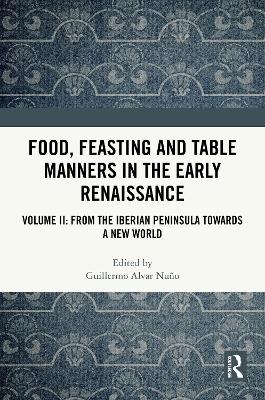
Food, Feasting and Table Manners in the Early Renaissance
Routledge (Verlag)
978-1-032-33127-0 (ISBN)
The present volume focuses on a two-fold issue: food as a cultural element that united Mediterranean European society, and food as a cultural encounter between European explorers and new worlds during the early Renaissance. Therefore, this volume continues the themes introduced in the previous monograph, Food, Feasting and Table Manners in the Late Middle Ages: Volume I: The Iberian Peninsula in the European Context, but takes into account the new, global scale of the era.
Readers will find here a panorama of what, and how, people ate in Mediterranean Europe during the fifteenth and sixteenth centuries and learn how cultural aspects of food were exported to the new lands that were explored during the Age of Discovery.
Guillermo Alvar Nuño obtained his PhD in Latin Philology from the Complutense University of Madrid. He developed his teaching career at the Université de Franche-Comté (Besançon, France, 2014–2017) and the University of Alcalá (2017–), where he currently teaches subjects related to the ancient and mediaeval worlds. As a researcher, he has worked with late antique and mediaeval pedagogical texts on the moral formation of ancient and mediaeval man. He has also researched the development of the courtly model in mediaeval Europe, the influence of classical authors in the Middle Ages and the development of Spanish humanism in the fifteenth and sixteenth centuries.
Introduction
THE IBERIAN PENINSULA AND THE FIRST GLOBAL KITCHEN, OR THE OLD WORLD VERSUS NEW WORLDS
Guillermo Alvar Nuño
Chapter 1
From a Mediterranean to a European Cuisine, from Spain to the Americas. Some Remarks about Food in the First Globalisation
María Ángeles Pérez Samper
Chapter 2
At the Table with New Social Classes. Giovanni Boccaccio’s Decameron and the Description of Meals for a Thriving Bourgeoisie
Carmen F. Blanco Valdés
Chapter 3
Eating Culture in Late Middle Ages and Early Renaissance Portugal
Luis Correia de Sousa
Chapter 4
SELF-DISCIPLINE DURING THE REIGN OF THE CATHOLIC MONARCHS: MODESTY AND ATTITUDES TOWARDS FOOD IN HERNANDO DE TALAVERA’S INSTRUCCIÓN QUE ORDENÓ PARA EL REGIMIENTO DE SU CASA
Cristina Moya García
Chapter 5
The Regulation of Morals during the Reign of the Catholic Monarchs: Food and Clothing in Hernando de Talavera’s Tractado provechoso
Teresa Jiménez Calvente
Chapter 6
At the Table of a Noble Castilian Household. The Lords of Marchena and the Use of Courtliness as a Strategy for Power
Juan Luis Carriazo Rubio
Chapter 7
Food in short chivalric narrative: an exploration of uncharted territory
Karla Xiomara Luna Mariscal
Chapter 8
Aphrodisiacs in Amatus Lusitanus: Ceres, Bacchus and food myths
Ana Isabel Martín Ferreira
Chapter 9
Feasts turned to Stone: Food in Sculpture Cycles from Seville to New Spain
Juan Clemente Rodríguez Estévez
Chapter 10
Cassava: a major staple in pre- and post-conquest America
Rudy Chaulet
Chapter 11
When the Land of the Sunset met the Land of the Rising Sun. Food in the Cultural Encounter between Iberians and the Japanese
Antonio Doñas
| Erscheinungsdatum | 06.03.2025 |
|---|---|
| Zusatzinfo | 28 Halftones, black and white; 28 Illustrations, black and white |
| Verlagsort | London |
| Sprache | englisch |
| Maße | 156 x 234 mm |
| Gewicht | 620 g |
| Themenwelt | Geschichte ► Allgemeine Geschichte ► Neuzeit (bis 1918) |
| Geschichte ► Teilgebiete der Geschichte ► Kulturgeschichte | |
| Geschichte ► Teilgebiete der Geschichte ► Wirtschaftsgeschichte | |
| Sozialwissenschaften | |
| ISBN-10 | 1-032-33127-5 / 1032331275 |
| ISBN-13 | 978-1-032-33127-0 / 9781032331270 |
| Zustand | Neuware |
| Informationen gemäß Produktsicherheitsverordnung (GPSR) | |
| Haben Sie eine Frage zum Produkt? |
aus dem Bereich