


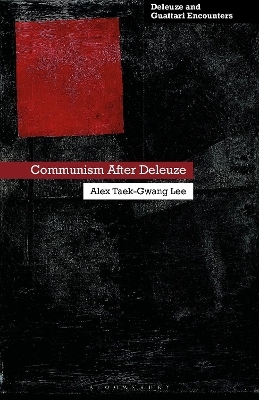
Communism After Deleuze
Seiten
2025
Bloomsbury Academic (Verlag)
978-1-350-47403-1 (ISBN)
Bloomsbury Academic (Verlag)
978-1-350-47403-1 (ISBN)
Introduces Gilles Deleuze’s concept of communism and how it lays out the extent of his critique of global capitalism.
This new reading of Gilles Deleuze forges a link between his early and later works by decoding his hidden agenda for communism.
Encoded in the idea of ‘the Third World’, Deleuze used his concept of communism as a bulwark against fascist politics and the liberal political economy. Inspired by May 68 and its aftermath, these concealed interpretations of Marx are now tacitly forgotten but can unlock a deeper understanding of Deleuze’s political project.
Often regarded as an apolitical philosopher, the challenges that Deleuze mounted to structuralism are easy to overlook. By reinvigorating the communist aspect of his political project and linking his ideas to Alain Badiou, Jacques Rancière and Slavoj Žižek, Alex Taek-Gwang Lee reveals Deleuze’s objective: to rescue Marxism from the dogmatic status quo and revive its political agendas. This major undertaking situates his ideas alongside and sets out a new framework for reading the significance of Marxist thought in postwar France. Ultimately, this new understanding of Deleuze’s critique of global capitalism opens up his vision of materialistic politics as a means of shaping the people and the proletariat of the future.
This new reading of Gilles Deleuze forges a link between his early and later works by decoding his hidden agenda for communism.
Encoded in the idea of ‘the Third World’, Deleuze used his concept of communism as a bulwark against fascist politics and the liberal political economy. Inspired by May 68 and its aftermath, these concealed interpretations of Marx are now tacitly forgotten but can unlock a deeper understanding of Deleuze’s political project.
Often regarded as an apolitical philosopher, the challenges that Deleuze mounted to structuralism are easy to overlook. By reinvigorating the communist aspect of his political project and linking his ideas to Alain Badiou, Jacques Rancière and Slavoj Žižek, Alex Taek-Gwang Lee reveals Deleuze’s objective: to rescue Marxism from the dogmatic status quo and revive its political agendas. This major undertaking situates his ideas alongside and sets out a new framework for reading the significance of Marxist thought in postwar France. Ultimately, this new understanding of Deleuze’s critique of global capitalism opens up his vision of materialistic politics as a means of shaping the people and the proletariat of the future.
Alex Taek-Gwang Lee is a professor of cultural studies at the School of Global Communication and a founding director of the Center for Technology in Humanities at Kyung Hee University, Korea.
1. Introduction: Deleuze and Minor Communism
2. Deleuze and Structuralism
3. From Anti-Oedipus to A Thousand Plateaus
4. Faciality, Ritournelle, and the Urstaat
5. Deleuze’s unwritten Marx
6. Conclusion: How Do We Recognise Deleuze’s Communism?
| Erscheinungsdatum | 24.01.2025 |
|---|---|
| Reihe/Serie | Deleuze and Guattari Encounters |
| Verlagsort | London |
| Sprache | englisch |
| Maße | 146 x 218 mm |
| Gewicht | 400 g |
| Themenwelt | Geisteswissenschaften ► Philosophie |
| Sozialwissenschaften ► Politik / Verwaltung ► Politische Systeme | |
| Sozialwissenschaften ► Politik / Verwaltung ► Politische Theorie | |
| ISBN-10 | 1-350-47403-7 / 1350474037 |
| ISBN-13 | 978-1-350-47403-1 / 9781350474031 |
| Zustand | Neuware |
| Informationen gemäß Produktsicherheitsverordnung (GPSR) | |
| Haben Sie eine Frage zum Produkt? |
Mehr entdecken
aus dem Bereich


aus dem Bereich
Das politische System der USA und die Zukunft der Demokratie
Buch | Hardcover (2025)
C.H.Beck (Verlag)
CHF 39,20
Russland, Europa, Amerika
Buch | Softcover (2025)
C.H.Beck (Verlag)
CHF 25,20


