


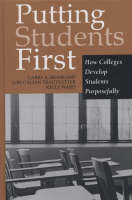
Putting Students First
Anker Publishing Co (Verlag)
978-1-882982-94-3 (ISBN)
- Titel ist leider vergriffen;
keine Neuauflage - Artikel merken
Putting Students First offers perspectives and recommendations in areas of holistic student development such as * Understanding millennial college students * The role of faculty in defining culture * The design and implementation of curriculum * The impact of cocurricular involvement * Fostering relationships with on-campus and off-campus communities By organizing the campus environment into "4Cs"-culture, curriculum, cocurriculum, and community-the authors create a conceptual framework for faculty, student affairs staff, and administrators to discuss, plan, and create college environments that effectively support the learning and development of students. Each chapter includes an introduction, evidence and analysis, a summary, and questions to help readers consider how to develop students holistically on their own campuses.
Larry A Braskamp received his B.A. from College and his M.A. and Ph.D. from the University of Iowa. In 1967, he joined the University of Nebraska-Lincoln as a professor in the department of Educational Psychology, where he received a Distinguished Teacher Award. After serving at Nebraska as assistant to the chancellor, he came to the University of Illinois at Urbana-Champaign in 1976. There he held a number of administrative positions, including associate vice chancellor for academic affairs, director of the Office of Instructional and Management Services and acting dean of the College of Applied Life Studies. He was dean of the College of Education at the University of Illinois at Chicago (UIC) from 1989-1996. From 1996-1997, he was professor of policy studies in the College of Education and a faculty fellow in the International Center for Health Leadership Development at UIC. Currently he is professor emeritus of education at Loyola University Chicago, where he served as senior vice president for academic affairs and senior fellow at the Association of American Colleges and Universities. His research interests include the role of church colleges in American Higher education and the role of faculty assessment in faculty development and organization decision-making. He is the coauthor or coeditor of six books, including Assessing Faculty Work: Enhancing Individual and Institutional Performance (Jossey-Bass, 1994), Evaluation of Campus Services and Programs (Jossey-Bass, 1987), and The Motivation Factor: A Theory of Personal Investment (Lexington Books, 1986), and has published more than 100 research articles and papers. Lois Calian Trautvetter is associate director for Northwestern University's Higher Education Administration and Policy Program and assistant professor in the School of Education and Social Policy. She received her Ph.D. in higher education administration from the University of Michigan, her M.S. in polymer chemistry from Carnegie Mellon University, and her B.A. in chemistry from the University of Michigan, her M.S. in polymer chemistry from Carnegie Mellon University, and her B.A. in chemistry from The College of Wooster. She teaches college student development theory and research methodology courses. Her research interests include faculty and professional development issues such as productivity, enhancing research and teaching, motivation, and new and junior faculty. She is also interested the role, of church colleges in American higher education as well as professional development for K-12 teachers to improve math and science teaching, gender issues, and females in science. She participated as a researcher in the past two postsecondary national centers for education funded by the Department of Education (Office of Education Research and Improvement) and has written book chapters and articles on faculty. She also has patents as a chemist in the coatings and resins industry. Kelly Ward is associate professor of higher education at Washington State University. Her research interests are in the areas of faculty work, including balancing teaching, research, and service; faculty involvement in the community; and balancing work and family for those on the tenure track. She is also interested in campus and community engagement, service-learning, and policy issues related to equity and diversity. Dr. Ward has held faculty and administrative positions at Oklahoma State University and the University of Montana. She earned her Ph.D. in higher education from Penn State University.
About the Authors. Foreword. Acknowledgements. Introduction. 1 Putting Students First. Introduction. Why Is It Important to Put Students and Their Development First? Who Are Today's College Students? Who Develops These Students? In What Context Is Holistic Development Occurring? Why Study Church-Related Colleges and Universities? Summary. 2 Conceptual Framework and Design of the Project. Introduction. Theoretical Bases for Holistic Student Development. Faith, Spirituality, and Student Development. Student Development and the Church-Related Context. Conceptual Framework: Personal Investment Theory. Project Design. Summary. 3 Culture. Introduction. Discerning and Acting on Institutional Mission. Copyrighted Material. vi Putting Students First. Building on a Legacy. Communicating Institutional Mission and Identity. Leadership. College Location. Campus Facilities. Expectations and Contributions of Faculty. Faculty as Role Models. Using a Career Perspective on Faculty Development. Faculty Evaluation as a Reflection of Culture. Support and Challenge. Summary. Questions for Campus Conversations. 4 Curriculum. Introduction. Philosophical Foundations of the Curriculum. Centrality of a Liberal Arts Education. Integrating Faith and Learning. Worldviews. Pedagogy. Developmentally Tailored Experiences for Students. Pedagogy of Engagement: Field-Based and Community-Based Learning. Summary. Questions for Campus Conversations. 5 Cocurriculum. Introduction. Mutual Reinforcement of Learning. Campus Rituals. Residence Life. Student Leadership. Relationships With Coaches, Professional Staff, and Campus Ministry. Faculty Interactions. Immersion Experiences. Summary. Questions for Campus Conversations. 6 Community. Introduction. Shared Governance. Defining Community. Maintaining Community Amidst Change. Diversity Within Community. Communities Beyond the Campus. Dealing With Difference and External Communities. Summary. Questions for Campus Conversations. 7 Creating Communities That Put Students First. Introduction. Chapter Overview. Mission Is Reality, Not Rhetoric. Learning and Development Are Integrated. The Campus Community Fosters Support and Challenge. Summary. Bibliography. Index.
| Erscheint lt. Verlag | 25.9.2007 |
|---|---|
| Reihe/Serie | JB-Anker |
| Verlagsort | Bolton |
| Sprache | englisch |
| Maße | 155 x 237 mm |
| Gewicht | 488 g |
| Themenwelt | Sozialwissenschaften ► Pädagogik |
| ISBN-10 | 1-882982-94-0 / 1882982940 |
| ISBN-13 | 978-1-882982-94-3 / 9781882982943 |
| Zustand | Neuware |
| Informationen gemäß Produktsicherheitsverordnung (GPSR) | |
| Haben Sie eine Frage zum Produkt? |
aus dem Bereich


