


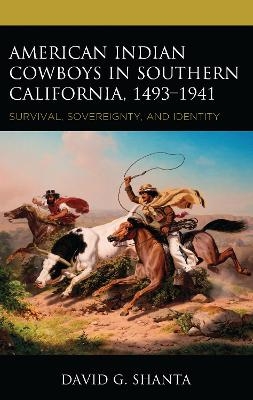
American Indian Cowboys in Southern California, 1493–1941
Survival, Sovereignty, and Identity
Seiten
2024
Lexington Books (Verlag)
978-1-6669-5704-4 (ISBN)
Lexington Books (Verlag)
978-1-6669-5704-4 (ISBN)
This book examines how California Indigenous groups forged a new economy based on cattle, opening the door to the assertion and recognition of American Indian sovereignty over ancestral lands by the United States. Shanta reflects on how they survived, kept their cultures alive, and gained recognition of their sovereign status.
In 1769–1770, Spanish Catholic missionaries, soldiers, and Cochimí Indians of Baja California launched The Sacred Expedition to Alta California, to claim it for God and King. Domesticated animals like horses and cattle provided food security in the continual expansion of the Spanish empire. The rapidly increasing herds consumed traditional sources of Indigenous foods, medicines, tools, and weapons and soon outstripped the ability of soldiers and priests to control them. This reality forced the Spanish to train trusted Indian converts in the art of cowboying and cattle ranching. In this book, David G. Shanta provides new insights into the impact of horses and cattle on the Indigenous peoples of the Spanish Borderlands after early colonization. American Indian cowboys formed the backbone of Spanish mission economies, the international trade in cowhides and tallow that created the Mexican ranchero class known as Californios, and later on American cattle operations. Shanta shows that California Native peoples first adopted cowboying and cattle ranching, as a survival strategy. They acquired and ran their own herds, forming a new, California Indian economy based on cattle. This new economy reinforced their demands for sovereignty over their ancestral lands. This book affirms the innovative nature of American Indian Cowboys and brings to light how they survived, gained recognition of their sovereign status, and incorporated cowboying and cattle ranching into family traditions and tribal identities.
In 1769–1770, Spanish Catholic missionaries, soldiers, and Cochimí Indians of Baja California launched The Sacred Expedition to Alta California, to claim it for God and King. Domesticated animals like horses and cattle provided food security in the continual expansion of the Spanish empire. The rapidly increasing herds consumed traditional sources of Indigenous foods, medicines, tools, and weapons and soon outstripped the ability of soldiers and priests to control them. This reality forced the Spanish to train trusted Indian converts in the art of cowboying and cattle ranching. In this book, David G. Shanta provides new insights into the impact of horses and cattle on the Indigenous peoples of the Spanish Borderlands after early colonization. American Indian cowboys formed the backbone of Spanish mission economies, the international trade in cowhides and tallow that created the Mexican ranchero class known as Californios, and later on American cattle operations. Shanta shows that California Native peoples first adopted cowboying and cattle ranching, as a survival strategy. They acquired and ran their own herds, forming a new, California Indian economy based on cattle. This new economy reinforced their demands for sovereignty over their ancestral lands. This book affirms the innovative nature of American Indian Cowboys and brings to light how they survived, gained recognition of their sovereign status, and incorporated cowboying and cattle ranching into family traditions and tribal identities.
David G. Shanta is lecturer in the Department of History at California State University, San Bernardino.
List of Tables and Figures
Acknowledgments
Introduction
Chapter One: Spanish Origins of California Mission Cattle
Chapter Two: Marches to New California, 1769?1781
Chapter Three: California Mission Cattle and Indian Vaqueros 1769?1833
Chapter Four: Hides and Tallow: Native American Labor and the Rise of Californio Society, 1833?1848
Chapter Five: The Early American Period, 1848?1890
Chapter Six: “Not Citizens but Subjects,” 1891?1920
Chapter Seven: A New Economy Based on Cattle, 1921?1941
Conclusion
Bibliography
About the Author
| Erscheinungsdatum | 25.09.2024 |
|---|---|
| Zusatzinfo | 5 BW Photos, 2 Tables |
| Sprache | englisch |
| Maße | 157 x 235 mm |
| Gewicht | 472 g |
| Themenwelt | Sachbuch/Ratgeber ► Geschichte / Politik ► Regional- / Landesgeschichte |
| Geisteswissenschaften ► Geschichte ► Regional- / Ländergeschichte | |
| Sozialwissenschaften ► Ethnologie | |
| Sozialwissenschaften ► Soziologie | |
| ISBN-10 | 1-6669-5704-6 / 1666957046 |
| ISBN-13 | 978-1-6669-5704-4 / 9781666957044 |
| Zustand | Neuware |
| Informationen gemäß Produktsicherheitsverordnung (GPSR) | |
| Haben Sie eine Frage zum Produkt? |
Mehr entdecken
aus dem Bereich



aus dem Bereich
eine Geschichte der Vereinigten Staaten von 1950 bis heute
Buch | Hardcover (2024)
Klett-Cotta (Verlag)
CHF 48,95


