


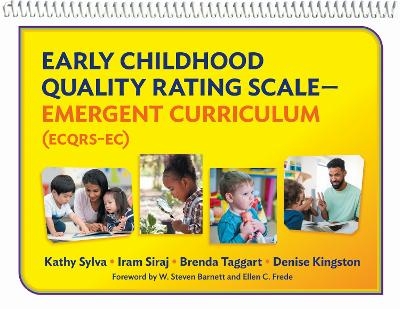
Early Childhood Quality Rating Scale—Emergent Curriculum (ECQRS-EC)
Teachers' College Press (Verlag)
9780807786550 (ISBN)
"Using the ECQRS-EC as a teacher self-assessment tool would be extremely effective for ensuring that teachers understand the intentional pedagogical strategies that enhance learning... Large-scale use in state and other continuous improvement systems can help to provide all children with the early childhood education each needs to thrive." —From the Foreword by W. Steven Barnett and Ellen C. Frede, co-directors, National Institute for Early Education Research, Rutgers, the State University of New Jersey
Young children's learning depends on a wide range of experiences that support their holistic development. While many different curricular frameworks are used around the world, there is increasing agreement that the emerging academic skills of language and literacy, mathematics, and science should be supported by a playful pedagogy in the early years. The Early Childhood Quality Rating Scale—Emergent Curriculum (ECQRS-EC) is designed to measure quality in these key areas within preschool settings.
In addition to three content-area subscales, this evidence-based tool includes a subscale dedicated to diversity and inclusion to help educators support gender and cultural differences in children 3– years old who are developing at different rates. Because it recognizes the important role of the adult in providing children with high-quality interactions, this new quality rating scale can be used for research, teacher self-evaluation, and program improvement, audit, and regulation.
Book Features:
Focuses on the role of the early childhood educator, their pedagogy, and planning.
Items are firmly grounded in culturally and developmentally appropriate practice.
Diversity Subscale, "Supporting Diversity and Inclusion," reflects the importance of sensitivity to supporting special needs and being inclusive of all cultures, including Indigenous people.
Kathy Sylva is Professor of Educational Psychology at the University of Oxford. She has researched extensively in the education and care of young children, with a special interest in the effects of early education and also the role of education in combating social disadvantage. Iram Siraj is Professor of Child Development and Education at the University of Oxford, UK and Research Professor, University of Maynooth, Ireland. She is coauthor of each of the Curriculum, Leadership and Interaction Quality Rating Scales (CLIQRS) and has led several RCTs on effective professional learning. Brenda Taggart is an Honorary Senior Research Associate at University College London Institute of Education. She co-led on the Effective Pre-school, Primary, and Secondary Education (EPPSE 997-2 4). Her background is in teaching and research that explores the impact of educational initiatives. Denise Kingston is Senior Researcher at Oxford University and an Honorary Research Fellow at the University of Sussex. She is a specialist in children's development, with a background in educational psychology. Her research focus is effective professional development and early childhood pedagogy and practice.
Contents
Foreword by W. Steven Barnett and Ellen C. Frede vii
Introduction to the Early Childhood Quality Rating Scale—Emergent Curriculum (ECQRS-EC)
The Underlying Principles of ECQRS-EC 3
Rationale for the Development of New Items and Indicators in the ECQRS-EC 5
Language and Emergent Literacy 5
Changes to and Additional Items in Emergent Mathematics 5
Emergent Science 7
The Overlap Between the Sustained Shared Thinking and Emotional Well-Being Scale (SSTEW) and Mathematics and Science Items in ECQRS-EC 7
Supporting Diversity and Inclusion 8
Reliability and Validity 9
Content of the ECQRS-EC Scales
Preparing to Use the ECQRS-EC 3
Timing 3
Contextual Information on the Center 3
Definitions 3
Optional Scoring Systems 4
Conducting the Observation 5
Scoring the Scales
ECQRS-EC and the "Spirit of the Scales" 7
Cautions in Use 7
Using ECQRS-EC as a Self-Assessment and Improvement Tool 7
Making Judgments 8
Use of Supplementary (Nonobservation) Evidence 2
The Score Sheet, Joint Observation Sheet, and ECQRS-EC Profile 22
Content of the Scales 23
Subscale : Language and Emergent Literacy 24
Item : Environmental Print: Letters and Words 24
Item 2: Book and Literacy Areas 2
Item 3: Adults Reading With the Children 28
Item 4: Sounds in Words 3
Item 5: Emergent Writing/Mark Making 32
Item : Talking and Listening 34
Item 7: Words and Sentences 3
Subscale 2: Emergent Mathematics 38
Item 8: Counting and the Application of Counting 38
Item 9: Understanding and Representing Number 4
Item : Math Talk and Thinking Mathematically 44
Item a: Mathematical Activities: Shape 48
Item b: Mathematical Activities: Sorting, Matching, and Comparing 5
Item c: Mathematical Activities: Subitizing 52
Subscale 3: Emergent Science 5
Item 2: Natural Materials 5
Item 3: Areas Featuring Science/Science Resources 58
Item 4: Developing Scientific Thinking and the Scientific Process
Item 5a: Science Activities: Nonliving 2
Item 5b: Science Activities: Living Processes 4
Item 5c: Science Activities: Food Preparation
Subscale 4: Supporting Diversity and Inclusion 8
Item : Planning for and Supporting Individual Learning Needs 8
Item 7: Gender Equality and Awareness 7
Item 8: Race Equality and Awareness 72
The ECQRS-EC Information Sheet 74
Rough Plan of Indoor and/or Outdoor Areas Being Observed 75
Score Sheet 77
Joint Observation/Inter-Rater Reliability for the ECQRS-EC 83
ECQRS-EC Profile 84
References 85
| Erscheinungsdatum | 05.01.2025 |
|---|---|
| Vorwort | W. Steven Barnett |
| Verlagsort | New York |
| Sprache | englisch |
| Maße | 279 x 216 mm |
| Themenwelt | Sozialwissenschaften ► Pädagogik ► Vorschulpädagogik |
| ISBN-13 | 9780807786550 / 9780807786550 |
| Zustand | Neuware |
| Informationen gemäß Produktsicherheitsverordnung (GPSR) | |
| Haben Sie eine Frage zum Produkt? |
aus dem Bereich


