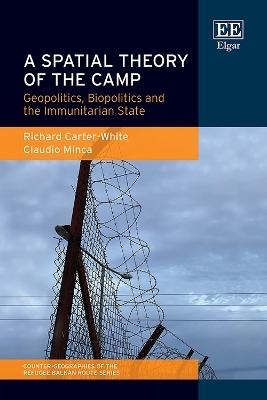
A Spatial Theory of the Camp
Edward Elgar Publishing Ltd (Verlag)
9781800887688 (ISBN)
From concentration camps to refugee settlements, there is little consensus about what exactly defines ‘the camp’. This timely and comprehensive book adopts a geographical perspective to develop a spatial theory of the camp, advancing the interdisciplinary field of camp studies. Richard Carter-White and Claudio Minca explore the spatial logics and practices that unite different camps, demonstrating why the camp has become such an integral tool of contemporary governance and what this reveals about the geopolitics and biopolitics of the modern nation-state.
Through a thorough parallel analysis of historical concentration camps and contemporary refugee camps, this book conceptualizes ‘the camp’ as an institution through which selected groups and individuals are included in society through a set of exclusionary practices. Providing an innovative and multifaceted geographical analysis of camp contexts, chapters focus on the examples of Auschwitz concentration camp and refugee camps along the Balkan Route. Throughout the analysis, the book draws upon Roberto Esposito’s political philosophy to theorize that camps are an attempt at ‘immunizing’ the nation-state from its inherent state of crisis.
A Spatial Theory of the Camp will be an indispensable reference for those interested in camp studies. It will also be beneficial to students and academics of human geography, political philosophy, Holocaust studies, and refugee and migration studies.
Richard Carter-White, Senior Lecturer in Human Geography, School of Communication, Society and Culture, Macquarie University, Australia and Claudio Minca, Professor of Geography, Department of History and Cultures, University of Bologna, Italy
Contents
Preface
1 What is a camp?
PART I CONCEPTUALIZING THE CAMP
2 Camp geographies, camp spatialities
3 Camp theory
4 Camp methodologies
PART II GEOPOLITICS
5 Concentration camp geopolitics
6 Camp geopolitics along the Balkan Route
PART III EXCEPTION
7 Auschwitz and the ‘double exception’
8 Thresholds: the biopolitics of camps and jungles along the Balkan Route
PART IV COMMUNITY
9 Life and community in the concentration camp
10 Refugee camp communities
PART V TEMPORALITY
11 After Auschwitz
12 Camp temporalities along the Balkan Route
13 No camps
Bibliography
Index
| Erscheinungsdatum | 14.05.2025 |
|---|---|
| Reihe/Serie | Counter-geographies of the Refugee Balkan Route series |
| Verlagsort | Cheltenham |
| Sprache | englisch |
| Maße | 156 x 234 mm |
| Themenwelt | Naturwissenschaften ► Geowissenschaften ► Geografie / Kartografie |
| Sozialwissenschaften ► Politik / Verwaltung | |
| Sozialwissenschaften ► Soziologie | |
| ISBN-13 | 9781800887688 / 9781800887688 |
| Zustand | Neuware |
| Informationen gemäß Produktsicherheitsverordnung (GPSR) | |
| Haben Sie eine Frage zum Produkt? |
aus dem Bereich