


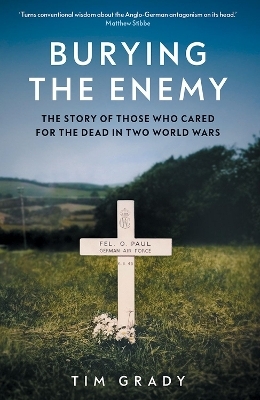
Burying the Enemy
The Story of Those who Cared for the Dead in Two World Wars
Seiten
2025
Yale University Press (Verlag)
978-0-300-27397-7 (ISBN)
Yale University Press (Verlag)
978-0-300-27397-7 (ISBN)
A fascinating and moving history of the British and German war dead buried on enemy soil in the two world wars
Why do societies only remember their own national war dead? Today, the enemy dead might be largely hidden from view, but this wasn’t always the case. During both world wars, Germans and Britons died in their thousands in enemy territory. From Berlin to Bath, London to Leipzig, civilian communities buried the enemy in the closest parish churchyard. Perhaps surprisingly, local people embraced these graves, often caring for them with considerable tenderness.
Tim Grady explores the history of this curious aspect of postwar community. He reveals how, as the two states moved bodies to new military cemeteries, local people protested at the disturbance of the dead, and ties between the bereaved families and those who cared for the graves were severed forever. With the enemy out of sight and mind, the British and Germans concentrated solely on commemorating their own war dead, and their own sacrifices. Today’s insular public memory of the world wars was only made possible by clearing away signs of the enemy—allowing people to tell themselves much simpler narratives of the recent past as a result.
Why do societies only remember their own national war dead? Today, the enemy dead might be largely hidden from view, but this wasn’t always the case. During both world wars, Germans and Britons died in their thousands in enemy territory. From Berlin to Bath, London to Leipzig, civilian communities buried the enemy in the closest parish churchyard. Perhaps surprisingly, local people embraced these graves, often caring for them with considerable tenderness.
Tim Grady explores the history of this curious aspect of postwar community. He reveals how, as the two states moved bodies to new military cemeteries, local people protested at the disturbance of the dead, and ties between the bereaved families and those who cared for the graves were severed forever. With the enemy out of sight and mind, the British and Germans concentrated solely on commemorating their own war dead, and their own sacrifices. Today’s insular public memory of the world wars was only made possible by clearing away signs of the enemy—allowing people to tell themselves much simpler narratives of the recent past as a result.
Tim Grady is professor of modern history at the University of Chester. He is the author of A Deadly Legacy, which was shortlisted for the Wolfson History Prize and the Cundill Prize, and The German-Jewish Soldiers of the First World War in History and Memory, which was proxime accessit for the RHS Gladstone Book Prize.
| Erscheinungsdatum | 08.03.2025 |
|---|---|
| Zusatzinfo | 39 b-w illus.+ 2 maps |
| Sprache | englisch |
| Maße | 152 x 235 mm |
| Themenwelt | Geschichte ► Allgemeine Geschichte ► Neuzeit (bis 1918) |
| Geschichte ► Allgemeine Geschichte ► 1918 bis 1945 | |
| Geschichte ► Teilgebiete der Geschichte ► Militärgeschichte | |
| Sozialwissenschaften ► Soziologie ► Mikrosoziologie | |
| ISBN-10 | 0-300-27397-5 / 0300273975 |
| ISBN-13 | 978-0-300-27397-7 / 9780300273977 |
| Zustand | Neuware |
| Informationen gemäß Produktsicherheitsverordnung (GPSR) | |
| Haben Sie eine Frage zum Produkt? |
Mehr entdecken
aus dem Bereich
aus dem Bereich
Geschichte einer wilden Handlung
Buch | Hardcover (2024)
C.H.Beck (Verlag)
CHF 47,60


