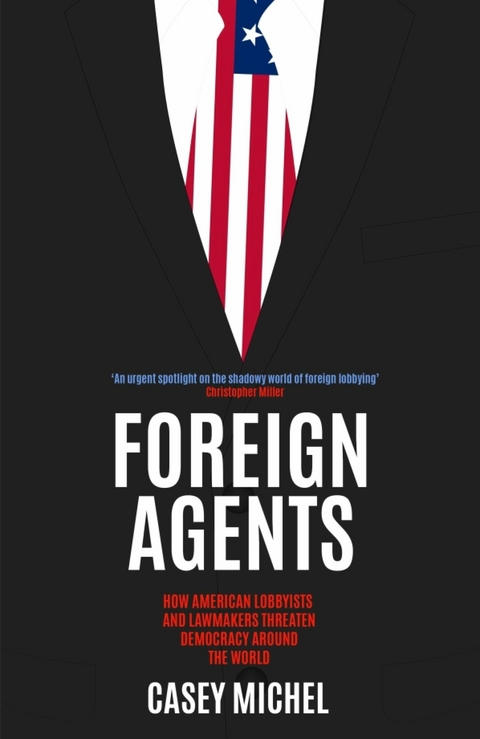
Foreign Agents (eBook)
320 Seiten
Icon Books (Verlag)
9781837731893 (ISBN)
Casey Michel is an author, journalist, and director of the Combating Kleptocracy Program with the Human Rights Foundation. He is the author of American Kleptocracy, named by The Economist as one of the 'best books to read to understand financial crime.' His writing on offshoring, foreign lobbying, authoritarianism, and illicit wealth has appeared in Financial Times, The Wall Street Journal, The Atlantic, Foreign Affairs, and The Washington Post, among other outlets, and he has appeared on NPR, BBC, CNN, and MSNBC, among other stations. He has also testified in front of the Senate Judiciary Committee on the links between illicit financial networks and national security. He received his Master's degree in Russian, Eurasian, and East European Studies from Columbia University's Harriman Institute, and served as a Peace Corps Volunteer in northern Kazakhstan. Foreign Agents is his second book.
Casey Michel is an author, journalist, and director of the Combating Kleptocracy Program with the Human Rights Foundation. He is the author of American Kleptocracy, named by The Economist as one of the 'best books to read to understand financial crime.' His writing on offshoring, foreign lobbying, authoritarianism, and illicit wealth has appeared in Financial Times, The Wall Street Journal, The Atlantic, Foreign Affairs, and The Washington Post, among other outlets, and he has appeared on NPR, BBC, CNN, and MSNBC, among other stations. He has also testified in front of the Senate Judiciary Committee on the links between illicit financial networks and national security. He received his Master's degree in Russian, Eurasian, and East European Studies from Columbia University's Harriman Institute, and served as a Peace Corps Volunteer in northern Kazakhstan. Foreign Agents is his second book.
Prologue: Bad Business
The first thing I learned at school was that some people are idiots; the second thing I learned was that some are even worse.
—Orhan Pamuk1
On May 19, 1934, a man named Ivy Lee sat in front of a row of American congressional officials, all of whom were trying to determine whether Lee was secretly working for a new regime in Germany known as the Nazis.
Lee wasn’t an unknown figure to these officials. There in his starched collar and his pinstriped suit, his heavy cheeks beginning to sweat in the stuffy room, Lee cut a familiar look. By the early 1930s, Lee was already an American celebrity: a man close to politicians, tycoons, and cultural icons alike, steering their careers and their policies—and the direction of the country writ large. Not long before, Lee had launched a brand-new industry, which quickly roared across the nation. To his proponents, this new enterprise was the savior of American capitalism: an amalgamation of advertising and advice, useful to both business owners and political forces trying to navigate the strains of the early twentieth century. To his detractors, it was simply an excuse to plaster decorum on outright deceit, spinning lies in the service of deep-pocketed clients who were trying to protect their wealth from the masses.
The field was still hazy to most Americans, including those congressional officials now peering down at Lee. “Your business is what?” asked John McCormack, a Democrat who chaired the committee Lee sat in front of, known as the House Un-American Activities Committee.2
Lee looked back at him. “It is very difficult to describe, Mr. Chairman,” he replied. “Some people call it ‘publicity agent.’ Some people call it ‘counsel in public relations.’ But that would give you a general idea of it.”3 Even Lee may not have known what he’d launched.
But others noticed. This new industry—this new field of “public relations,” as it was eventually described—had brought Lee clients from across the country. There were the giants of the Gilded Age who’d turned to Lee to help bury controversies—people like the Rockefellers, who relied on Lee to help cover up some of the worst massacres in American history. There were the copper and steel and banking magnates, turning to Lee to thwart any kind of regulatory oversight. There were the plutocrats of the railroad industry, who still maintained a stranglehold on American transit, depending on Lee to retain their monopolies. And there were the politicians of the era, deep in the pockets of these American oligarchs, relying on Lee’s assistance in blocking the progressive forces rising around the nation.
But they weren’t the only ones. As Lee found success after success in America, international clients came calling, from across the political spectrum. The forces of fascism gaining ground in Italy welcomed Lee with open arms. Rising totalitarians in Moscow were likewise eager to see what kind of opportunities Lee might be able to unlock.
And there, in Germany, was a client who recruited Lee in the early 1930s: a company named I.G. Farben, which was concerned, as Lee told American officials on that day in 1934, with how Germany was perceived in the United States—and how Lee might be able to improve things.
The higher-ups at I.G. Farben knew Lee’s talents. They’d read about his connections and his cant, his willingness to open doors for—and whitewash—whichever clients were willing to pay the most for his services. As Lee revealed to congressional investigators, I.G. Farben was happy to pay for Lee’s work, for some of these “public relations” services they’d heard so much about, if only he’d make it easier for Germany to improve its image in the United States—and expand the efforts and success of a new dictatorship building in Berlin. “The directors of the company told me they were very much concerned over the German relationships with the United States, and antagonism toward Germany in the United States,” Lee admitted during the hearing. “They wanted advice as to how those relations could be improved. So they made an arrangement with me to give them such advice.”4 And that, to Lee, was all it was: an honest arrangement, based on honest advice. He’d broken no laws. He’d committed no crimes. And he was happy to take payment—the equivalent of more than half a million dollars, adjusting for inflation—for just such assistance.
Lee claimed that the guidance he offered was only to I.G. Farben— not that such advice was especially controversial, anyway. He told his German counterparts that if they wanted the regime in Berlin—which Lee preferred to refer to as the “German government” rather than Nazis—to succeed, they should avoid blatantly obvious propaganda. “Our people regard it as meddling with American affairs, and it was bad business,” Lee claimed. (When McCormack asked if Lee would ever consider acting as a mouthpiece for propaganda, Lee stiffened, saying that he’d “taken the position long ago that I would not disseminate anything, any [propaganda], however innocuous.”)5 Instead, Lee advised that the Nazis should “establish closer relationships . . . with American press correspondents located in Germany” and try to get those journalists to disseminate Nazi messaging. That, Lee told his German partners, was key: finding trusted mouthpieces and middlemen who could blast Nazi messaging far and wide, all for the sake of improving relations between the United States and Germany.
But as the questions continued, Lee revealed that it wasn’t just advice he had provided. He admitted that he’d also charged one of his employees to monitor American media for “what they are saying about Germany.” Lee would then relay the themes, as well as his thoughts, to his German contacts. All the better for German counterparts to craft their messages for American audiences—and for American audiences to understand that this new regime in Berlin was one worth supporting.
The hearing never grew heated, never grew especially raucous. (As Lee cooed at one point, “My dear sir, I am perfectly delighted to cooperate.”) His polished demeanor, though, belied a tension Lee had never known: a tension suddenly bubbling to the surface, breaking around Washington, spilling across Europe. Because no matter how much Lee tried to deny any connection between the Nazis and I.G. Farben, the American legislators refused to bite. “In other words, the material that was sent here by [I.G. Farben] was material spread—we would call it propaganda—by authority of the German Government,” Rep. Samuel Dickstein said at one point, pointing to items I.G. Farben had shipped to Lee. “But the distinction that you make in your statement is, as I take it, that the German Government did not send it to you directly; that it was sent to you by [I.G. Farben].” As Dickstein laid out, Lee’s claims that he’d advised only I.G. Farben were a deflection. In reality, the company—a conglomerate later responsible for, among other things, producing the poison gas that would slaughter millions of Jewish victims—was simply a cutout, a middleman between Lee and his ultimate Nazi clients. As Lee mumbled in response, “Right.”6
As the hearing wore on, and as the connections between Lee and the Nazis became obvious, Lee’s defenses began to slip. He admitted he’d been recruited by I.G. Farben chief Max Ilgner, a Nazi collaborator who would later oversee key pieces of Germany’s economy during the Second World War. He admitted meeting directly with Nazi propaganda chief Joseph Goebbels and having a “very interesting conversation” with the war criminal. He’d even met personally with Adolf Hitler, telling the tyrant that he’d “like better to understand him if I could”—all the better to help craft the Nazis’ message for American audiences. And he admitted that he’d advised the Nazis—via their I.G. Farben cutout—on the best way to spin Germany’s growing stockpile of military weaponry, “to make clear to the American people” that these arms weren’t actually a threat.7
As Lee finished testifying, he thanked the officials, once more with the kind of obsequious, oleaginous manners that had served him so long. His body, and especially his scalp, ached, and he’d already begun making plans for a trip back to Germany, hoping to enjoy the soothing spa treatments that he thought might help. At fifty-seven, he deserved a breather, a break from this sudden pressure from Americans wondering just who he was working for, and just what impact he might be having on American policy. Plus, he wanted to check in on those clients he’d just described: those Germans who’d paid him phenomenal sums to help open doors, crafting messages for unsuspecting audiences— crafting messages that would help the Nazis rise, reign, and wreak havoc across the European continent.
Lee left that afternoon, sweat curdling around his collar, preparing for projects and clients to come. He had no inkling that the fallout from the hearing he’d just participated in would, in only a few short months, kill him, detonating the reputation he’d spent decades building—or that, nearly a century later, the kinds of links he’d created with the Nazis would come roaring back and nearly undo American democracy in the...
| Erscheint lt. Verlag | 29.8.2024 |
|---|---|
| Verlagsort | London |
| Sprache | englisch |
| Themenwelt | Sozialwissenschaften ► Politik / Verwaltung |
| ISBN-13 | 9781837731893 / 9781837731893 |
| Informationen gemäß Produktsicherheitsverordnung (GPSR) | |
| Haben Sie eine Frage zum Produkt? |
 EPUB (Wasserzeichen)
DRM: Digitales Wasserzeichen
Dieses eBook enthält ein digitales Wasserzeichen und ist damit für Sie personalisiert. Bei einer missbräuchlichen Weitergabe des eBooks an Dritte ist eine Rückverfolgung an die Quelle möglich.
Dateiformat: EPUB (Electronic Publication)
EPUB ist ein offener Standard für eBooks und eignet sich besonders zur Darstellung von Belletristik und Sachbüchern. Der Fließtext wird dynamisch an die Display- und Schriftgröße angepasst. Auch für mobile Lesegeräte ist EPUB daher gut geeignet.
Systemvoraussetzungen:
PC/Mac: Mit einem PC oder Mac können Sie dieses eBook lesen. Sie benötigen dafür die kostenlose Software Adobe Digital Editions.
eReader: Dieses eBook kann mit (fast) allen eBook-Readern gelesen werden. Mit dem amazon-Kindle ist es aber nicht kompatibel.
Smartphone/Tablet: Egal ob Apple oder Android, dieses eBook können Sie lesen. Sie benötigen dafür eine kostenlose App.
Geräteliste und zusätzliche Hinweise
Buying eBooks from abroad
For tax law reasons we can sell eBooks just within Germany and Switzerland. Regrettably we cannot fulfill eBook-orders from other countries.
aus dem Bereich