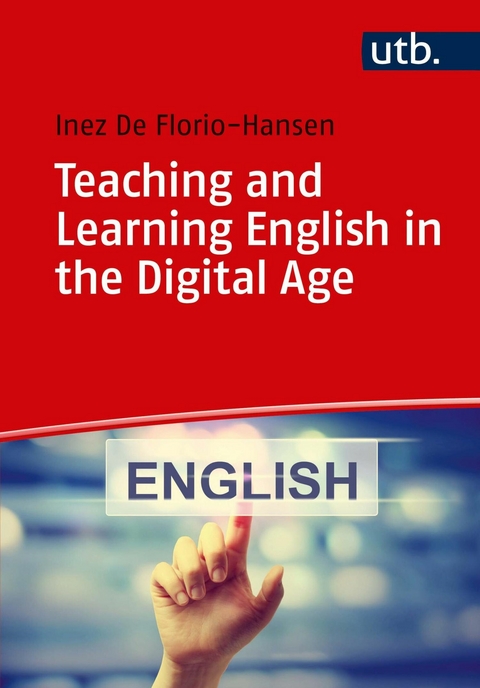
Teaching and Learning English in the Digital Age (eBook)
332 Seiten
UTB GmbH (Verlag)
978-3-8385-4954-5 (ISBN)
First of all, teaching and learning English in the digital age means using digital tools in TEFL classrooms. This introduction exemplifies how to implement them in a meaningful way in combination with reliable methods (for additional practice-oriented teaching and learning suggestions see: https://www.deflorio.de/blog . A further important aspect of digitization is teaching and learning about media. Teachers have to create and deploy opportunities that allow students to develop a critical stance toward media in general and digital media in particular. This introduction to TEFL shows that the rapidly increasing influences of digitization lead to more internationalized and globalized science-based approaches to teaching and learning English. In this perspective, digitization offers an opportunity to rethink and reshape didactic concepts.
Introductory remarks 9
Part 1: Basic issues of TEFL
1. Introduction:
Fremdsprachendidaktik and Foreign Language Pedagogy 11
1.1 The aims of Fremdsprachendidaktik 12
1.2 The contributions of Sprachlehrforschung to Foreign Language Teaching 16
2 Scientific disciplines related to Foreign Language Teaching
(Bezugswissenschaften) 20
2.1 General remarks: Allgemeine Didaktik 21
2.2 Processes of learning EFL 23
2.3 Processes of teaching EFL 27
2.4 Contributions to content aspects of TEFL 32
3. Research methods 42
3.1 Research design and research methodology 43
3.2 A conventional differentiation: qualitative and quantitative research methods 45
3.3 Further approaches: descriptive and explanatory research 48
3.4 Evidence-based research and meta-analyses 53
4 Communicative Competence and Communicative Language Teaching (CLT) 61
4.1 The occurrence of CLT 62
4.2 The development of CLT in Germany 62
4.3 The development of CLT in the English-speaking countries 64
4.4 Further influences of CLT 66
4.5 Trivializations and misunderstandings 67
5 Implementing CLT: issues of methodology 73
5.1 Approach, strategy/method and technique 74
5.2 Implementing CLT in TEFL classrooms 77
6 Official recommendations: Council of Europe and European Centre for Modern Languages 98
6.1 Relevant aims of the Council of Europe (CoE) and the European Centre for Modern Languages (ECML) 99
6.2 Threshold Level, Common European Framework of Reference and the Companion Volume with New Descriptors 101
6.3 The European Language Portfolio 109
7 Official studies and guidelines: Standing Conference (KMK) and affiliated institutions 118
7.1 From PISA to DESI 119
7.2 KMK-Standards and the Institute for Quality Development in Education (IQB) 126
7.3 KMK Strategy-Paper: Education in the digital world 137
Part 2: Learners and teachers in the context of digitization
8 Successful learners 143
8.1 Learning styles 144
8.2 Learning models 147
8.3 Motivation and interest 153
8.4 Digital natives and computer competence 157
9 Being a better teacher 163
9.1 Teaching styles and subjective theories 164
9.2 Fundamental preconditions: classroom management and classroom climate170
9.3 A major challenge: inclusion and heterogeneity 175
10 Teacher education in the digital age 180
10.1 Digital immigrants 181
10.2 Pre- and in-service training 187
10.3 KMK requirements for teaching in the digital world 193
Part 3: Practical issues of TEFL
11 Th e interplay between reliable methods and digital media 197
11.1 Computer, Internet, and digitization: a brief overview 198
11.2 Th e integration of digital tools into TEFL classrooms 201
11.3 Th e interdependence between analogical and digital knowledge, skills and attitudes 228
12 From language to literature: Intercultural Discourse Competence 230
12.1 Plea for an integrated view 231
12.2 From Communicative Competence to Intercultural Discourse Competence 232
12.3 ICD: the power of language 241
12.4 ICD: the power of cultures 243
12.5 ICD: the power of literature 245
13 A teaching model as starting point 250
13.1 The MET – a science-oriented teaching model 251
13.2 Planning and starting the lesson 255
13.3 Presenting knowledge and skills – assertive questioning 259
13.4 Guided and independent practice 262
13.5 Cooperative and project-based learning 268
14 Feedback: formative assessment 275
14.1 Newer research into feedback 276
14.2 Formative feedback given by teachers to students 282
14.3 Formative peer feedback 288
14.4 Feedback given by students to teachers 290
15 Feedback: summative assessment 296
15.1 Formative and summative assessment: common features of feedback 297
15.2 Summative assessment: general traits 298
15.3 Guidelines, regulations and laws 299
15.4 Suggestions for meaningful summative assessment 304
Conclusion: simple, unexpected, concrete, credible, emotional and narrative 310
References 311
Glossary 329
| Erscheint lt. Verlag | 23.4.2018 |
|---|---|
| Verlagsort | Stuttgart |
| Sprache | englisch |
| Themenwelt | Sozialwissenschaften ► Pädagogik ► Schulpädagogik / Grundschule |
| Schlagworte | Classroom management • Computer • Didaktik • Digitale Medien • Digitalisierung • Digitalklassen • Englisch • Englischdidaktik • English as a foreign language • Fremdsprache • learning styles • Lehramt • Lehrbuch • Lehren und Lernen von Fremdsprachen • Lernen • Lernen von Fremdsprachen • Lernmodule • Referendare • Studierende • Tabletklassen • Teaching • Unterricht • UTB |
| ISBN-10 | 3-8385-4954-6 / 3838549546 |
| ISBN-13 | 978-3-8385-4954-5 / 9783838549545 |
| Informationen gemäß Produktsicherheitsverordnung (GPSR) | |
| Haben Sie eine Frage zum Produkt? |
 PDF (Wasserzeichen)
DRM: Digitales Wasserzeichen
Dieses eBook enthält ein digitales Wasserzeichen und ist damit für Sie personalisiert. Bei einer missbräuchlichen Weitergabe des eBooks an Dritte ist eine Rückverfolgung an die Quelle möglich.
Dateiformat: PDF (Portable Document Format)
Mit einem festen Seitenlayout eignet sich die PDF besonders für Fachbücher mit Spalten, Tabellen und Abbildungen. Eine PDF kann auf fast allen Geräten angezeigt werden, ist aber für kleine Displays (Smartphone, eReader) nur eingeschränkt geeignet.
Systemvoraussetzungen:
PC/Mac: Mit einem PC oder Mac können Sie dieses eBook lesen. Sie benötigen dafür einen PDF-Viewer - z.B. den Adobe Reader oder Adobe Digital Editions.
eReader: Dieses eBook kann mit (fast) allen eBook-Readern gelesen werden. Mit dem amazon-Kindle ist es aber nicht kompatibel.
Smartphone/Tablet: Egal ob Apple oder Android, dieses eBook können Sie lesen. Sie benötigen dafür einen PDF-Viewer - z.B. die kostenlose Adobe Digital Editions-App.
Buying eBooks from abroad
For tax law reasons we can sell eBooks just within Germany and Switzerland. Regrettably we cannot fulfill eBook-orders from other countries.
aus dem Bereich