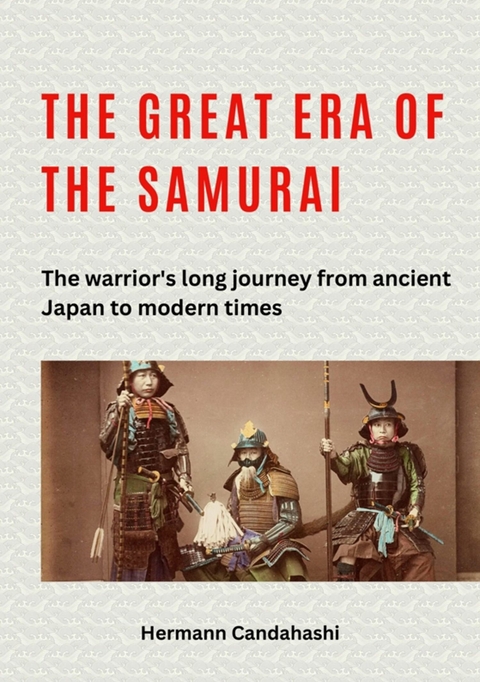
The great era of the samurai (eBook)
155 Seiten
tredition (Verlag)
978-3-384-25943-1 (ISBN)
I was born and raised in Germany, but I discovered my interest and passion for Japan at a young age, initially through movies and literature. After completing my education, I went on my first trips. I was increasingly impressed by the beauty of Japanese nature and the hospitality of the people. My enthusiasm and love for the country with its long cultural tradition, its contradictions and rituals, which still influence life in many areas, continues to this day. In my books, I would like to share my admiration and love for Japan with you. At the same time, I try to build a bridge between our two cultures. My aim is to promote understanding and appreciation of Japanese culture. If I have succeeded in doing this with you, dear reader, I will have fulfilled a wish and possibly aroused your interest in other topics relating to this country through my books. Hermann Candahashi
I was born and raised in Germany, but I discovered my interest and passion for Japan at a young age, initially through movies and literature. After completing my education, I went on my first trips. I was increasingly impressed by the beauty of Japanese nature and the hospitality of the people. My enthusiasm and love for the country with its long cultural tradition, its contradictions and rituals, which still influence life in many areas, continues to this day. In my books, I would like to share my admiration and love for Japan with you. At the same time, I try to build a bridge between our two cultures. My aim is to promote understanding and appreciation of Japanese culture. If I have succeeded in doing this with you, dear reader, I will have fulfilled a wish and possibly aroused your interest in other topics relating to this country through my books. Hermann Candahashi
The philosophy of the samurai: Bushido
The philosophy of the samurai, known as bushido, the "way of the warrior," is more than just a code for warriors; it is a way of life deeply rooted in Japanese culture and history. Bushido developed over centu-ries and was shaped by various influences such as Zen Buddhism, Confucianism, and Shinto. This chapter is devoted to examining in detail bushido, its principles, and its significance to the samurai and Japanese society.
Bushido did not emerge suddenly, but developed gradually over time. In the early period of samurai history, there were no written rules governing warrior behavior. Rather, it was a collection of orally transmitted traditions and practices that governed the daily lives and warfare of the samurai.
With the consolidation of samurai power under the Minamoto shogunate in the 12th century, bushido began to formalize. It was a time of political instability and warlike conflict, which required a clear and strict structure for warrior behavior. This structure helped the samurai establish themselves as a disciplined and loyal warrior class.
Zen Buddhism played a central role in the develop-ment of Bushido. Zen taught the samurai to discipline the mind, accept the impermanence of life, and fear death. These teachings were especially important for the samurai, who were constantly in life-threatening situations. Zen meditation helped them remain calm and determined in the face of death and perfect their martial arts.
A famous example of the influence of Zen on the samurai is the story of Miyamoto Musashi, a legendary swordsman of the early 17th century. Musashi was not only a master with the sword, but also a follower of Zen Buddhism. His teachings and writings, especially the book "Go Rin No Sho" (The Book of Five Rings), reflect the deep connection between Zen and Bushido.
In addition to Zen Buddhism, Confucianism also had a significant influence on Bushido. Confucian philosophy emphasizes values such as loyalty, duty, respect, and harmony in social relationships. These values were incorporated into the Bushido code and helped to strengthen the moral and social order within the samurai class and Japanese society.
Loyalty to the lord (daimyo) and the willingness to die for him were central aspects of Bushido. This loyalty was not only a matter of honor, but also a duty to family and ancestors. Respect for parents, teachers, and elders was equally important and was taught as part of the samurai's upbringing and training.
Bushido is characterized by seven central virtues that define the ideal image of a samurai. These virtues are:
Gi (righteousness): The ability to do the right thing and act morally upright, even in difficult situations. A samurai always had to act justly and honorably.
Yu (courage): The courage to face danger and stand up for one's convictions. This courage had to be accompanied by wisdom and prudence.
Jin (compassion): The pursuit of compassion and generosity towards others. A samurai should not only be a warrior, but also a person of compassion.
Rei (respect): Politeness and respect towards others, regardless of their social status. This respect was an expression of inner strength and self-discipline.
Makoto (sincerity): Honesty and truthfulness in words and deeds. A samurai was never allowed to lie or deceive.
Meiyo (honor): Honor was the greatest asset of a samurai. The loss of honor was worse than death.
Chugi (loyalty): Unwavering loyalty to the master, family and fellow human beings. Loyalty was the bond that held samurai society together.
The everyday life of the samurai
The daily life of a samurai was shaped by these virtues and the Bushido code. From early childhood, aspiring samurai were taught the principles of Bushido. They learned how to use weapons, martial arts, strategy and tactics, but also calligraphy, poetry and the tea ceremony. This comprehensive training was intended to shape them into accomplished warriors and cultured people.
A typical day began early in the morning with physical training and meditation. Practicing sword techniques and other martial arts was a daily ritual that strengthened not only physical strength but also mental discipline. The samurai also studied military strategies and the works of classical Chinese and Japanese philosophers.
In addition to physical and mental training, participation in social and religious ceremonies was also an important part of samurai life. These ceremonies promoted community spirit and loyalty within the samurai community.
Although Bushido was primarily aimed at male samurai, women also played an important role in samurai society. Samurai women, known as onna-bugeisha, were often trained in the art of fighting to defend their families and estates in the event of an attack. They were taught the principles of bushido and were responsible for raising the next generation of samurai.
A well-known example is Tomoe Gozen, a late 12th century warrior famous for her bravery and fighting skills. She fought alongside her lord and showed that the principles of bushido were also important for women.
With the onset of the Edo period (1603-1868) and the long period of peace, the role of the samurai changed. As there was less military conflict, many samurai took on administrative and bureaucratic duties. However, the bushido code remained of great importance and was now applied to civilian life as well.
The samurai devoted themselves more to the arts, literature and philosophy. Great importance was attached to the tea ceremony, poetry and calligraphy, and many samurai became patrons and supporters of the arts. The principles of Bushido shaped their behavior in daily life and helped to maintain social and moral order in a peaceful society.
Although Bushido is deeply rooted in Japanese culture, it has also been criticized and questioned. Some critics argued that the strict code of honor and emphasis on loyalty and obedience could lead to unreflective conformism. During the Meiji Restoration in the 19th century and the subsequent modernization of Japan, Bushido was partially reformed and reinterpreted to meet the demands of modern times.
In the early 20th century, Bushido was partially instrumentalized by the Japanese military leadership to promote nationalism and justify militarism. This distortion of the original principles led to a critical debate about Bushido after World War II.
Despite the historical changes and the critical debates, Bushido remains a central part of Japanese identity. In modern times, Bushido is often viewed as an ethical guide that emphasizes values such as discipline, honesty, respect, and responsibility. These values are present in many areas of modern Japanese life, from business to sports.
Martial arts such as kendo, judo, and karate, which grew out of the traditions of the samurai, continue to teach the principles of Bushido and encourage the development of character and discipline. The ideal of the samurai and Bushido can also be found in Japanese popular culture, in films, literature, and games, showing how deeply rooted this philosophy has remained in the collective consciousness.
Bushido, the "way of the warrior," is far more than just a code for samurai; it is a profound philosophy that embodies the essence of Japanese culture and history. From its origins in a warlike society to its role in modern times, Bushido has always emphasized values such as honor, courage, respect, and loyalty. Despite the changes and challenges it has faced throughout history, Bushido remains a living legacy that endures in many aspects of modern Japanese life, shaping the moral and ethical orientation of individuals and communities and recalling a time when the principles of the warrior code formed the basis for a life of honor and integrity.
The seven virtues in detail
To fully understand the meaning of Bushido, it is important to take a closer look at the seven central virtues and examine their application in the everyday life of a samurai.
Gi (righteousness): For the samurai, righteousness meant doing the right thing in every situation, even if it entailed personal disadvantages. This virtue required the samurai to have incorruptible morals and a willingness to defend their beliefs. Righteousness was the basis for trust and respect in society.
Yu (courage): Courage went beyond physical bravery and also included the ability to make morally difficult decisions and stand up for what was right. Courage also required a willingness to sacrifice oneself when necessary to ensure the welfare of the community or lord.
Jin (compassion): Compassion was a sign of strength, not weakness. A samurai showed compassion through generosity and caring for others, especially the weaker ones. This virtue helped to promote a just and harmonious society.
Rei (Respect): Respect was expressed in politeness and consideration for others. It was about treating everyone with dignity, regardless of their social status. Respect was an expression of inner strength and the ability to recognize and respect the dignity of others.
Makoto (Sincerity): Sincerity meant that a samurai was always honest and truthful. This virtue required them not to use deception and always to speak the truth. Sincerity created trust and honesty in the samurai's relationships with others.
Meiyo (Honor): Honor was a samurai's greatest asset. Maintaining honor was central to their lives and actions. A loss of honor, for example through dishonorable behavior or failure, was a disgrace that was considered worse than death.
Chugi (Loyalty): Loyalty was the foundation of samurai society. A samurai had to be loyal to his lord, his family,...
| Erscheint lt. Verlag | 13.6.2024 |
|---|---|
| Verlagsort | Ahrensburg |
| Sprache | englisch |
| Themenwelt | Kunst / Musik / Theater ► Malerei / Plastik |
| Sachbuch/Ratgeber | |
| Geisteswissenschaften ► Geschichte ► Regional- / Ländergeschichte | |
| Geisteswissenschaften ► Philosophie ► Ethik | |
| Geisteswissenschaften ► Religion / Theologie ► Buddhismus | |
| Informatik ► Weitere Themen ► CAD-Programme | |
| Medizin / Pharmazie ► Allgemeines / Lexika | |
| Sozialwissenschaften ► Soziologie | |
| Technik | |
| Schlagworte | ART • Bushido • daisho • Edo Period • ERA • Historical Warriors • How • japanese tradition • Japan Feudalism • Katana • Long • meiji restoration • naginata • New • oda nobunaga • Samurai • samurai armor • samurai battles • samurai honor • Samurai Loyalty • Sengoku period • Shoginat • Shogun • Tanto • the • this • Time • Tokugawa • Toyotomi Hideyoshi • Wakizashi • Warrior Caste • Warrior class • Warrior Ethos • when • Yari • Yumi • zen philosophy |
| ISBN-10 | 3-384-25943-2 / 3384259432 |
| ISBN-13 | 978-3-384-25943-1 / 9783384259431 |
| Informationen gemäß Produktsicherheitsverordnung (GPSR) | |
| Haben Sie eine Frage zum Produkt? |
 EPUB (Wasserzeichen)
DRM: Digitales Wasserzeichen
Dieses eBook enthält ein digitales Wasserzeichen und ist damit für Sie personalisiert. Bei einer missbräuchlichen Weitergabe des eBooks an Dritte ist eine Rückverfolgung an die Quelle möglich.
Dateiformat: EPUB (Electronic Publication)
EPUB ist ein offener Standard für eBooks und eignet sich besonders zur Darstellung von Belletristik und Sachbüchern. Der Fließtext wird dynamisch an die Display- und Schriftgröße angepasst. Auch für mobile Lesegeräte ist EPUB daher gut geeignet.
Systemvoraussetzungen:
PC/Mac: Mit einem PC oder Mac können Sie dieses eBook lesen. Sie benötigen dafür die kostenlose Software Adobe Digital Editions.
eReader: Dieses eBook kann mit (fast) allen eBook-Readern gelesen werden. Mit dem amazon-Kindle ist es aber nicht kompatibel.
Smartphone/Tablet: Egal ob Apple oder Android, dieses eBook können Sie lesen. Sie benötigen dafür eine kostenlose App.
Geräteliste und zusätzliche Hinweise
Buying eBooks from abroad
For tax law reasons we can sell eBooks just within Germany and Switzerland. Regrettably we cannot fulfill eBook-orders from other countries.
aus dem Bereich