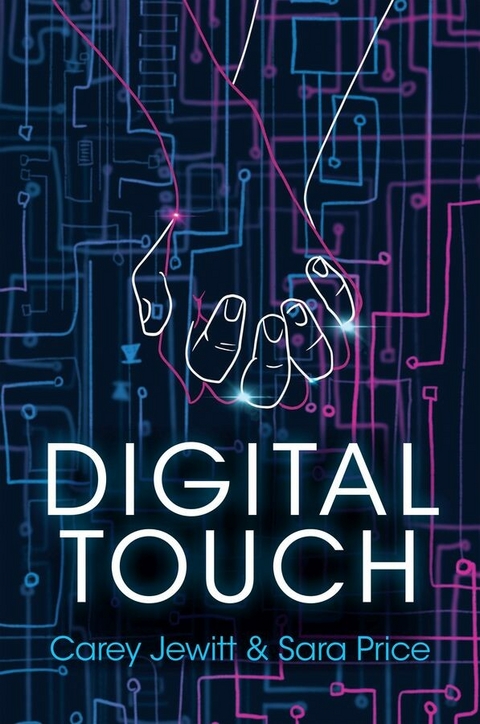
Digital Touch (eBook)
319 Seiten
John Wiley & Sons (Verlag)
978-1-5095-5665-6 (ISBN)
Digital Touch is a timely and original book that addresses such questions. Offering a rich account of digital touch, the book introduces the key issues and debates, as well as the design and ethical challenges raised by digital touch. Using clear, accessible examples and creative scenarios, the book shows how touch - how we touch, as well as what, whom and when we touch - is being profoundly reshaped by our use of technologies. Above all, it highlights the importance of digital touch in our daily lives and how it will impact our relationships and way of life in the future.
The first work of its kind, Digital Touch is the go-to book for anyone wanting to get to grips with this crucial emerging topic, especially students and scholars of Digital Media and Communication Studies, Digital Humanities, Sensory Studies, and Science and Technology Studies.
Carey Jewitt is Professor of Technology and Interaction at University College London.
Sara Price is Professor of Digital Learning at University College London.
Touch matters. It is fundamental to how we know ourselves and each other, and it is central to how we communicate. Digital touch is embedded in many technologies, from wearable devices and gaming hardware to tactile robots and future technologies. What would it be like if we could hug or touch digitally across distance? How might this shape our sense of connection? How might we establish trust or protect our privacy and safety? Digital Touch is a timely and original book that addresses such questions. Offering a rich account of digital touch, the book introduces the key issues and debates, as well as the design and ethical challenges raised by digital touch. Using clear, accessible examples and creative scenarios, the book shows how touch how we touch, as well as what, whom and when we touch is being profoundly reshaped by our use of technologies. Above all, it highlights the importance of digital touch in our daily lives and how it will impact our relationships and way of life in the future. The first work of its kind, Digital Touch is the go-to book for anyone wanting to get to grips with this crucial emerging topic, especially students and scholars of Digital Media and Communication Studies, Digital Humanities, Sensory Studies, and Science and Technology Studies.
1
What is Digital Touch?
This chapter introduces the scope of the book and makes a case for why touch matters, particularly as it becomes digitally mediated and enters the technoscape of digital communication. We argue for a social and holistic engagement with touch and propose the term ‘digital touch’ to emphasize a social orientation to touch. We outline our expanded view of touch with attention to the touching body and set out why a multimodal and multisensory lens is essential to progress digital touch. Finally, we give an overview of the chapter contents and introduce the key arguments that we engage with across the book.
Some of us first encountered digitally mediated touch when it crept into our hands and pockets via the mobile phone or via a touch screen in a bank, a museum, at work or at home. For those born in the 2000s, digital touch has always been there, waiting to reveal its potential. This book, however, stretches out beyond touch screens and vibrating notifications that now pervade our everyday sensorium to explore digital touch in the context of more advanced touch technologies that bring greater complexity to touch communication, including tactile robotics, virtual reality (VR), biosensing and wearables. Touch is increasingly at the vanguard of advances in digital communication technologies (Hoggan, 2013) and heralds a move beyond ‘ways of seeing’ to embrace ‘ways of feeling’ that is beginning to stretch the possibilities of how we ‘feel’ the world around us and how, what, whom and when we touch.
Throughout the book we offer a critical and balanced engagement with the significance of touch technologies’ rapid expansion and the ways in which this is reshaping the future landscape of touch. Avoiding a technocentric perspective, we seek to critique and understand the social implications of touch technology rather than to promote or celebrate it, and to critically engage with its potential futures, negative and positive, through our socially orientated approach. We explore if, when and how advances in touch technologies across a range of social and technological domains promise to change touch practices, and what this means at a fundamental level for what people ‘count’ as touch (Jewitt et al., 2021a; Price et al., 2021a). We acknowledge that hitherto, the historicity of digital touch is one high in ambition and promise, and low on delivery, described as ‘suspended in a state of perpetual immanence’ (Parisi, 2018, p. 32). A key argument of this book is that the failure of contemporary haptics to progress and deliver the step change needed is at least in part due to how its disciplinary shaping limits what touch is, how it becomes meaningful and what digital touch might come to be. We explore the social, cultural and political debates of what constitutes acceptable and desirable touch, the implications of a potential digital transformation and the new social forms of touch, other sensorial communication, and ways of being in the world that may emerge with attention to face-to-face and remote digitally mediated touch between people, people and objects or machines. The book addresses questions raised by this emergent digital touch landscape for how our experience of digital touch communication with close and distant others might be newly constituted, and the place of touch more generally. The question of what social problems may be alleviated by the expansion of digital touch remains open, and while we do not address this explicitly, we do point to the different contexts for which it is being designed and explore what that means for the place of digital touch technologies in our world. Rather we ask, what would it be like if we could hug or touch across distance? How might it shape our sense of connection? What bonds might be formed or lost? How might we establish trust or protect our privacy and safety? What might this mean for communicative norms, etiquettes and ethics?
Why touch matters
Touch is the first sense through which people apprehend their environment (Fulkerson, 2014; Montagu, 1971; Paterson, 2007). While touch is less spoken about (in comparison with vision and speech), it is central to human experience, culture and communication. Touching provides us with significant information and experience of ourselves and one another, is essential to our development (Field, 2003), and central to communication: ‘Just as we “do” things with words so, too, we act through touches’ (Finnegan, 2014, p. 208). Touch is an important means of enacting social relations including greetings – shaking hands and embracing; intimate communication – holding hands, kissing, cuddling and stroking; and more negatively in correction – punishment or restraining (Al-Shamahi, 2021; Linden, 2016). Touch is commonly used to communicate emotions and has a role in communicating complex social messages of trust, receptivity, and affection as well as nurture, dependence and affiliation. Indeed, touch is considered the clearest of all non-verbal cues (Reis, 1998) and is able to communicate a range of emotions effectively via specific touch actions (Hertenstein, 2002; Hertenstein et al., 2009). Touch has been shown to effectively influence people’s attitudes and create bonds with people and places (Price et al., 2022a), and interpersonal touch has been shown to improve information flow, result in a more favourable evaluation of communication partners and increase compliance (Field, 2003). The type and strength of a relationship between people affects how much and where on the body people think it is appropriate to touch (Lee and Guerrero, 2001). Touch is particularly significant in close or intimate relationships; it is shown to create and strengthen bonds between couples and is correlated with overall relationship and partner satisfaction (Gulledge et al., 2003), with a lack of touch having negative connotations (Gallace and Spence, 2010). Touch has positive and negative effects on work-based relationships (Simmering et al., 2013), with enormous potential in regulating workplace relationships (Fuller et al., 2011). While the action of touching another is typically straightforward, many factors influence the message being communicated, for example, the firmness with which a person cups another’s hand can be supportive or aggressive, the perceived bodily warmth (or lack of), the amount of movement or stillness in the touch, the body part used to touch or be touched, all demonstrating the broad, nuanced space of touch communication.
Touch is also crucial for our relationships with objects and tool use (Fulkerson, 2014) and fulfils social functions that serve to construct our experience of the world. Importantly, touching provides people with information about objects (e.g., texture and temperature), and supports perceptual understanding. Skilled touch is a theme central to how people create and make meaning (Malafouris and Koukouti, 2022; Samuelsson et al., 2022). Meaning-making through touch is constructed in interaction with others in particular cultural contexts, giving rise, not only to sensory forms of communication, but also to etiquettes around which touch is allowed: where, when, how and by whom. Indeed, knowing how to infer meaning from touch is considered the very basis of social being (Dunbar, 1996). Touch is thus socially grounded (Parisi, 2018), and closely connected to our emotions (Classen, 2012), creating a complex design space for touch technology to mediate affective experiences.
New social arrangements including migration, increased work mobility and changing norms of family life, have led to partners, friends and families living apart, often separated by long distances and periods of time. The resulting loss of social touch is a challenge for interpersonal interaction and communication. While people use a range of communicative technologies (e.g., video calling) to connect with distant friends, family and partners, these primarily communicate explicit information (Hassenzahl et al., 2012) rather than intimacy or relatedness. These technologies lack the physicality of touch (Haans and IJsselsteijn, 2006), which in the context of close relationships is seen as problematic, ‘the voice is not enough. The relationship is so physical and visual’ (Neustaedter and Greenberg, 2012, p. 755).
During the global Covid-19 pandemic, social distancing regulations or lockdown measures came to regulate social life for the mainstream population in unprecedented ways (such restrictions are mainstream for other regulatory regimes, from no-touch policies in various organizations, through to the extreme of incarceration). For many, this experience newly foregrounded the significance of interpersonal touch, primarily through its absence. Newspaper headlines, on ‘affection deprivation’ and ‘touch hunger’ abounded and underlined what became for some a key dilemma of the pandemic; the inability to be physically close or comfort each other through touch. The pandemic drew wider attention to the links between touch and wellbeing as well as the dialogic character of touch and its potentials for connection. It also raised the question of how touch might be digitally mediated – people were missing touch; could the digital come to the rescue?
Digital touch and the technoscape
In this book we use the term ‘digital touch’ rather than ‘haptics’, which is commonly used in Engineering, Computer Science and Human–Computer Interaction (HCI). Digital touch emphasizes our social orientation to touch and embraces a broad range of...
| Erscheint lt. Verlag | 29.5.2024 |
|---|---|
| Sprache | englisch |
| Themenwelt | Sozialwissenschaften ► Kommunikation / Medien ► Medienwissenschaft |
| Sozialwissenschaften ► Politik / Verwaltung | |
| Schlagworte | Carey Jewitt • Communication & Media Studies • Communication & Media Studies Special Topics • Cultural Studies • Digital Age • digital connection • Digital Culture & the Information Age • Digitale Kultur im Informationszeitalter • digitally mediated future • Digital Touch • Kommunikation • Kommunikation u. Medienforschung • Kulturwissenschaften • Media Studies • Medienforschung • Sara Price • sensor applications • sensorial communication • Spezialthemen Kommunikation u. Medienforschung • tactile robotics • Technology • touch • Touch Technologies • Virtual Reality |
| ISBN-10 | 1-5095-5665-6 / 1509556656 |
| ISBN-13 | 978-1-5095-5665-6 / 9781509556656 |
| Informationen gemäß Produktsicherheitsverordnung (GPSR) | |
| Haben Sie eine Frage zum Produkt? |
 EPUB (Adobe DRM)
Kopierschutz: Adobe-DRM
Adobe-DRM ist ein Kopierschutz, der das eBook vor Mißbrauch schützen soll. Dabei wird das eBook bereits beim Download auf Ihre persönliche Adobe-ID autorisiert. Lesen können Sie das eBook dann nur auf den Geräten, welche ebenfalls auf Ihre Adobe-ID registriert sind.
Details zum Adobe-DRM
Dateiformat: EPUB (Electronic Publication)
EPUB ist ein offener Standard für eBooks und eignet sich besonders zur Darstellung von Belletristik und Sachbüchern. Der Fließtext wird dynamisch an die Display- und Schriftgröße angepasst. Auch für mobile Lesegeräte ist EPUB daher gut geeignet.
Systemvoraussetzungen:
PC/Mac: Mit einem PC oder Mac können Sie dieses eBook lesen. Sie benötigen eine
eReader: Dieses eBook kann mit (fast) allen eBook-Readern gelesen werden. Mit dem amazon-Kindle ist es aber nicht kompatibel.
Smartphone/Tablet: Egal ob Apple oder Android, dieses eBook können Sie lesen. Sie benötigen eine
Geräteliste und zusätzliche Hinweise
Buying eBooks from abroad
For tax law reasons we can sell eBooks just within Germany and Switzerland. Regrettably we cannot fulfill eBook-orders from other countries.
aus dem Bereich