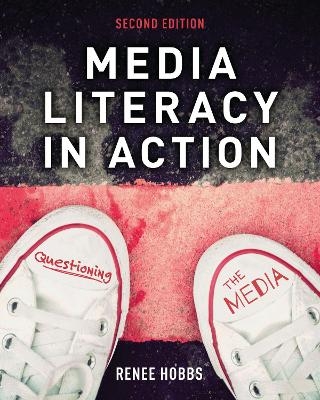
Media Literacy in Action
Rowman & Littlefield (Verlag)
978-1-5381-8013-6 (ISBN)
There’s never been a more important time for students to develop media literacy competencies. When students ask critical questions about the media they consume, they develop fundamental knowledge and critical thinking skills that prepare them for life, work, and meaningful citizenship.
Media Literacy in Action addresses learners who are simultaneously active as both creators and consumers of media messages. At the same time, the book recognizes that everyone is vulnerable to media influence because of our dependence on the instant gratification and feelings of connectedness that digital platforms provide. To thrive in a media-saturated society, people need to ask critical questions about what we watch, see, listen to, read, and use. This book gives students those tools.
Key features of the second edition:
Critical examination of AI technologies, algorithmic personalization, data privacy and surveillance, and the increased global regulation of digital platforms Attention to media literacy for empowerment and protectionInquiry-oriented approach to learning that cultivates intellectual curiosity and creative expressionFull-color presentation with figures and photos to increase student engagement
Each chapter includes:
Media Literacy Trailblazers: Profiles of key thinkers and their theories connect students with the discipline of media literacyMedia Literacy DISCourse (NEW): Visual representations of media literacy theoretical principles help learners internalize the practice of asking critical questions as they respond to specific media examplesLearning in Action (NEW): Summary and vocabulary sections combine with Analyze, Create, Reflect, and Act activities to empower students to apply ideas from each chapter.Supplemental Materials available at www.mlaction.com:
Students can review key ideas, learn about more Media Literacy Trailblazers, and watch videos aligned with each chapterInstructors can access a Teacher’s Guide of best practices, in-class activities, homework, and projects. Also available are chapter summaries, lecture slides, YouTube playlists, and test materials.
Renee Hobbs is one of the world’s leading authorities on digital and media literacy education and a professor at the University of Rhode Island’s Harrington School of Communication and Media. As a teacher, researcher, activist, and media professional, she has offered programs for educators on four continents and produced some of the leading empirical research on the subject. Hobbs is the author of 12 books and more than 200 scholarly and professional articles. Her work has received awards from professional organizations including the International Communication Association, the Media Ecology Association, the National Association for Media Literacy Education, and others. In collaboration with the Media Education Lab, Hobbs created COURAGEOUS RI, a statewide media literacy program designed to use media literacy and active listening to reduce the fear and hate that leads to violence, funded by the U.S. Department of Homeland Security. She has spoken at the United Nations and consulted extensively with educators, school leaders, and government officials in Belgium, Brazil, China, Croatia, Lebanon, the Netherlands, Germany, Romania, and many other countries.
Preface
About the Author
PART I: UNDERSTANDING MEDIA
Chapter 1 What Is Media Literacy?
Heightening Awareness
Asking Critical Questions
Connecting Past, Present, and Future
Expanding Literacy
Protecting Against Harmful Media
Confronting Institutional and Social Power
Resisting Distorted Representations
Critically Analyzing What’s True and False
Advancing Citizenship in a Democracy
Activating a Global Media Literacy Community
Media Literacy Theory
Media Literacy as a Moving Target
Media Literacy Trailblazer: Neil Postman
DISCourse: Crash Course Media Literacy
Chapter 2 Why Do People Use Media?
Media: A Definition
Smartphones Take Center Stage
Tracking Your Online Life
Uses and Gratifications
Media Literacy Trailblazer: Sonia Livingstone
DISCourse: Egg Crack Challenge
Chapter 3 How Do Search Engines Work?
Five Eras of the Internet
Questioning AI
Algorithmic Personalization
Search as Strategic Exploration
Search as Prelude to Purchase
How AI is Changing How We Search
The Politics of Filter Bubbles
Algorithms and Privacy
How Algorithms Discriminate
Censored Search
Surveillance Society
Regulating the Internet
AI Hype Cycles
Media Literacy Trailblazer: Michel Foucault
DISCourse: Take That Facebook
PART II: FORMS AND GENRES
Chapter 4 How Do People Get the News?
Reading, Watching, and Listening to News
News Values
Two Forms of News
News Aggregation on the Rise
The Power of Language
Trust but Verify
Framing Crime News
Eyewitness Reports
Partisanship and Journalistic Objectivity
Detecting Ideological Bias in the News
Fox News
Virality and Sensationalism
Media Literacy Trailblazer: Walter Lippmann
DISCourse: New Police Abuse Footage
Chapter 5 What Is the Difference between Advertising, Public Relations, and Propaganda?
Consumer Culture
Surveillance Capitalism
Where Art Meets Commerce
Children and Advertising
Regulating Advertising to Children
Advertising’s Unreal Realities
Influencer Marketing
Defining Propaganda
Propaganda Techniques
Publicity Matters
PR Approaches
Political Spin
Media Literacy Trailblazer: Roland Barthes
DISCourse: Fixed on Pixel
Chapter 6 Why Are We Attracted to Characters and Stories?
Storytelling and Culture
Storytelling as Social Change
Telling Emotional Truths Through Fiction
The Paradox of Tragedy
Who is the Author?
Characters Count
Archetypes of Storytelling
Narrative Conflict
Seven Basic Plots
Constructing Drama in Reality TV
Fandom, Copyright and Creativity
AI Storytelling
Media Literacy Trailblazer: Vladimir Propp
DISCourse: Willie Wonka and the Chocolate Factory
PART III: JUDGMENTS ABOUT TASTE, QUALITY, AND TRUST
Chapter 7 Why Do People Prefer Different Kinds of Music, Movies, and TV Shows?
What is Taste?
The Power of Playlists
How do People’s Taste Develop?
Media as Environment
Choices Matter
Media Awareness
Repetition & Popularity
Remixes and Spin-Offs
Genres Shape Expectations
The Birth of the Vlog
Chapter 8 Who Decides What Makes Media “Good”?
Tournaments of Value
Book Challenges in Schools and Society
Cultural Hierarchies
Memes: Making Morality Visual
Hashtag Activism
Popularity as a Measure of Quality
Reviews and Ratings
Review Aggregation
Judging Quality While Shopping Online
Virality Matters
Media Literacy Trailblazer: Pierre Bourdieu
DISCourse: Barbie Movie Review by Chris Stuckmann
Chapter 9 How Do People Decide Who and What to Trust?
Learning to Doubt
Organization Trust
Trust and Happiness
Truth Decay
Reality Check
Trust in Authority
Authenticity Rules
Political Polarization
Social Norms and Trust
Rebuilding Trust
Media Literacy Trailblazer: George Herbert Mead
DISCourse: Global Warming Cartoon
PART III: MEDIA ECONOMICS
Chapter 10 How Do Media Companies Make Money?
Entrepreneurship Matters
Jobs & Careers in Media Industries
The Media Marketplace
Purchases: The Direct Revenue Stream
Advertising: The Indirect Revenue Stream
Purchase + Advertising: The Mixed Revenue Stream
The First Amendment
Regulating Competition
Deregulation
Net Neutrality
Media Ownership
Antitrust Regulation
Censorship
Media Regulation Worldwide
Media Literacy Trailblazer: Dallas Smythe
DISCourse: Big Profits, Small Paybacks Chart
Chapter 11 Are Social Media Free?
Digital Authors Create Content
Digital Identity
Remix, Copyright, and Fair Use
The Doctrine of Fair Use
Protecting Digital Platforms from Users
Surveillance Capitalism
Regulating the Internet Economy
Your Private Life on TikTok
From Public to Private
Feeling Free
Content Moderation
Media Literacy Trailblazer: danah boyd
DISCourse: How WhatsApp Makes Money
PART IV: MEDIA EFFECTS
Chapter 12 Why Do People Worry about Stereotypes?
Stereotypes as Sensemaking
The Art of the Stereotype
The Danger of the Single Story
Are Stereotypes Realistic?
Similarity Matters
Cultivation Theory
Exploiting Stereotypes for Fun & Profit
Gender Matters
Identification & Loyalty
Representations of Sexuality
Implicit Bias
Rewards and Risks of Self-Representation
Owning Your Subjectivity
Racist and Sexist AI
Media Literacy Trailblazer: Stuart Hall
DISCourse: Disclosure
Chapter 13 What are the Benefits and Harms of Using Media?
Understanding Media Effects
Empowerment & Protection in Video Games
Gaming Addiction
Children: A Special Group
Children & Media Influence
Risks & Harms of Conflict
Digital Detox
Moral Panics
Sexually Explicit Media
Pornography Risks & Harms
Sexting
Porn Media Literacy
Media Literacy Trailblazer: Albert Bandura
DISCourse: The Neuroscience of Porn Addiction Explained
Chapter 14 How Do People Become Media Literate?
How Media Literacy Changes Over Time
Media Literacy for Young Children
Media Literacy as Public Health Issue
Reading in a Digital World
Creating Media
Reflection Matters
The Politics of Media Literacy
Lies My Teacher Told Me
Media Literacy for Democracy
Media Industry Support for Media Literacy
Media Literacy Media
The Changing Nature of Knowledge
Pathways & Obstacles
Media Literacy for All
Media Literacy Trailblazer: Len Masterman
Acknowledgments
References
Index
| Erscheinungsdatum | 20.12.2024 |
|---|---|
| Zusatzinfo | 3 Color Illustrations, 223 Color Photos, 1 Tables, 28 Textboxes |
| Sprache | englisch |
| Maße | 203 x 254 mm |
| Themenwelt | Sozialwissenschaften ► Kommunikation / Medien ► Kommunikationswissenschaft |
| Sozialwissenschaften ► Kommunikation / Medien ► Medienwissenschaft | |
| Sozialwissenschaften ► Soziologie ► Empirische Sozialforschung | |
| ISBN-10 | 1-5381-8013-8 / 1538180138 |
| ISBN-13 | 978-1-5381-8013-6 / 9781538180136 |
| Zustand | Neuware |
| Informationen gemäß Produktsicherheitsverordnung (GPSR) | |
| Haben Sie eine Frage zum Produkt? |
aus dem Bereich