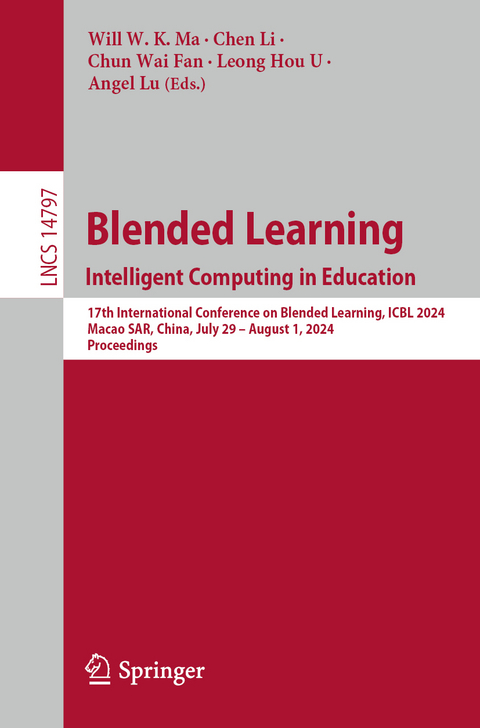
Blended Learning. Intelligent Computing in Education
Springer Verlag, Singapore
978-981-97-4441-1 (ISBN)
- Titel nicht im Sortiment
- Artikel merken
The selected papers are classified into four primary themes: revolutionizing education with AI;
This book constitutes the refereed proceedings of the 17th International Conference on Blended Learning. Intelligent Computing in Education, ICBL 2024, held in Macao, China, during July 29 - August 1, 2024.
The 26 papers presented in this volume were carefully reviewed and selected from 71 submissions.
The selected papers are classified into four primary themes: revolutionizing education with AI; blended learning and technological innovations; advancements in learning analytics; and innovative approaches in educational research.
.- Keynotes:.
.- Building a Learner-Centric Citywide Digital Literacy Ecosystem: Train-the-Trainer, Community-Based Learning, and Gifted Education.
.- Educational Technology trends in the AI era.
.- How to design scientific, happy and effective educational games: Research on educational game design from the perspective of learning sciences.
.- Blended Learning and AI: Enhancing Teaching and Learning in Higher Education.
.- Digital Literacy: Evolution, Evaluation and Enhancement.
.- Revolutionizing Education with AI:.
.- Complexities of Using Large Language Model Generative AI in Health Education and Robots (ID20).
.- New Dimensions: The Impact of the Metaverse and AI Avatars on Social Science Education (ID27).
.- Construction and Implementation of Generative AI-based Human-Machine Collaborative Classroom Teaching Model in Universities (ID46).
.- DMP_AI: An AI-Aided K-12 System for Teaching and Learning in Diverse Schools (ID64.
.- A Case Study Examines How a New Content Integration Impacts Learning Outcomes with AI Experience Inputs (ID68).
.- Blended Learning and Technological Innovations:
.- Understanding characteristics of teacher-student dialogue in urban-rural blended synchronous classroom: A learning analytics perspective (ID7).
.- Integrating a digital math vector game into a blended classroom: technological and instructional design principles (ID19).
.- K12 Blended Learning in China of “Education+” era: from the perspective of ecology (ID31).
.- AIGC empowered blended learning in university course design and implementation: A case study (ID43).
.- Exploring preschool teachers' perceived challenges in using ICT in Hong Kong after the pandemic (ID63).
.- Investigating Relationships Among Institutional Support, Perceived Technology Usefulness, Attitude Toward Using Technology and Teacher Professional Development Motivation: A Moderated Mediation Model (ID22).
.- Advancements in Learning Analytics:.
.- An Analysis of Learning Analytics Approaches for Course Evaluation (ID25).
.- Uncovering Students’ Processing Tactics towards ChatGPT’s Feedback in EFL Education Using Learning Analytics (ID38).
.- Enhancing EFL Learners’ Knowledge of L2 Requests during Mobile-mediated Text-based and Audio-based Dynamic Assessment (ID44).
.- Investigating Learning Behaviors and Intervention Effectiveness of Students with Special Educational Needs (ID62).
.- Study on the Influencing Factors of Middle School Students’ Deep Learning Competencies in the Smart Classroom Environment (ID36).
.- Innovative Approaches in Educational Research:.
.- A Study on the Design and Implementation of the Smart Site Safety System from the Stakeholders’ Perspectives (ID51).
.- Enhancing Youth Creativity through Computer-Supported Collaborative Learning: A Preliminary Investigation in Rural Chinese Elementary School (ID69).
.- Leveraging deep learning for classifying learner-generated course evaluation texts (ID26).
.- Analysis of Cyber Range Scenario Design--A Case Study (ID54).
.- Capturing Teachers’ Collaborative Talk Patterns in an Interdisciplinary Lesson Study: A Social Epistemic Network Signature Approach (ID39).
| Erscheinungsdatum | 29.06.2024 |
|---|---|
| Reihe/Serie | Lecture Notes in Computer Science |
| Zusatzinfo | 85 Illustrations, color; 11 Illustrations, black and white |
| Verlagsort | Singapore |
| Sprache | englisch |
| Maße | 155 x 235 mm |
| Themenwelt | Schulbuch / Wörterbuch ► Unterrichtsvorbereitung ► Unterrichts-Handreichungen |
| Informatik ► Software Entwicklung ► User Interfaces (HCI) | |
| Sozialwissenschaften ► Pädagogik | |
| Sozialwissenschaften ► Soziologie ► Empirische Sozialforschung | |
| Schlagworte | Adaptive Learning • Artificial Intelligence • augmented reality • Big Data • Blended Learning • Education • Educational technology • generative AI • ICT • intelligent computing • Learning Analytics • Learning Environments • learning experiences • mobile technology • pedagogical approaches |
| ISBN-10 | 981-97-4441-5 / 9819744415 |
| ISBN-13 | 978-981-97-4441-1 / 9789819744411 |
| Zustand | Neuware |
| Informationen gemäß Produktsicherheitsverordnung (GPSR) | |
| Haben Sie eine Frage zum Produkt? |
aus dem Bereich