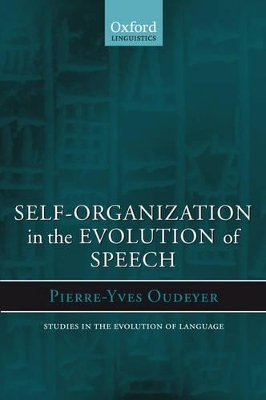
Self-Organization in the Evolution of Speech
Oxford University Press (Verlag)
978-0-19-928915-8 (ISBN)
Speech is the principal supporting medium of language. In this book Pierre-Yves Oudeyer considers how spoken language first emerged. He presents an original and integrated view of the interactions between self-organization and natural selection, reformulates questions about the origins of speech, and puts forward what at first sight appears to be a startling proposal - that speech can be spontaneously generated by the coupling of evolutionarily simple neural structures connecting perception and production. He explores this hypothesis by constructing a computational system to model the effects of linking auditory and vocal motor neural nets. He shows that a population of agents which used holistic and unarticulated vocalizations at the outset are inexorably led to a state in which their vocalizations have become discrete, combinatorial, and categorized in the same way by all group members. Furthermore, the simple syntactic rules that have emerged to regulate the combinations of sounds exhibit the fundamental properties of modern human speech systems.
This original and fascinating account will interest all those interested in the evolution of speech.
Pierre-Oudeyer is a researcher at Sony Computer Science Laboratory, Paris. He studies the origins and evolution of language, and is a specialist of computer modelling, including robotic systems, artificial intelligence, and developmental systems. His work on the origins of speech was awarded the French Prix Le Monde de la recherche universitaire, 2004 and the Prix ASTI in 2005. James R. Hurford is Professor of Linguistics at the University of Edinburgh. His books include Semantics (with B. Heasley, 1983), Grammar (1994), and as co-editor Approaches to the Evolution of Language (1998), all published by CUP.
1. The Self-Organization Revolution in Science ; 2. The Human Speech Code ; 3. Self-Organization and Evolution ; 4. Existing Theories ; 5. Artificial Systems as Research Tools for Natural Sciences ; 6. The Artificial System ; 7. Learning Perceptuo-Motor Correspondences ; 8. Strong Combinatoriality and Phonotactics ; 9. New Scenarios ; 10. Constructing for Understanding ; References ; Index
| Reihe/Serie | Studies in the Evolution of Language ; 6 |
|---|---|
| Zusatzinfo | Numerous halftones, line drawings and figures |
| Verlagsort | Oxford |
| Sprache | englisch |
| Maße | 156 x 234 mm |
| Gewicht | 306 g |
| Themenwelt | Geisteswissenschaften ► Archäologie |
| Geisteswissenschaften ► Psychologie ► Allgemeine Psychologie | |
| Geisteswissenschaften ► Psychologie ► Verhaltenstherapie | |
| Geisteswissenschaften ► Sprach- / Literaturwissenschaft ► Sprachwissenschaft | |
| Sozialwissenschaften ► Ethnologie | |
| Sozialwissenschaften ► Soziologie | |
| ISBN-10 | 0-19-928915-8 / 0199289158 |
| ISBN-13 | 978-0-19-928915-8 / 9780199289158 |
| Zustand | Neuware |
| Informationen gemäß Produktsicherheitsverordnung (GPSR) | |
| Haben Sie eine Frage zum Produkt? |
aus dem Bereich