


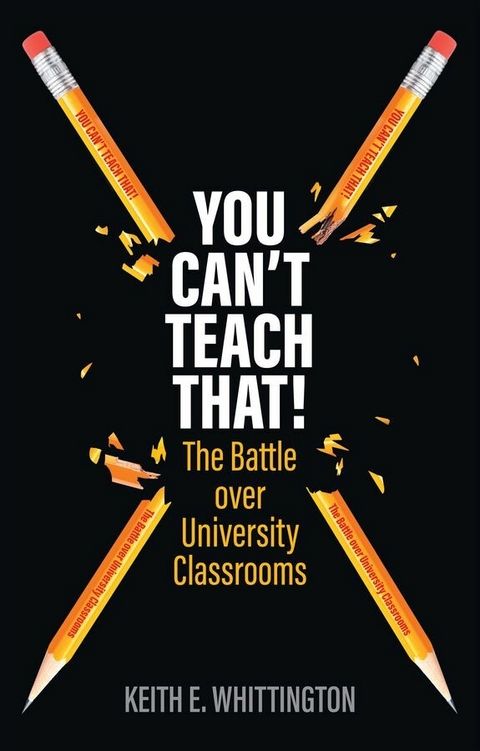
You Can't Teach That! (eBook)
231 Seiten
John Wiley & Sons (Verlag)
978-1-5095-6454-5 (ISBN)
The answer is far from clear but suddenly urgent. Unprecedented efforts are now underway to restrict what ideas can be promoted and discussed in university classrooms. Professors at public universities have long assumed that their freedom to teach is unassailable and that there were firm constitutional protections shielding them from political interventions. Those assumptions might always have been more hopeful than sound. A battle over the control of the university classroom is now brewing, and the courts will be called upon to establish clearer guidelines as to what - if any - limits legislatures might have in dictating what is taught in public universities.
In this path-breaking book, Keith Whittington argues that the First Amendment imposes meaningful limits on how government officials can restrict the ideas discussed on university campuses. In clear and accessible prose, he illuminates the legal status of academic freedom in the United States and shows how existing constitutional doctrine can be deployed to protect unbridled free inquiry.
Keith E. Whittington is the William Nelson Cromwell Professor of Politics at Princeton University and a leading expert on academic freedom and American constitutional law and politics. Among his prize-winning books is Speak Freely: Why Universities Must Defend Free Speech. He is the founding chair of the Academic Freedom Alliance and a visiting fellow at the Hoover Institution.
Who controls what is taught in American universities professors or politicians? The answer is far from clear but suddenly urgent. Unprecedented efforts are now underway to restrict what ideas can be promoted and discussed in university classrooms. Professors at public universities have long assumed that their freedom to teach is unassailable and that there were firm constitutional protections shielding them from political interventions. Those assumptions might always have been more hopeful than sound. A battle over the control of the university classroom is now brewing, and the courts will be called upon to establish clearer guidelines as to what if any limits legislatures might have in dictating what is taught in public universities. In this path-breaking book, Keith Whittington argues that the First Amendment imposes meaningful limits on how government officials can restrict the ideas discussed on university campuses. In clear and accessible prose, he illuminates the legal status of academic freedom in the United States and shows how existing constitutional doctrine can be deployed to protect unbridled free inquiry.
Keith E. Whittington is the William Nelson Cromwell Professor of Politics at Princeton University and a leading expert on academic freedom and American constitutional law and politics. Among his prize-winning books is Speak Freely: Why Universities Must Defend Free Speech. He is the founding chair of the Academic Freedom Alliance and a visiting fellow at the Hoover Institution.
Preface
1. The Culture War and the Universities
2. Academic Freedom in the United States
3. The Era of the Loyalty Oaths
4. The First Amendment Comes to Campus
5. The Professor as a Government Employee
6. Teaching in the Government School
7. Compelling Students to Believe
Conclusion
Further Reading
Acknowledgements
Notes
Index
"You Can't Teach That! is an important and timely book. The recent wave of state legislative restrictions on academic freedom is a dangerous development, and Keith Whittington makes a strong case that these laws are inconsistent with the best understanding of First Amendment freedoms."
Thomas Moylan Keck, Maxwell School of Citizenship & Public Affairs, Syracuse University
"A robust and authoritative overview of the fierce debates over academic freedom in America."
Floyd Abrams, Senior Counsel, Cahill Gordon & Reindel LLP
"This timely and urgent book provides the best available overview of the most aggressive attack on academic freedom since the McCarthy era. Everyone who cares about American higher education should read it."
Jonathan Rauch, Brookings Institution
2
Academic Freedom in the United States
As part of its commencement celebrations in May of 1878, Vanderbilt University in Nashville, Tennessee, had scheduled a public lecture by one of its distinguished professors. Formerly a professor at the University of Michigan and the chancellor of Syracuse University, Alexander Winchell had been recruited to the newly established Vanderbilt University to teach geology and zoology. The subject of his address was to be “Man in the Light of Geology.”
Students had only arrived on the new campus in the fall of 1875. The southern denomination of the Methodist church had planned to found a new university in Tennessee, but those plans were shelved during the Civil War and Reconstruction. Surprisingly, the shipping magnate Cornelius Vanderbilt took an interest in the project and provided the funds to launch the new endeavor, and the builders quickly broke ground for a university that would bear its benefactor’s name.
Vanderbilt opened its doors at a transition point in American higher education. Most universities in the United States had begun with strong ties to a church, and training ministers was often the primary mission. In the years after the Civil War, the college landscape began to change. Aided by federal land grants, state universities were springing up across the country with a goal of educating a broader class of Americans and providing useful knowledge to fuel the American economy. Even the older colleges began to make space for teaching in the natural sciences. Harvard University had just appointed a chemist to be its president, and Charles Eliot embarked on an ambitious project of converting Harvard into a serious research university. The year after students first enrolled in Vanderbilt, Johns Hopkins launched with the explicit aim of being a secular research university like the leading institutions of Europe. Although under the sponsorship of the Methodist church, Vanderbilt did not follow the old convention of choosing a minister to administer the university. Instead, the board turned to Landon Garland, a physics and geology professor with experience running a university. Active in the Methodist church, Garland had helped stymie an earlier proposal to establish a theology school, arguing instead that what was needed was a first-rate university with a department of biblical studies, sitting alongside departments of science, medicine, and law. Recruiting serious scholars from the North like Winchell signaled that Vanderbilt University meant to be truly national in spirit and to establish its place as a leading American university.
Winchell was a celebrated figure and a popular lecturer, but the invitation to speak at commencement was not a mere honorific. It turned out to be an ambush. Some months before, Winchell had given a public lecture back in Syracuse, New York. The local Nashville paper carried a report of this “interesting lecture” on “the origin of the races.” Winchell boldly told his New York audience, “New truths are better than old errors.” While we should mourn “the loss of a belief,” “it is only truth which is divine.” The Syracuse lecture previewed Winchell’s latest scholarly tract, an examination of the prehistoric origins of mankind. He contended that the scientific evidence demonstrated that the “first of all men … appeared in Africa” and were blessed with “the divine spark of intelligence.” They were, Winchell thought, “pre-Adamites” and the natural ancestors of the modern inhabitants of Africa. The Adam of the Bible was created later and elsewhere, and from him modern Europeans descended. Winchell declined to say whether the first men were “descended from a being unworthy to be called a man,” but insisted that the diversity of humankind and “the epoch of his first appearance on the earth” were “subjects to be settled by scientific investigation.” Religious faith, he warned, should not be tied to “corruptible science.” Science advanced through theory and evidence, and scientific opinion could “vanish like a summer cloud” in the face of new theories and better evidence. Winchell’s own theory of the origin of the races could be right or wrong (in fact, his theory was idiosyncratic even in his own time), but his argument would be judged by the scientific method and not biblical exegesis. Religious believers should learn “to discriminate between religious faiths and scientific opinions.”1
Less than an hour before he was to deliver his commencement speech at Vanderbilt, Winchell met with the chair of the board of trustees, Bishop Holland McTyeire. McTyeire was not there simply to exchange pleasantries. As the professor later recounted, the bishop “embraced the opportunity to introduce a business which caused me extraordinary surprise.” The bishop wanted to inform him that “we are having considerable annoyance from the criticisms which are passed by our people on some of your positions in matters of opinion, and it is likely to increase.” To put it bluntly, “they object to evolution.” Winchell protested that he had never publicly endorsed the theory of human evolution, but the chairman of the board was not there to argue with him. It was enough that “our people are complaining, and the University will suffer.” The board was giving the professor an opportunity to “relieve us of our embarrassments,” and it would be meeting right after Winchell’s commencement address. Indeed it had been the bishop who had suggested that Winchell’s commencement address be on subject of evolution. The professor had not appreciated the significance of that suggestion, and now the bishop wished to make it plain. “I wanted you to have an opportunity to put yourself right.”
Winchell was given a choice. He could either use his commencement address explicitly to renounce the theory of evolution or he could resign his professorship. Winchell refused either option. “If the Board have the manliness to dismiss me for cause, and declare the cause, I prefer they should do it.” If they took that step, Winchell vowed, it would be “unjust and oppressive, as well as discrediting to the University. It will recoil upon its authors.” The board, McTyeire rejoined, did not “propose to treat you as the Inquisition treated Galileo,” but Winchell insisted “what you propose is the same thing.” “It is ecclesiastical proscription for an opinion which must be settled by scientific evidence.”2 The next day Winchell received his notice of termination.
Winchell did not go quietly. Unlike many younger and less well-established professors, he was willing to stake his reputation against that of the fledgling Vanderbilt University. He took his case to the press and rallied his allies to his defense. Although Winchell declared that he had always striven to avoid “any utterance offensive to strait orthodoxy,” he also insisted that universities would engage in a “gross perversion of a sacred trust” if professors “are forbidden to proclaim principles of science which have gained almost universal acceptance.”3 Winchell might have thought himself secure in his position at Vanderbilt since he had, as his defenders in the press noted, taken on the “thankless office of a reconciler between theology and science” and had offered up “so conservative a presentation of the race question” that his Southern white neighbors should not have objected.4
If so, he miscalculated. The Darwinist Popular Science Monthly fulminated, “Vanderbilt fought the progress of science by bigotry, intolerance and proscription.” The Nashville Christian Advocate retorted,
The people – “our people” – have no objection to orthodoxy. Parents who have sons to be educated prefer the safety of that atmosphere to genteel infidelity. Let anti-Methodist critics rage – Vanderbilt University is safe… . Those who are in charge of it know what they are about.5
Vanderbilt had, according to the Atlanta Daily Constitution, merely “asserted the right of self-protection, the right of self-control, the right of self-direction – nothing else.” The university, “because of him, was inevitably doomed to be identified with ‘advanced’ scientific theories,” and the board of trustees appropriately recognized that it had a higher duty “to guard its students against all scientific scepticism.”6 The quarrelsome professor was sent back to Ann Arbor.
The battle over Darwinism was not unique to Vanderbilt, and the Winchell affair was neither the first nor the last skirmish. Shortly after Winchell left Tennessee, the famed sociologist William Graham Sumner found himself in a fight with the president of Yale College. Perhaps the nation’s premier “Social Darwinist,” Sumner assigned as a coursebook a text by the English writer Herbert Spencer. Spencer applied evolutionary theory and the mantra of “survival of the fittest” to the social world rather than the natural world. President Noah Porter did not object to the teaching of Charles Darwin in the natural sciences at Yale. He had strong views, however, about the “so-called science” of sociology. He viewed Spencer and other upstart social...
| Erscheint lt. Verlag | 13.5.2024 |
|---|---|
| Sprache | englisch |
| Themenwelt | Sozialwissenschaften ► Pädagogik |
| Sozialwissenschaften ► Politik / Verwaltung | |
| Schlagworte | academic freedom • Bildungswesen • cancelled • Education • Education Special Topics • freedom of speech • Free Speech • higher education • Literature • Literaturwissenschaft • Political Science • Political Science Special Topics • Politikwissenschaft • postcolonial theory • Spezialthemen Bildungswesen • Spezialthemen Politikwissenschaft • Theorie der Postkolonialzeit • Universities |
| ISBN-10 | 1-5095-6454-3 / 1509564543 |
| ISBN-13 | 978-1-5095-6454-5 / 9781509564545 |
| Informationen gemäß Produktsicherheitsverordnung (GPSR) | |
| Haben Sie eine Frage zum Produkt? |
 EPUB (Adobe DRM)
Kopierschutz: Adobe-DRM
Adobe-DRM ist ein Kopierschutz, der das eBook vor Mißbrauch schützen soll. Dabei wird das eBook bereits beim Download auf Ihre persönliche Adobe-ID autorisiert. Lesen können Sie das eBook dann nur auf den Geräten, welche ebenfalls auf Ihre Adobe-ID registriert sind.
Details zum Adobe-DRM
Dateiformat: EPUB (Electronic Publication)
EPUB ist ein offener Standard für eBooks und eignet sich besonders zur Darstellung von Belletristik und Sachbüchern. Der Fließtext wird dynamisch an die Display- und Schriftgröße angepasst. Auch für mobile Lesegeräte ist EPUB daher gut geeignet.
Systemvoraussetzungen:
PC/Mac: Mit einem PC oder Mac können Sie dieses eBook lesen. Sie benötigen eine
eReader: Dieses eBook kann mit (fast) allen eBook-Readern gelesen werden. Mit dem amazon-Kindle ist es aber nicht kompatibel.
Smartphone/Tablet: Egal ob Apple oder Android, dieses eBook können Sie lesen. Sie benötigen eine
Geräteliste und zusätzliche Hinweise
Buying eBooks from abroad
For tax law reasons we can sell eBooks just within Germany and Switzerland. Regrettably we cannot fulfill eBook-orders from other countries.
aus dem Bereich


