Introduction
To 21st-century Russians, 9 May is the most important date in the state calendar. It is Victory Day which celebrates the defeat of Nazi Germany in 1945. It occurs one day later than Victory-in-Europe Day as two separate surrender documents were signed by Germany with the Western Allies in Reims and with the then Soviet Union in Berlin. During the Soviet era, Victory Day was traditionally marked by a massive cold-war display of military forces parading through Red Square, intercontinental ballistic missiles and all. After the collapse of the Soviet Union in 1991, the parades were suspended, only to be revived in 1995, the year the golden jubilee of the victory was celebrated.
Although the parade on the 75th anniversary in 2020 was cancelled due to Covid-19, clearly 9 May was an important day for Russia’s President Vladimir Putin. As Supreme Commander-in-Chief of the armed forces of the Russian Federation, it was his opportunity to follow Russia’s leaders from Joseph Stalin onwards to take his place on the grandstand in front of Lenin’s tomb to review the troops and deliver a rousing Victory Day speech about Russia’s greatness.
While the parade was scaled back in 2023 (it featured just one tank), the Kremlin’s rhetoric was not. Nor was Russian aggression abroad: some 200,000 Russian troops had been sent across Russia’s borders to invade and capture Ukraine, more than the USSR had deployed in its attempts to conquer Afghanistan from 1979 (a failed conquest lasting until 1989). Likewise, fighting Ukraine’s standing army of 400,000 had turned into a bloodbath.
‘Today civilization is once again at a decisive turning point,’ Putin proclaimed in his angry speech as if Russia was under a military attack within its borders rather than an aggressor beyond its country. ‘A real war has been unleashed against our Motherland.’
Putin drew exotic parallels, describing Russia’s small neighbour as if the country was an existential threat on the doorstep of the gigantic, hulking bulk of the Russian Federation. As he had done in crescendo since 2014, he labelled Ukraine’s government ‘neo-Nazis’ and a ‘criminal regime’—neglecting the fact that in Ukraine presidents stood after two terms and that he himself, following in the footsteps of Hitler, had absorbed all power since his first-ever election. Nor did he mention that during World War II Ukraine had paid a heavy price for helping defend Russia’s landmass against Nazi Germany: half of the 27 million Soviet casualties according to some estimates were Ukrainians, then almost a third of the country’s population. In 1961, the message on the same day was very different. Kyiv (then still called Kiev) was awarded the Order of Lenin for its resistance against the Nazi threat to the USSR and proclaimed a Hero City.
Putin welcomed the Russian soldiers present at the parade who had fought to invade Ukraine. ‘We are proud of the participants of the special military operation. The future of our people depends on you,’ he pontificated from the Red Square podium.
It was advisable for Putin’s audience to choose their words carefully. Anyone suggesting that the ‘special military operation’ was actually a war waged by Russia against a dwarf state was liable to be arrested for subversion. Putin also blamed the West for ‘destroying traditional values’ and, in an even more outlandish slur, for propagandizing a ‘system of robbery and violence’.
‘The goal of our enemies, and there is nothing new here, is to achieve the disintegration and destruction of our country,’ he fulminated as if resisting Russia’s land grab by its smaller neighbours could break Russian culture and Russia’s people. Concluding his fallacious speech, he exhorted: ‘To Russia! To our brave armed forces! To Victory!’ Audiences around Russia, having heard similar speeches for almost two decades, lapped it up.
While opposition leaders languished in jail or lay buried in their graves, and could not naysay him, dissent suddenly came from an unexpected quarter.
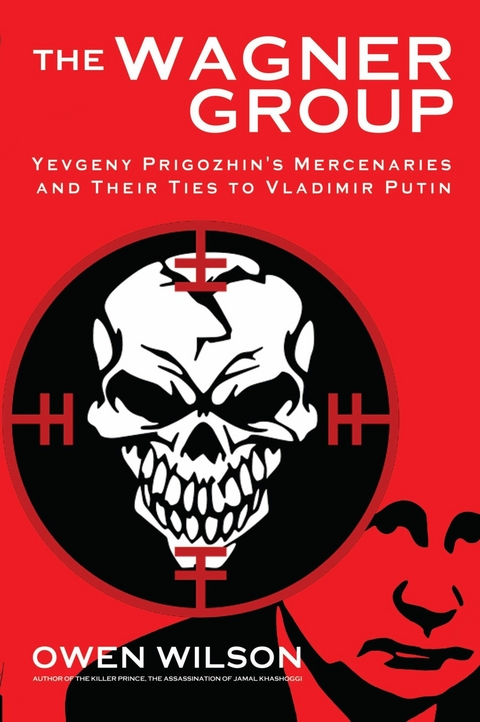
On the same day, 62-year-old Yevgeny Prigozhin, a shadowy figure once known as ‘Putin’s chef’ and now head of The Wagner Group, a brutal private mercenary company fighting for hire in half-a-dozen countries—including on Russia’s pay in the Ukraine—piped up and publicly labelled the Russian president a ‘complete a******e’.
For weeks, gun-for-hire Prigozhin had ever-more vocally complained about Putin’s invasion and even expressly exposed Putin’s Nazi parallels as nonsense. He had darkly hinted that the invasion of the resource-rich Ukraine was motivated purely by private financial gain. On 9 May, he seized the opportunity to release a video tearing a strip off Putin himself, complaining that his men fighting in the eastern Ukrainian city of Bakhmut were being starved of ammunition and artillery shells.
His reference to Russia’s leader avoided mentioning ‘president’ or the name ‘Vladimir Putin’ but was nonetheless a thinly veiled reference that did not leave room open for much misinterpretation.
‘They’re collecting them in warehouses—why, no one knows,’ he said. ‘Instead of spending a shell to kill the enemy and save the lives of our soldiers, they let our soldiers die—and the “happy grandfather” thinks this is good for him.’ ‘Grandpa in his bunker’ was how Russian dissidents regularly derided the 70-year-old Putin.
‘If he turns out to be right, then God bless everybody... but how will we win the war, if, by chance—and I’m just speculating—it turns out that this grandfather is a complete arsehole?’
It was a breathtaking public take-down of Russia’s unchallenged ruler of 23 years. No Russian had even mildly contradicted Putin before and lived to tell the tale, and here was a seemingly fringe figure of the Moscow establishment who used the saltiest of language to criticize the president.
Prigozhin went on: ‘The shells give freedom. And if they don’t give freedom with the shells... if they keep holding onto them, then first we need to shove it up their a**e and then throw them in jail.’
The talk about ammunition was nothing new. For almost half a year Prigozhin had blamed Russia’s defence minister Sergei Shoigu and General Valery Gerasimov, the chief of Russia’s armed forces, for not providing his mercenaries in Ukraine with sufficient ammunition.
Days earlier, he had gripped the world press by threatening to pull out of the Russian frontline at Bakhmut in eastern Ukraine. He had also taken aim at the Kremlin ‘breeding new PMCs’—ad hoc militias formed and paid for under Kremlin pressure by Russia’s multinationals such as Gazprom and Rosneft. They were technically illegal in Russia—but were badly needed since the Russian military was defeated in its attempt to take Kyiv in 2022. The Kremlin was doing this instead of putting ‘200,000 soldiers, as I asked’ under the command of the Wagner Group PMC, Prigozhin said.
Prigozhin had openly clashed before with Gerasimov—and other, lower-ranking army generals—over their leadership of the war. After planning the invasion of Ukraine, Gerasimov had briefly disappeared, but in January 2023 he was reinstated to Prigozhin’s fury.
Prigozhin’s approach to war was unorthodox. Recruiting from prisons, as Prigozhin did, was a Wagner Group speciality. But where usually recruiters seek out those who committed minor felonies, he chose to put weapons in the hands of the most dangerous criminals, including serial killers: men who felt no compunction to kill, loot and even torture.
With the official Russian army performing poorly in Ukraine, Prigozhin’s dirty tactics delivered successes that made the army’s failures that much clearer while making him an outspoken national hero for as long as the heavily controlled Russian media reported his words. By May 2023, he was thought to have become more popular than Putin though by now he was banned from Russia’s state-controlled mass media. When he said explosively, ‘We need to stop deceiving the population and telling them that everything is fine,’ and, ‘I must honestly say: Russia is on the brink of a disaster’ only Russian war wonks on Telegram, Russia’s twitter, could hear him say these anarchic words.
Since January 2023, officials in the Kremlin were taking down the Wagner Group a peg without shutting the angry Prigozhin out entirely. Starving it of ammunition was one way to bump up its casualty rate and stymie the chances of success. Arrangements were also made for the Russian military to take over recruitment drives from prisons and for new 6-month contracts henceforth to be directly with the ministry of defence so that conscripts fell directly under defence minister Shoigu’s chain of command. Meanwhile, the Wagner Group was also cannibalized as experienced fighters and instructors were being lured...


 EPUB (Wasserzeichen)