


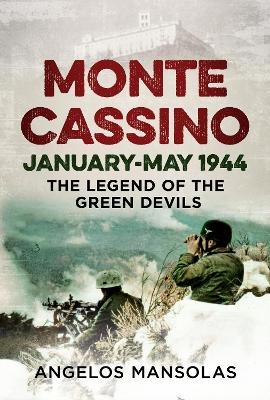
Monte Cassino January–May 1944
The Legend of the Green Devils
Seiten
2025
|
2nd New edition
Alan Sutton (Verlag)
978-1-80420-057-5 (ISBN)
Alan Sutton (Verlag)
978-1-80420-057-5 (ISBN)
In early 1944, the Allies attempted to break through the German defences in Central Italy in a series of separate assaults, aiming to reach and conquer Rome. The assaults, on the rocky hill of Monte Cassino, ended up as one of the longest and deadliest engagements ever fought on European soil.
In early 1944, two Allied armies were poised to launch a massive assault against German forces in central Italy to open the way north to Rome. Obstructing them was the Gustav Line: the most formidably constructed defensive line the Western Allies would ever come up against. There were three routes of attack to choose from. The fastest one passed directly through the Liri valley, but it demanded the perilous fording of the Rapido River. The second possible route involved outflanking the Gustav Line to the east, but to do so the Allies would need to capture innumerable rough peaks and ridges along the massif on terrain that favoured the defenders. The third and final option was to breach the enemy's defences directly in front of the town of Cassino, crowned with its iconic medieval monastery; it would mean engaging in costly house-to-house fighting until the very last of the determined German paratroopers had been killed or captured. The Allied commanders decided to try all three options. None of them were easy, and all proved deadly.
In early 1944, two Allied armies were poised to launch a massive assault against German forces in central Italy to open the way north to Rome. Obstructing them was the Gustav Line: the most formidably constructed defensive line the Western Allies would ever come up against. There were three routes of attack to choose from. The fastest one passed directly through the Liri valley, but it demanded the perilous fording of the Rapido River. The second possible route involved outflanking the Gustav Line to the east, but to do so the Allies would need to capture innumerable rough peaks and ridges along the massif on terrain that favoured the defenders. The third and final option was to breach the enemy's defences directly in front of the town of Cassino, crowned with its iconic medieval monastery; it would mean engaging in costly house-to-house fighting until the very last of the determined German paratroopers had been killed or captured. The Allied commanders decided to try all three options. None of them were easy, and all proved deadly.
Angelos Mansolas was born in 1962 in Athens, Greece. He served for 30 years as a communications technician in the Hellenic Air Force, retiring in 2012 with the rank of flight lieutenant. He is a dedicated military aviation researcher and has written for several Greek-language history magazines. As an artist, he has also provided colour profiles of aircraft. He currently works for Greek magazine Military History, specialising in Byzantine history, the American Civil War, military aviation and the battles of the First and Second World Wars.
| Erscheinungsdatum | 02.12.2025 |
|---|---|
| Zusatzinfo | 84 mono and 45 colour illustrations |
| Sprache | englisch |
| Maße | 156 x 234 mm |
| Themenwelt | Geschichte ► Allgemeine Geschichte ► 1918 bis 1945 |
| Geschichte ► Teilgebiete der Geschichte ► Militärgeschichte | |
| Sozialwissenschaften ► Politik / Verwaltung | |
| ISBN-10 | 1-80420-057-3 / 1804200573 |
| ISBN-13 | 978-1-80420-057-5 / 9781804200575 |
| Zustand | Neuware |
| Informationen gemäß Produktsicherheitsverordnung (GPSR) | |
| Haben Sie eine Frage zum Produkt? |
Mehr entdecken
aus dem Bereich

aus dem Bereich
Deutschland 1933 bis 1945
Buch | Hardcover (2025)
S. Fischer (Verlag)
CHF 47,60
ein Psychologe erlebt das Konzentrationslager
Buch | Hardcover (2024)
Kösel (Verlag)
CHF 30,80
Helfer und Vollstrecker: Das Dritte Reich in 24 Porträts
Buch | Hardcover (2025)
DVA (Verlag)
CHF 55,95


