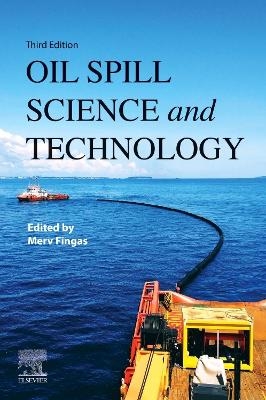
Oil Spill Science and Technology
Elsevier - Health Sciences Division (Verlag)
978-0-443-21703-6 (ISBN)
Written by over 24 experts in the field, this updated edition combines technology with case studies to identify the current state of knowledge surrounding oil spills that will encourage additional areas of research that are left to uncover in this critical sector of the energy industry.
Merv Fingas has over 40 years of experience in oil and chemical spill research. Previously, he was Chief of the Emergencies Science Division of Environment Canada for 30 years and is currently working on research in Western Canada. Dr. Fingas has a PhD in Environmental Physics from McGill University, three Masters degrees in chemistry, business, and mathematics - all from the University of Ottawa, as well as a BS in Chemistry and a BA in Arts from Indiana. He has authored over 1,000 technical publications including books, manuals, and 500 peer-reviewed papers. He has won over 20 awards for research and papers from the United States Government, Canadian Government, and international conferences. He has served on two committees on the National Academy of Sciences of the United States on oil spills and as chairman of several ASTM and inter-governmental committees on spill matters, was the founding chairman of the ASTM sub-committee on in-situ burning and chairman of oil spill treating agents and another on oil spill detection and remote sensing. Dr. Fingas has collaborated on studies with over 25 organizations around the world, coordinated studies for over 30 years through 6 internationally attended committees and developed co-operative projects with many international groups
Chapter 1 - Introduction to the history of oil spills
Chapter 2 - Photooxidation of oil at sea—Historical perspective, current state of the science and future direction
Chapter 3 - How to model evaporation
Chapter 4 - Water-in-oil emulsions
Chapter 5 - Introduction to spill modeling
Chapter 6 - Review of oil spill remote sensing: The current state of the art
Chapter 7 - In situ burning: A summary
Chapter 8 - Laser fluorosensors for oil spill detection
Chapter 9 - Shoreline countermeasures
Chapter 10 - Remediation of oiled mangroves: Lessons from the Niger Delta
Chapter 11 - Rapid forensic oil identification by direct analysis in real time (DART) with time-of-flight mass spectrometry and confirmation by gas chromatography-mass spectrometry
Chapter 12 - Fates of petroleum compounds from the Deepwater Horizon oil spill
Chapter 13 - Bioremediation strategies for diesel-contaminated Antarctic soils
| Erscheinungsdatum | 14.12.2024 |
|---|---|
| Verlagsort | Philadelphia |
| Sprache | englisch |
| Maße | 152 x 229 mm |
| Gewicht | 450 g |
| Themenwelt | Naturwissenschaften ► Biologie ► Ökologie / Naturschutz |
| Sozialwissenschaften ► Soziologie | |
| Technik ► Umwelttechnik / Biotechnologie | |
| ISBN-10 | 0-443-21703-3 / 0443217033 |
| ISBN-13 | 978-0-443-21703-6 / 9780443217036 |
| Zustand | Neuware |
| Informationen gemäß Produktsicherheitsverordnung (GPSR) | |
| Haben Sie eine Frage zum Produkt? |
aus dem Bereich