


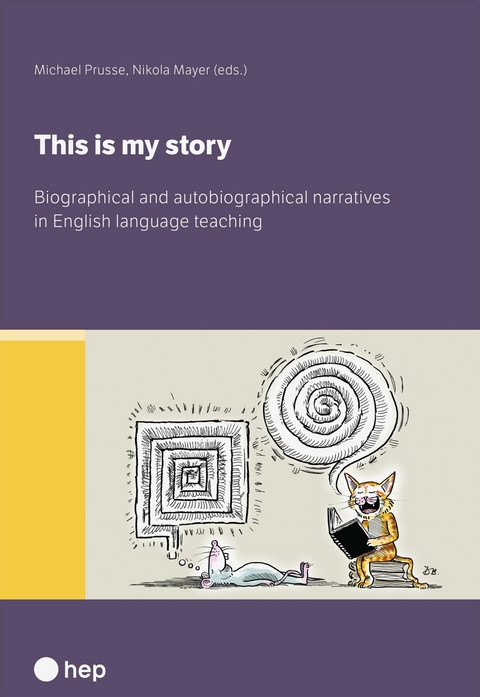
This Is My Story (E-Book) (eBook)
200 Seiten
hep verlag
978-3-0355-2647-9 (ISBN)
Michael C. Prusse is Professor of English language teacher education at the Zurich University of Teacher Education, where he heads the Department of Master Programmes in Subject-Specific Education. His research focuses on language in professional contexts, pedagogical content knowledge, and on teaching literature in the ELT classroom. He has a particular interest in children's and young adult narratives in various media formats. Nikola Mayer is a professor for Teaching English as a Foreign Language (secondary level) at the University of Education Zurich / Switzerland. She has worked at several institutions focusing both on primary and secondary EFL education. Her present research interests lie in the field of reading graphic novels, enhancing visual literacy, multimodal literacy and multiliteracies; embedding young adult literature in the EFL classroom and on implementing reflective elements into EFL teacher education.
Michael C. Prusse is Professor of English language teacher education at the Zurich University of Teacher Education, where he heads the Department of Master Programmes in Subject-Specific Education. His research focuses on language in professional contexts, pedagogical content knowledge, and on teaching literature in the ELT classroom. He has a particular interest in children's and young adult narratives in various media formats. Nikola Mayer is a professor for Teaching English as a Foreign Language (secondary level) at the University of Education Zurich / Switzerland. She has worked at several institutions focusing both on primary and secondary EFL education. Her present research interests lie in the field of reading graphic novels, enhancing visual literacy, multimodal literacy and multiliteracies; embedding young adult literature in the EFL classroom and on implementing reflective elements into EFL teacher education.
Introduction: “It’s Not Like Your Story, It’s My Story!”
Michael C. Prusse, Nikola Mayer
Storytelling is often considered as an innate faculty in humans, an aspect of the species that distinguishes it from the other creatures that subsist on planet Earth. Mankind’s evident compulsion to conceive both existence and experience through narrative cannot be confined – it surfaces as a persisting feature of any human society. In addition to its ubiquity, the notion of storytelling “existed long before people gave it a name and tried to figure out how it works” (Abbott 2008, xv). As a result of the prominence of stories in human evolution, some researchers have coined descriptive terms to account for the phenomenon: homo narrans (e.g. Stiles 1999; Brockmeier 2014, 333) would be one example, while another designates humans as the “storytelling animal” (Gottschall 2012, xvii). The pervasiveness of stories is remarkable and, inherently, the ability to tell and to listen to stories “is both universal and timeless” (Wajnryb 2002, 1). According to Abbott, it is not astonishing “that there are theorists who place it next to language itself as the distinctive human trait” (Abbott 2008, 1). This sweeping statement is not unfounded: There appears to be “no human collective that doesn’t have its stories – going back as far as the peoples of prehistory whose cave drawings are evidence of the earliest urge to communicate in story” (Wajnryb 2002, 1). In the 21st century, human beings still “navigate the world with words, and as the world slips onto the web”, people must face this challenge and continue “to communicate and to comprehend what we are reading” (Gaiman 2013, n.p.) and viewing. Stories clearly facilitate the transmission and comprehension of messages. Whether one looks at journalism, advertising or politics – most human communicative activities are dominated by narrative frameworks.
Despite this universal prevalence of narrative, its significance has frequently been contested – particularly in its fictional dimension – and its relevance is regularly denied by those who perceive fiction, for instance, as a form of escapism that has no practical relevance for human existence. The latter stance can be beautifully illustrated by referring to Salman Rushdie, who vividly describes hostile attitudes towards storytelling in his children’s novel, Haroun and the Sea of Stories (1990). There, it is not the wicked poisoner of the “Sea of Stories”, the evil schemer of the novel, Khattam-Shud, who poses the most potent threat to the power of narrative, but Mr Sengupta, the boring “clerk at the offices of the City Corporation” (1991, 19), who regularly maintains: “What are all these stories? Life is not a storybook or joke shop. All this fun will come to no good. What’s the use of stories that aren’t even true” (1991, 20). By means of Mr Sengupta, Rushdie identifies a utilitarian-minded audience that does not care for stories any longer as the most virulent problem, because it is people like this character who consider narrative simply as a useless distraction. Ignoring the power and influence of stories is rooted in the fact that their positive potential is not directly visible: in other words, unless somebody writes a bestseller, fiction does not put bread on anybody’s table, particularly not for those who only consume it. Rushdie, who composed the narrative of Haroun for his son in the shape of an allegory, used the fairy tale plot to explain his own story, the tale of what happened to the author after the publication of The Satanic Verses (1988). Several Muslim readers were offended by Rushdie’s book, because they deemed it blasphemous. Consequently, Iran’s political and religious leader, Ayatollah Khomeini (whose name, incidentally, fused with the expression “shut up”, is most likely the inspiration for the arch-villain in Haroun and the Sea of Stories, Khattam-Shud), issued a proclamation which ordered Muslims across the world to kill the author, his translators and his publishers. Rushdie rightly perceived this not just as an attack on his person but also as a general attempt to silence storytellers. The writer, for whom it was and still is a matter of life and death, is, of course, not the only one to emphasise the influence that narrative can have on people. Neil Gaiman, for instance, in a conversation with the photographer Cambridge Jones for an exhibition at the Story Museum in Oxford, is keen on pointing out that those who “think that stories aren’t important – aren’t as important as breathing, aren’t as important as warmth, aren’t as important as life – are missing the point” (Gaiman 2014, n.p.). In the words of another novelist, Patrick Ness, who put them into the mouth of the eponymous character in A Monster Calls, Gaiman’s statement is affirmed but slightly modified: “Stories are important, the monster said. They can be more important than anything. If they carry the truth” (Ness 2012, 151). The consumption of narratives may be perceived as a waste of time by Rushdie’s Mr Sengupta, but it is fiction that “allows our brains to practice reacting to the kinds of challenges that are, and always were, most crucial to our success as a species” (Gottschall 2012, 67).
The way humans face their daily lives, sometimes filled with confusing and irrational moments that in their propinquity make no sense, is resolved by narrative that reorganises these numerous occurrences into a logical sequence: “Stories give intelligible form to the lived immediacy of our interactions with the world, embodied experiences that are already meaningful but that we may not fully comprehend” (Armstrong 2020, 28). Karen Coats, Director of the Centre for Research in Children’s Literature at the University of Cambridge, puts the same sentiment in plain language: “Every day, stuff happens. We eat, we sleep, we play, we work, we worship, we love, we hate, we complain, we cry, we laugh. And through it all, we use stories to make sense of the world we find and to shape it so that it becomes our world” (Coats 2017, 199). Rushdie’s example from above establishes a link between fiction and the theme of biography and autobiography that lies at the heart of this collection on storytelling in children’s and young adult narratives. This means that, in general, a biographical or autobiographical outlook on events seems to be the dominant aspect of narrative. Already the pillars of occidental literature, the Greek myths such as the Iliad or the Odyssey, essentially focus on the biographies of their protagonists, while their readers (or listeners in the original format) follow the fates of Helen of Troy, Hector, Achill and Ulysses and experience the impact of events and the involvement of the gods by partaking in the stories of their lives. Virgil resumed this tradition when composing the Aeneid. Hence, the history of Rome is also related by means of the mythical biographies of the relevant protagonists, such as Aeneas himself, Dido, Romulus and Remus, and the ensuing generations of leaders that founded an empire that, like the Greek one, had a lasting impact on European history and which, in combination, are still perceived as the cradles of Western civilisation. This tradition of narrating lives can be pursued like a red thread through the history of English literature, from the picaresque novels of Defoe and Fielding to the Victorian life narratives by Gaskell, Thackeray or Dickens and, even further, to the modernist experiments of Faulkner, Joyce and Woolf. It is in the light and context of such narrative conventions that Joseph Conrad could utter his famous statement: “Fiction is history, human history, or it is nothing” (1924, 17).
And still, the question remains – why are we so fascinated with both telling our own stories and reading others’ life stories? The late Columbian author Gabriel García Márquez offers an answer to this when naming his memoir Living to Tell the Tales (a bit more powerful in the Spanish original – Vivir Para Contarla), linking his personal experiences and his purpose in life to his vocation as an author. Rebecca Solnit, on the other hand, retells and embeds her life stories in Recollections of My Non-Existence to draw attention to a female perspective which has much to do with being seen and holding one’s ground in a society that tends to overlook many existences other than the white male. Looking back at her beginnings and her formation as an author, she defines the more conventional memoirs as being “stories of overcoming, arcs of eventual triumph, personal problems to be taken care of by personal evolution and resolve” (Solnit 2020. 47). At the end of her book, after guiding us through an encouraging and disturbing selection of her memoir, she...
| Erscheint lt. Verlag | 1.4.2024 |
|---|---|
| Verlagsort | Bern |
| Sprache | englisch |
| Themenwelt | Sozialwissenschaften ► Pädagogik |
| Schlagworte | Cognitive Development • Intercultural Interactions • Language Learning • Story • Storys • Storytelling • Teacher |
| ISBN-10 | 3-0355-2647-8 / 3035526478 |
| ISBN-13 | 978-3-0355-2647-9 / 9783035526479 |
| Informationen gemäß Produktsicherheitsverordnung (GPSR) | |
| Haben Sie eine Frage zum Produkt? |
 EPUB (Adobe DRM)
Kopierschutz: Adobe-DRM
Adobe-DRM ist ein Kopierschutz, der das eBook vor Mißbrauch schützen soll. Dabei wird das eBook bereits beim Download auf Ihre persönliche Adobe-ID autorisiert. Lesen können Sie das eBook dann nur auf den Geräten, welche ebenfalls auf Ihre Adobe-ID registriert sind.
Details zum Adobe-DRM
Dateiformat: EPUB (Electronic Publication)
EPUB ist ein offener Standard für eBooks und eignet sich besonders zur Darstellung von Belletristik und Sachbüchern. Der Fließtext wird dynamisch an die Display- und Schriftgröße angepasst. Auch für mobile Lesegeräte ist EPUB daher gut geeignet.
Systemvoraussetzungen:
PC/Mac: Mit einem PC oder Mac können Sie dieses eBook lesen. Sie benötigen eine
eReader: Dieses eBook kann mit (fast) allen eBook-Readern gelesen werden. Mit dem amazon-Kindle ist es aber nicht kompatibel.
Smartphone/Tablet: Egal ob Apple oder Android, dieses eBook können Sie lesen. Sie benötigen eine
Geräteliste und zusätzliche Hinweise
Buying eBooks from abroad
For tax law reasons we can sell eBooks just within Germany and Switzerland. Regrettably we cannot fulfill eBook-orders from other countries.
aus dem Bereich


