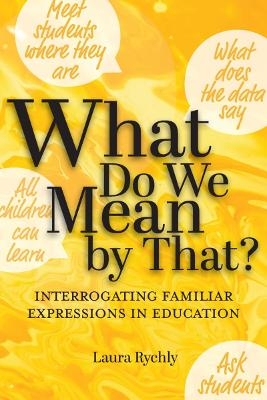
What Do We Mean by That?
Myers Education Press (Verlag)
978-1-9755-0584-4 (ISBN)
What Do We Mean by That?: Interrogating Familiar Expressions in Education is a collection of essays that opens a space for all educational workers--teachers, teacher educators, administrators, politicians, and others--to unpack commonly used educational phrases and ideas.
The idea is to carefully examine what we say to one another when we talk about schools, curriculum, students, and other educational problems or issues--when we say things like "We have to meet students where they are," and "All children can learn," or "What does the data say?" What Do We Mean by That? challenges and clarifies such phrases and the how, and why, that they shape educational policies and practices.
The influential curricular theorist Dwayne Huebner charged us to always be aware of our "man-made tools," such as language, and said that since "all educators attempt to shape the world; theorists should call attention to the tools used for the shaping in order that the world being shaped can be more beautiful and just."
Language is a tool in educational practice in myriad ways: between administrators and teachers, teachers and students, teachers and parents, and students and students, as examples. A scripted curriculum is a tool intended to provide fixed language to teachers. It is normal for phrases to make their way into our everyday practices and get lodged there. But we need opportunities to interrupt ourselves and study our language tools to ensure they help create beauty and justice.
This collection of thoughtful essays seeks to be this interruption. It is an invaluable tool for improving the educational experience of students and schools.
Perfect for courses such as: Foundations of Education; Curriculum Studies; Diversity in Education; Educational Rhetoric and Policy.
Laura Rychly (Ed.D., Georgia Southern University in Curriculum Studies) is an Associate Professor of Curriculum Studies at Augusta University in Augusta, Georgia. Her research interests revolve around ways to improve life in classrooms for teachers and students. This has taken the form of theorizing about teacher and learner agency, accountability to language, and improvisational theater in middle schools. A former middle school language arts teacher, she is especially committed to studying and sharing ways young adolescents interpret their schooling experiences and what they internalize as a result of the interactions they share with peers and adults in these contexts.
Acknowledgments
Introduction
ONE: Academic Language and Historic Linguicism
Leah Panther and Katherine A. Perrotta
TWO: Prior Knowledge
Linda Hogg
THREE: "Just Be Creative!"
Jeff McLaughlin
FOUR: What Do We Truly Mean by Learning Loss?
Samantha Harrienger and Kevin Cataldo
FIVE: My Kids Can't Do That!
Janel Janiczek Smith and Robyn Ovrick
SIX: "The Community." What Is It Exactly?
Racheal M. Banda Rothrock
SEVEN: Are We Really Friends? Examining Early Childhood Education's (ECE's) (Mis)Use of the Term
Charlene Montaño Nolan, Carolyn Brennan, and Kira Reklai
EIGHT: What Do We Mean by "Parent Involvement"? Rethinking Home-School Connections
Anne Valauri
NINE: The Right and the Responsibility: The Paradox of "Self-Care" for Teachers and Educators
Jennifer Lawson and Mary-Elizabeth Vaquer
TEN: Apparently, "Good Teachers" Are Superhuman: Decoding Rhetoric That Perpetuates the "Good Teacher" Ideology
Toni Bailey
ELEVEN: Do It for the Kids: A Philosophy of Celebration and Coercion
Sadie Gray
TWELVE: On Diversity, Equity, and Inclusion:
W hat Do You Mean by That?
Julia A. Lynch, Amy Swain, and Monisha Atkinson
THIRTEEN: I Don't See Color. I Just See My Students
Megan Paulk
FOURTEEN: A Sticker Does Not A "Safe Space" Make, But You Can Affirm LGBTQ+ People Through Action
Peggy Shannon-Baker
FIFTEEN: Interrogating the Digital Divide – Panacea or Panic in the Classroom?
Andrea Arce-Trigatti, Dorota Silber-Furman, S. Luke Anderson, and Hannah Willis
SIXTEEN: "I Just Want My Child To Be Happy": Examining What We Really Mean by That in the Field of Education Using a Simple Framework for Identifying and Dismantling White Supremacist Patriarchal (WSP) Ideology in Schools and Society
Jeanine M. Staples-Dixon
About the Authors
Index
NOTE: Table of Contents subject to change up until publication date
| Erscheinungsdatum | 05.04.2024 |
|---|---|
| Reihe/Serie | Academy for Educational Studies |
| Sprache | englisch |
| Maße | 152 x 229 mm |
| Themenwelt | Sozialwissenschaften ► Pädagogik ► Allgemeines / Lexika |
| Sozialwissenschaften ► Pädagogik ► Berufspädagogik | |
| Sozialwissenschaften ► Pädagogik ► Bildungstheorie | |
| ISBN-10 | 1-9755-0584-0 / 1975505840 |
| ISBN-13 | 978-1-9755-0584-4 / 9781975505844 |
| Zustand | Neuware |
| Informationen gemäß Produktsicherheitsverordnung (GPSR) | |
| Haben Sie eine Frage zum Produkt? |
aus dem Bereich